Results by title
3 books match the query 'Approaching'
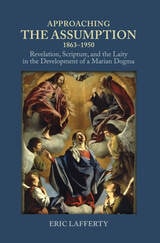
Approaching the Assumption, 1863-1950
Revelation, Scripture, and the Laity in the Development of a Marian DogmaEric Lafferty
Catholic University of America Press, 2026
The Assumption of Mary refers to the ancient Christian belief that the Mother of God was taken up into Heaven, body and soul, at the end of her earthly life. For centuries, Catholics and other Christians celebrated the Assumption as a liturgical feast and meditated on the miraculous event in the Rosary. Nevertheless, its relationship to Revelation remained undefined. This changed in 1950 when Pope Pius XII declared the Assumption of Mary a dogma of the Catholic Church. In this rare exercise of papal authority, Pius XII infallibly and irrevocably taught that the Assumption was a truth revealed by God. This book explores how the definition of this Marian dogma came to fruition.
After a brief history of the prior three Marian dogmas — Mother of God, Ever-Virgin, and the Immaculate Conception — this book narrates the major moments in the effort to obtain a dogmatic definition of the Assumption. The beginning of this “Assumptionist movement” can be dated to 1863 when Queen Isabel II of Spain petitioned the pope to declare the Assumption a dogma. Subsequently, petitionary efforts and scholarly inquiry increased and spread throughout the world. In addition to the narrative of this movement, this book gives special consideration to three vital aspects: debate over the Assumption’s definability as a dogma, if and how Scripture reveals the Assumption, and the contribution of the laity on a matter of doctrine.
Collectively, the Assumptionist movement emerges as a critical event in the nineteenth- and twentieth-century Catholic Church. Culminating in a dogmatic definition shortly before the opening of Vatican II, it also serves as a key point of inquiry for continuity and development of doctrine. A final chapter argues that the operative beliefs pertaining to Revelation, Scripture, and the laity during the Assumptionist movement stand in continuity with the teachings of Vatican II.
[more]
Approaching the Millennium
Essays on Angels in AmericaDeborah R. Geis and Steven F. Kruger, Editors
University of Michigan Press, 1997
Tony Kushner's complex and demanding play Angels in America: A Gay Fantasia on National Themes has been the most talked about, analyzed, and celebrated play of the decade. The critic Harold Bloom has included Kushner's play in his "Western canon" alongside Shakespeare and the Bible, and drama scholar John M. Clum has termed it "a turning point in the history of gay drama, the history of American drama, and of American literary culture." While we might be somewhat wary of the instant canonization that such critical assessments confer, clearly Kushner's play is an important work, honored by the Pulitzer Prize, thought worthy of recognition on "purely aesthetic" grounds at the same time that it has been embraced--and occasionally rejected--for its politics.
Kushner's play explicitly positions itself in the current American conflict over identity politics, yet also situates that debate in a broader historical context: the American history of McCarthyism, of immigration and the "melting pot," of westward expansion, and of racist exploitation. Furthermore, the play enters into the politically volatile struggles of the AIDS crisis, struggles themselves interconnected with the politics of sexuality, gender, race, and class.
The original essays in Approaching the Millennium explore the complexities of the play and situate it in its particular, conflicted historical moment. The contributors help us understand and appreciate the play as a literary work, as theatrical text, as popular cultural phenomenon, and as political reflection and intervention. Specific topics include how the play thematizes gender and sexuality, race and ethnicity; the postmodern incarnation of the Brechtian epic; AIDS and the landscape of American politics. The range of different international productions of Angels in America provides a rich basis for discussion of its production history, including the linguistic and cultural shifts required in its "translation" from one stage to the next.
The last section of Approaching the Millennium includes interviews with Tony Kushner and other key creators and players involved in the original productions of Angels. The interviews explore issues raised earlier in the volume and dialogues between the creative artists who have shaped the play and the critics and "theatricians" engaged in responding to it.
Contributors to this volume are Arnold Aronson, Art Borreca, Gregory W. Bredbeck, Michael Cadden, Nicholas de Jongh, Allen J. Frantzen, Stanton B. Garner, Deborah R. Geis, Martin Harries, Steven F. Kruger, James Miller, Framji Minwalla, Donald Pease, Janelle Reinelt, David Román, David Savran, Ron Scapp, and Alisa Solomon.
Deborah Geis is Associate Professor of English, Queens College, City University of New York. Steven F. Kruger is Professor and Chair of the Department of English, Queens College, City University of New York.
[more]
Decolonizing Mormonism
Approaching a Postcolonial ZionEdited by Gina Colvin and Joanna Brooks
University of Utah Press, 2018
This volume seeks nothing less than to shift the focus of Mormon studies from its historic North American, Euro-American “center” to the critical questions being raised by Mormons living at the movement’s cultural and geographic margins.
As a social institution, Mormonism is shaped around cultural notions, systems, and ideas that have currency in the United States but make less sense beyond the land of its genesis. Even as an avowedly international religion some 183 years out from its inception, it makes few allowances for diverse international contexts, with Salt Lake City prescribing programs, policies, curricula, leadership, and edicts for the church’s international regions. While Mormonism’s greatest strength is its organizational coherence, there is also a cost paid for those at the church’s peripheries.
Decolonizing Mormonism brings together the work of 15 scholars from around the globe who critically reflect on global Mormon experiences and American-Mormon cultural imperialism. Indigenous, minority, and Global South Mormons ask in unison: what is the relationship between Mormonism and imperialism and where must the Mormon movement go in order to achieve its long-cherished dream of equality for all in Zion? Their stories are both heartbreaking and heartening and provide a rich resource for thinking about the future of Mormon missiology and the possibilities inherent in the work of Mormon contextual theology.
[more]