Results by title
5 books match the query 'Aptheker, Bettina'

Citizen of the World
The Late Career and Legacy of W. E. B. Du BoisEdited by Phillip Luke Sinitiere
Northwestern University Press, 2019
From his birth in 1868 until his death in 1963, Du Bois sought the liberation of black people in the United States and across the world through intellectual and political labor. His tireless efforts documented and demonstrated connections between freedom for African-descended people abroad and black freedom at home.
In concert with growing scholarship on his twilight years, the essays in this volume assert the fundamental importance of considering Du Bois’s later decades not as a life in decline that descended into blind ideological allegiance to socialism and communism but as the life of a productive, generative intellectual who responded rationally, imaginatively, and radically to massive mid-century changes around the world, and who remained committed to freedom’s realization until his final hour.

Red Diapers
GROWING UP IN THE COMMUNIST LEFTEdited by Judy Kaplan and Linn Shapiro
University of Illinois Press, 1998
Red Diapers is the
first anthology of autobiographical writings by the children of American
communists. These memoirs, short stories, and poems reflect the joys and
perils of growing up in a subculture defined by its opposition to some
of society's most deeply held values. How red diaper babies have come
to terms with their political inheritance is the theme of this compelling
anthology.
Some contributors have fond
memories of family activism; others recall the past with ambivalence or
even pain. The authors range in age from their twenties to their eighties.
Some, such as Watergate reporter Carl Bernstein and sixties activist Bettina
Aptheker, are widely known themselves; some are the children of well-known
American leftists, including Jeff Lawson, son of blacklisted screenwriter
John Howard Lawson, and Robert Meeropol, son of Ethel and Julius Rosenberg.
In disparate voices, the contributors elaborate on how their parents attempted
to pass on to them the torch of radical politics.
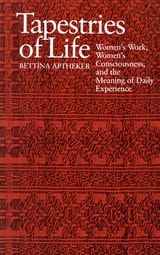
Tapestries of Life
Women's Work, Women's Consciousness, and the Meaning of Daily ExperienceBettina Aptheker
University of Massachusetts Press, 1989

Woman's Legacy
Essays on Race, Sex, and Class in American HistoryBettina Aptheker
University of Massachusetts Press, 1982
Woman's Legacy: Essays on Race, Sex, and Class in American History is a groundbreaking collection of essays by prominent feminist scholar and historian Bettina Aptheker. Emerging from her dissertation research, this work examines the interconnected systems of racial, sexual, and class oppression that have shaped the experiences of women in American history. Through careful historical analysis and feminist scholarship, Aptheker explores how race, sex, and class work together to form complex systems of domination and resistance in the American historical context. The essays investigate women's community roles, activism, and agency while centering the lived experiences of women, particularly Black women, across different historical periods. This seminal work contributes to African American women's history and feminist historiography, bridging women's studies with critical analysis of historical structures and social movements. An essential text for those interested in intersectional approaches to American history and women's studies.

“The Most Dangerous Communist in the United States”
A Biography of Herbert ApthekerGary Murrell
University of Massachusetts Press, 2015
When J. Edgar Hoover declared Herbert Aptheker “the most dangerous Communist in the United States,” the notorious FBI director misconstrued his true significance. In this first book-length biography of Aptheker (1915–2003), Gary Murrell provides a balanced yet unflinching assessment of the controversial figure who was at once a leading historian of African America, radical political activist, literary executor of W. E. B. Du Bois, and lifelong member of the American Communist Party. Although blacklisted at U.S. universities, Aptheker published dozens of books, including the groundbreaking American Negro Slave Revolts (1943) and the monumental seven-volume Documentary History of the Negro People (1951–1994). He also edited four volumes of the correspondence and unpublished writings of Du Bois, an achievement that Eric Foner, writing in the New York Times Book Review, called “a milestone in the coming of age of Afro-American history.”
As Murrell shows, Aptheker the historian was inseparable from Aptheker the leading Communist Party intellectual, polemicist, and agitator. During the 1960s, his ability to rouse and inspire both black and white student radicals made him one of the few Old Leftists accepted by the New Left. Aptheker had joined the CPUSA during its heyday in the 1930s, convinced that only through the party's leadership could fascism be defeated and true liberation be achieved: he ended his affiliation five decades later in 1991 after the collapse of socialism in the Soviet Union and Eastern Europe.
In an afterword, Bettina Aptheker adds to Murrell's narrative by illuminating her mother Fay's vital contributions to her father's work and by affirming the particularly devastating challenges of life in a family dedicated to radical political and social change.