Results by title
3 books match the query 'Aquaculture'
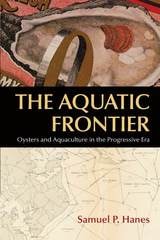
The Aquatic Frontier
Oysters and Aquaculture in the Progressive EraSamuel P. Hanes
University of Massachusetts Press, 2019
Although few remember their former significance, oysters were one of the largest U.S. fisheries at their peak in the late nineteenth century. As the fishery industrialized on-and offshore, oyster farms and canning factories spread along the Eastern Seaboard, with overharvesting becoming increasingly common. During the Progressive Era, state governments founded new agencies to cope with this problem and control this expanding economy. Regulators faced a choice: keep elaborate conservation systems based on common property rights or develop new ones with private, hatchery-stocked aquaculture farms. The tradition-preserving solution won, laying the groundwork for modern oyster management.
The Aquatic Frontier explores the forms this debate took between 1870 and 1920 in law enforcement, legislative advising, natural science, and oyster cartography. Samuel P. Hanes argues that the effort to centralize and privatize the industry failed due to a lack of understanding of the complex social-ecological systems in place—a common dilemma for environmental managers in this time period and for fisheries management confronting dangers from dwindling populations today.
The Aquatic Frontier explores the forms this debate took between 1870 and 1920 in law enforcement, legislative advising, natural science, and oyster cartography. Samuel P. Hanes argues that the effort to centralize and privatize the industry failed due to a lack of understanding of the complex social-ecological systems in place—a common dilemma for environmental managers in this time period and for fisheries management confronting dangers from dwindling populations today.
[more]
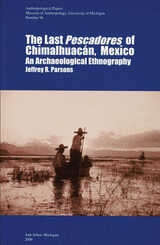
The Last Pescadores of Chimalhuacán, Mexico
An Archaeological EthnographyJeffrey R. Parsons
University of Michigan Press, 2006
Based on his study of the nearly vanished aquatic economy of Chimalhuacán in the Valley of Mexico, Parsons describes the surviving vestiges of aquatic insect collection and fishing and considers their developmental and archaeological implications within a broad context of historical, ethnographic, biological, ecological, and archaeological information from Mexico, North and South America, the Near East, and Africa. Activities, implements, artifacts, and landscapes are richly illustrated, in many cases with the author’s own photos and a number of vintage photographs. The study concludes that aquatic resources were fully complementary with agricultural products during prehispanic times in Mesoamerica where a pastoral economy was absent.
[more]
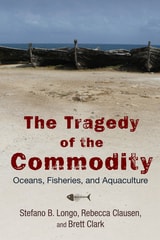
The Tragedy of the Commodity
Oceans, Fisheries, and AquacultureLongo, Stefano B
Rutgers University Press, 2015
Winner of the 2017 Paul Sweezy Marxist Sociology Book Award from the American Sociological Association
Although humans have long depended on oceans and aquatic ecosystems for sustenance and trade, only recently has human influence on these resources dramatically increased, transforming and undermining oceanic environments throughout the world. Marine ecosystems are in a crisis that is global in scope, rapid in pace, and colossal in scale. In The Tragedy of the Commodity, sociologists Stefano B. Longo, Rebecca Clausen, and Brett Clark explore the role human influence plays in this crisis, highlighting the social and economic forces that are at the heart of this looming ecological problem.
Although humans have long depended on oceans and aquatic ecosystems for sustenance and trade, only recently has human influence on these resources dramatically increased, transforming and undermining oceanic environments throughout the world. Marine ecosystems are in a crisis that is global in scope, rapid in pace, and colossal in scale. In The Tragedy of the Commodity, sociologists Stefano B. Longo, Rebecca Clausen, and Brett Clark explore the role human influence plays in this crisis, highlighting the social and economic forces that are at the heart of this looming ecological problem.
In a critique of the classic theory “the tragedy of the commons” by ecologist Garrett Hardin, the authors move beyond simplistic explanations—such as unrestrained self-interest or population growth—to argue that it is the commodification of aquatic resources that leads to the depletion of fisheries and the development of environmentally suspect means of aquaculture. To illustrate this argument, the book features two fascinating case studies—the thousand-year history of the bluefin tuna fishery in the Mediterranean and the massive Pacific salmon fishery. Longo, Clausen, and Clark describe how new fishing technologies, transformations in ships and storage capacities, and the expansion of seafood markets combined to alter radically and permanently these crucial ecosystems. In doing so, the authors underscore how the particular organization of social production contributes to ecological degradation and an increase in the pressures placed upon the ocean. The authors highlight the historical, political, economic, and cultural forces that shape how we interact with the larger biophysical world.
A path-breaking analysis of overfishing, The Tragedy of the Commodity yields insight into issues such as deforestation, biodiversity loss, pollution, and climate change.
[more]