Results by title
9 books match the query 'Arab nationalism'

Contemporary Arab Thought
Studies in Post-1967 Arab Intellectual HistoryIbrahim M. Abu-Rabi'
Pluto Press, 2003
Contemporary Arab Thought is a complex term, encompassing a constellation of social, political, religious and ideological ideas that have evolved over the past two hundred years — ideas that represent the leading positions of the social classes in modern and contemporary Arab societies.
Distinguished Islamic scholar Ibrahim Abu-Rabi‘ addresses such questions as the Shari‘ah, human rights, civil society, secularism and globalization. This is complimented by a focused discussion on the writings of key Arab thinkers who represent established trends of thought in the Arab world, including Muhammad ‘Abid al-Jabiri, Adallah Laroui, Muhammad al-Ghazali, Rashid al-Ghannoushi, Qutatnine Zurayk, Mahdi ‘Amil and many others.
Before 1967, some Arab countries launched hopeful programmes of modernisation. After the 1967 defeat with Israel, many of these hopes were dashed. This book retraces the Arab world’s aborted modernity of recent decades. Abu-Rabi‘ explores the development of contemporary Arab thought against the historical background of the rise of modern Islamism, and the impact of the West on the modern Arab world.

Islamism in the Shadow of al-Qaeda
By François Burgat
University of Texas Press, 2008
A renowned authority on Islamic movements, François Burgat lived for eighteen years in the Arab world, including his time as director of the French Center for Archaeology and Social Sciences at Yemen. He also dedicated many months to fieldwork in North Africa. Bringing Burgat's decades of expertise to the complex dialogues that have marked the post-9/11 world, Islamism in the Shadow of al-Qaeda delivers much-needed clarity and historical perspective.
In Burgat's eyes, most of the West's political and media rhetoric has only fueled al-Qaeda's case, revealing a woeful lack of comprehension regarding the violent authoritarianism that divides the Middle East and creates a breeding ground for terrorism. Islamism in the Shadow of al-Qaeda provides a primer of the three eras of political Islam, from the 1928 founding of the Muslim Brothers to the rise of post-colonial dictatorships and the current radicalization of "Generation al-Qaeda." Offering a new roadmap for stability, Burgat bridges the ideologies—political, religious, and cultural—that must be traversed if the deadly sectarianism is to be superseded.
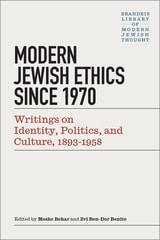
Modern Middle Eastern Jewish Thought
Writings on Identity, Politics, and Culture, 1893–1958Edited by Moshe Behar and Zvi Ben-Dor Benite
Brandeis University Press, 2013

Nationalist Voices in Jordan
The Street and the StateBy Betty S. Anderson
University of Texas Press, 2005
According to conventional wisdom, the national identity of the Jordanian state was defined by the ruling Hashemite family, which has governed the country since the 1920s. But this view overlooks the significant role that the "Arab street"—in this case, ordinary Jordanians and Palestinians—played and continues to play in defining national identity in Jordan and the Fertile Crescent as a whole. Indeed, as this pathfinding study makes clear, "the street" no less than the state has been a major actor in the process of nation building in the Middle East during and after the colonial era.
In this book, Betty Anderson examines the activities of the Jordanian National Movement (JNM), a collection of leftist political parties that worked to promote pan-Arab unity and oppose the continuation of a separate Jordanian state from the 1920s through the 1950s. Using primary sources including memoirs, interviews, poetry, textbooks, and newspapers, as well as archival records, she shows how the expansion of education, new jobs in the public and private sectors, changes in economic relationships, the establishment of national militaries, and the explosion of media outlets all converged to offer ordinary Jordanians and Palestinians (who were under the Jordanian government at the time) an alternative sense of national identity. Anderson convincingly demonstrates that key elements of the JNM's pan-Arab vision and goals influenced and were ultimately adopted by the Hashemite elite, even though the movement itself was politically defeated in 1957.
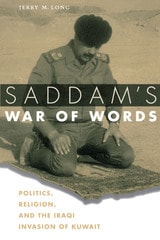
Saddam's War of Words
Politics, Religion, and the Iraqi Invasion of KuwaitBy Jerry M. Long
University of Texas Press, 2004
From a Western perspective, the Persian Gulf War of 1990-1991 largely fulfilled the first President Bush's objective: "In, out, do it, do it right, get gone. That's the message." But in the Arab world, the causes and consequences of Saddam Hussein's invasion of Kuwait and his subsequent defeat by a U.S.-led coalition were never so clear-cut. The potent blend of Islam and Arab nationalism that Saddam forged to justify the unjustifiable—his invasion of a Muslim state—gained remarkable support among both Muslims and Arabs and continued to resonate in the Middle East long after the fighting ended. Indeed, as this study argues in passing, it became a significant strand in the tangled web of ideologies and actions that led to the attacks of 9/11.
This landmark book offers the first in-depth investigation of how Saddam Hussein used Islam and Arab nationalism to legitimate his invasion of Kuwait in the eyes of fellow Muslims and Arabs, while delegitimating the actions of the U.S.-led coalition and its Arab members. Jerry M. Long addresses three fundamental issues: how extensively and in what specific ways Iraq appealed to Islam during the Kuwait crisis; how elites, Islamists, and the elusive Arab "street," both in and out of the coalition, responded to that appeal and why they responded as they did; and the longer-term effects that resulted from Saddam's strategy.

The American University of Beirut
Arab Nationalism and Liberal EducationBy Betty S. Anderson
University of Texas Press, 2011
Since the American University of Beirut opened its doors in 1866, the campus has stood at the intersection of a rapidly changing American educational project for the Middle East and an ongoing student quest for Arab national identity and empowerment. Betty S. Anderson provides a unique and comprehensive analysis of how the school shifted from a missionary institution providing a curriculum in Arabic to one offering an English-language American liberal education extolling freedom of speech and analytical discovery.
Anderson discusses how generations of students demanded that they be considered legitimate voices of authority over their own education; increasingly, these students sought to introduce into their classrooms the real-life political issues raging in the Arab world. The Darwin Affair of 1882, the introduction of coeducation in the 1920s, the Arab nationalist protests of the late 1940s and early 1950s, and the even larger protests of the 1970s all challenged the Americans and Arabs to fashion an educational program relevant to a student body constantly bombarded with political and social change. Anderson reveals that the two groups chose to develop a program that combined American goals for liberal education with an Arab student demand that the educational experience remain relevant to their lives outside the school's walls. As a result, in eras of both cooperation and conflict, the American leaders and the students at the school have made this American institution of the Arab world and of Beirut.
The Contemporary Arab Reader on Political Islam
Edited by Ibrahim M. Abu-Rabi' and Tere Vaden
Pluto Press, 2010
The Contemporary Arab Reader on Political Islam brings together the writings of highly influential figures in the field of Islamism in the contemporary Arab world, many of whose writings have never been available before in English.
Addressing the key issues such as human rights, civil society, secularism, globalisation and ummah, and the impact of the West on the modern Arab world, this is the perfect starting point for students and academics looking to understand 'Political Islam' in contemporary Arab and Muslim societies.
The contributors include such important Islamist thinkers and activists as Abdullah Azzam, central to the spread of Islamism in Afghanistan, Sayyid Muhammad Hussain Fadlallah, a major Shiite figure in contemporary Lebanon and Ahmad Bin Yousuf, a political advisor to Akram Haniyya in Gaza.

The Great Syrian Revolt and the Rise of Arab Nationalism
By Michael Provence
University of Texas Press, 2005
The Great Syrian Revolt of 1925 was the largest and longest-lasting anti-colonial insurgency in the inter-war Arab East. Mobilizing peasants, workers, and army veterans, rather than urban elites and nationalist intellectuals, it was the first mass movement against colonial rule in the Middle East. The revolt failed to liberate Syria from French occupation, but it provided a model of popular nationalism and resistance that remains potent in the Middle East today. Each subsequent Arab uprising against foreign rule has repeated the language and tactics of the Great Syrian Revolt.
In this work, Michael Provence uses newly released secret colonial intelligence sources, neglected memoirs, and popular memory to tell the story of the revolt from the perspective of its participants. He shows how Ottoman-subsidized military education created a generation of leaders of modest background who came to rebel against both the French Mandate rulers of Syria and the Syrian intellectuals and landowners who helped the colonial regime to function. This new popular nationalism was unprecedented in the Arab world. Provence shows compellingly that the Great Syrian Revolt was a formative event in shaping the modern Middle East.

The Making of Arab Americans
From Syrian Nationalism to U.S. CitizenshipBy Hani J. Bawardi
University of Texas Press, 2014