Results by title
7 books match the query 'Archaeological Investigations'
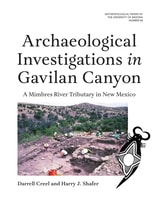
Archaeological Investigations in Gavilan Canyon
A Mimbres River Tributary in New MexicoDarrell Creel and Harry J. Shafer
University of Arizona Press, 2027
In the 1980s, Texas A&M University’s NAN Ranch Project included surveys and excavations in Gavilan Canyon, a major tributary of the Mimbres River. Uniquely, these excavations documented water control systems and their uses. Collected and now made available for the first time, Archaeological Investigations in Gavilan Canyon shares results from the excavations that were conducted primarily at Pueblo Vinegaroon, a Classic Period Mimbres pueblo of about twenty rooms, and at nearby Cholla Village.
During the NAN Ranch Project, researchers conducted extensive surveys of the canyon from its confluence with the Mimbres River and documented numerous sites dating to as early as Early Archaic through Classic Mimbres. The results also document pithouse sites as well as numerous small masonry pueblos. Analysis shows that the ebb and flow of late prehistoric occupation in Gavilan Canyon largely matches the occurrence of wet periods and prolonged droughts.
The book reveals that the changes in occupation in Gavilan Canyon help explain changes seen in the Mimbres River Valley, including the extensively excavated NAN Ranch and Swarts sites.
Archaeological Investigations in Northeastern Xuzestan, 1976
Edited by Henry T. Wright
University of Michigan Press, 1976
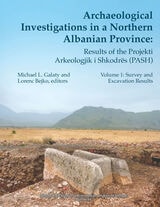
Archaeological Investigations in a Northern Albanian Province
Results of the Projekti Arkeologjik i Shkodrës (PASH): Volume One: Survey and Excavation ResultsMichael L. Galaty and Lorenc Bejko, Editors
University of Michigan Press, 2023
Some of the earliest and largest hill forts and tumuli (burial mounds) in Albania, dating to the Bronze and Iron Age, are located in Shkodër. Shkodër (Rozafa) Castle became the capital of the so-called Illyrian Kingdom, which was conquered by Rome in the early 3rd century BC. This research report, focused on the province of Shkodër, is based on five years of field and laboratory work and is the first synthetic archaeological treatment of this region.
The results of the Projekti Arkeologjik i Shkodrës (or PASH) are presented here in two volumes. Volume 1 includes geological context, a literature review, historical background, and reports on the regional survey and test excavations at three settlements and three tumuli. In Volume 2, the authors describe the artifacts recovered through survey and excavation, including chipped stone, small finds, and pottery from the prehistoric, Classical, Roman, medieval, and post-medieval periods. They also present results of faunal, petrographic, chemical, carpological, and strontium isotope analyses of the artifacts. Extensive supporting data is available on the University of Michigan's Deep Blue data repository: https://doi.org/10.7302/xnpy-0e60
These two volumes place northern Albania—and the Shkodër Province in particular—at the forefront of archaeological research in the Balkans.
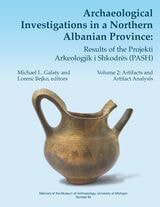
Archaeological Investigations in a Northern Albanian Province
Results of the Projekti Arkeologjik i Shkodrës (PASH): Volume Two: Artifacts and Artifact AnalysisMichael L. Galaty and Lorenc Bejko, Editors
University of Michigan Press, 2023
Some of the earliest and largest hill forts and tumuli (burial mounds) in Albania, dating to the Bronze and Iron Age, are located in Shkodër. Shkodër (Rozafa) Castle became the capital of the so-called Illyrian Kingdom, which was conquered by Rome in the early 3rd century BC. This research report, focused on the province of Shkodër, is based on five years of field and laboratory work and is the first synthetic archaeological treatment of this region.
The results of the Projekti Arkeologjik i Shkodrës (or PASH) are presented here in two volumes. Volume 1 includes geological context, a literature review, historical background, and reports on the regional survey and test excavations at three settlements and three tumuli. In Volume 2, the authors describe the artifacts recovered through survey and excavation, including chipped stone, small finds, and pottery from the prehistoric, Classical, Roman, medieval, and post-medieval periods. They also present results of faunal, petrographic, chemical, carpological, and strontium isotope analyses of the artifacts. Extensive supporting data is available on the University of Michigan's Deep Blue data repository: https://doi.org/10.7302/xnpy-0e60
These two volumes place northern Albania—and the Shkodër Province in particular—at the forefront of archaeological research in the Balkans.
Archaeological Investigations on Agattu, Aleutian Islands
Albert C. Spaulding
University of Michigan Press, 1962
Medicine Creek
Seventy Years of Archaeological InvestigationsEdited by Donna C. Roper
University of Alabama Press, 2002
This valuable book is an excellent overview of long-term archaeological investigations in the valley that remains at the forefront of studies on the First Americans.
In southwest Nebraska, a stretch of Medicine Creek approximately 20 kilometers long holds a remarkable concentration of both late Paleoindian and late prehistoric sites. Unlike several nearby similar and parallel streams that drain the divide between the Platte and Republican Rivers, Medicine Creek has undergone 70 years of archaeological excavations that reveal a long occupation by North America's earliest inhabitants.
Donna Roper has collected the written research in this volume that originated in a conference celebrating the 50th anniversary of the 1947 River Basin Survey. In addition to 12 chapters reviewing the long history of archaeological investigations at Medicine Creek, the volume contains recent analyses of and new perspectives on old sites and old data. Two of the sites discussed are considered for pre-Clovis status because they show evidence of human modification of mammoth faunal remains in the late Pleistocene Age. Studies of later occupation of Upper Republican phase sites yield information on the lifeways of Plains village people.
Presented by major investigators at Medicine Creek, the contributions are a balanced blend of the historical research and the current state-of-the-art work and analysis. Roper's comprehensive look at the archaeology, paleontology, and geomorphology at Medicine Creek gives scientists and amateurs a full assessment of a site that has taught us much about the North American continent and its early people.
Soils, Climate and Society
Archaeological Investigations in Ancient AmericaJohn D. Wingard
University Press of Colorado, 2013
The volume traces the origins of agriculture, the transition to agrarian societies, the sociocultural implications of agriculture, agriculture's effects on population, and the theory of carrying capacity, considering the relation of agriculture to the profound social changes that it wrought in the New World. Soil science plays a significant, though varied, role in each case study, and is the common component of each analysis. Soil chemistry is also of particular importance to several of the studies, as it determines the amount of food that can be produced in a particular soil and the effects of occupation or cultivation on that soil, thus having consequences for future cultivators.
Soils, Climate and Society demonstrates that renewed investigation of agricultural production and demography can answer questions about the past, as well as stimulate further research. It will be of interest to scholars of archaeology, historical ecology and geography, and agricultural history.