Results by title
3 books match the query 'Archaeological collections'
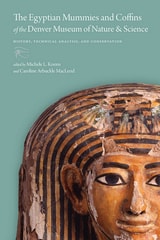
Egyptian Mummies and Coffins of the Denver Museum of Nature & Science
History, Technical Analysis, and ConservationMichele L. Koons
University Press of Colorado, 2020
In the 1970s and 1980s, the Denver Museum of Nature & Science acquired two ancient Egyptian mummies and three coffins. The mummies are the remains of two women who lived in an unknown locale in ancient Egypt. They both died in their thirties and have now been subjected to a number of unpublished scientific and unscientific analyses over the years. In 2016, as DMNS prepared to update its Egyptian Hall, staff scientists decided to reexamine the mummies and coffins using innovative, inexpensive, and accessible techniques.
This interdisciplinary volume provides a history of the mummies’ discovery and relocation to Colorado. It guides the reader through various analytical techniques, detailing past research and introducing new data and best practices for future conservation efforts. The new analysis includes more accurate radiocarbon dating, fully comprehensive data from updated CT scans, examples of Egyptian blue and yellow pigments on the coffins uncovered by non-invasive x-ray fluorescence, unprecedented analysis of the coffin wood, updated translations and stylistic analysis of the text and imagery on the coffins, gas chromatography of the paints and resins, linen analysis, and much more.
The Egyptian Mummies and Coffins of the Denver Museum of Nature & Science provides replicable findings and consistent terminology for institutions performing holistic studies on extant museum collections of a range of material types. It will add substantially to what we know about the effective conservation of Egyptian mummies and coffins.
Contributors: Christopher H. Baisan, Hans Barnard, Bonnie Clark, Pearce Paul Creasman, Farrah Cundiff, Jessica M. Fletcher, Kari L. Hayes, Kathryn Howley, Stephen Humphries, Keith Miller, Vanessa Muros, Robyn Price, David Rubinstein, Judith Southward, Jason Weinman
[more]
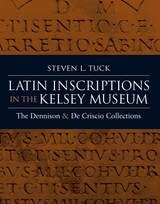
Latin Inscriptions in the Kelsey Museum
The Dennison and De Criscio CollectionsSteven L. Tuck
University of Michigan Press, 2006
The Latin inscriptions in the Kelsey Museum are among the best primary sources we have for documenting the lives of the lower classes in the Roman world. They provide unique evidence of the details of Roman daily life, including beliefs, occupations, families, and attitudes toward death.
The 400 entries in this volume include all of the Latin inscriptions on stone or metal in the Kelsey Museum of Archaeology at the University of Michigan; they represent the largest, and arguably the most important, collection of Latin inscriptions in the Western Hemisphere. The collection is notable not just for its size but for the fact that almost all the inscriptions were acquired by purchase for their scholarly and educational value to the members of the university community. Because of this, the collection is also an important testimony to a seminal phase in the development of the study of Classics at the University of Michigan. For the first time ever, this project makes the Latin inscriptions of the Kelsey available in one volume and has provided an opportunity to reexamine some texts that have not been edited in over a century. The commentaries for this edition have benefited from a wealth of recent scholarship resulting in some amended readings and reidentification of texts.
Steven L. Tuck is Assistant Professor of Classics at Miami University of Ohio.
The Kelsey Museum Studies series, edited by University of Michigan professors Elaine Gazda, Margaret Cool Root, and John Pedley, is designed to publish unusual material in the Museum's collections, together with reports of current and past archaeological expeditions sponsored by the University of Michigan.
[more]
Organizing for Foreign Policy Crises
Presidents, Advisers, and the Management of Decision MakingPatrick J. Haney
University of Michigan Press, 2002
Presidents often assemble ad hoc groups of advisers to help them make decisions during foreign policy crises. These advisers may include the holders of the traditional foreign policy positions--secretaries of state and defense--as well as others from within and without the executive branch. It has never been clear what role these groups play in the development of policy. In this landmark study, Patrick Haney examines how these crisis decision groups were structured and how they performed the tasks of providing information, advice, and analysis to the president. From this, Haney investigates the links between a president's crisis management structure and the decision-making process that took place during a foreign policy crisis.
Haney employs case studies to examine the different ways presidents from Truman through Bush used crisis decision-making groups to help manage foreign policy crises. He looks at the role of these groups in handling the Berlin blockade in 1948, the Suez Crisis in 1956, the Tet offensive in 1968, the Yom Kippur War in 1973, and the Panama invasion in 1989, among other crises. He extends our understanding of the organization, management and behavior of the decision-making groups presidents assemble during foreign policy crises. This book will appeal to scholars of the American presidency and American foreign policy.
Patrick Haney is Assistant Professor of Political Science, Miami University of Ohio.
[more]