Results by title
6 books match the query 'Archaeologies'
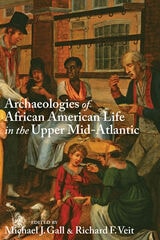
Archaeologies of African American Life in the Upper Mid-Atlantic
Edited by Michael J. Gall and Richard F. Veit
University of Alabama Press, 2017
A 2018 CHOICE OUTSTANDING ACADEMIC TITLE
New scholarship provides insights into the archaeology and cultural history of African American life from a collection of sites in the Mid-Atlantic
This groundbreaking volume explores the archaeology of African American life and cultures in the Upper Mid-Atlantic region, using sites dating from the eighteenth through the twentieth centuries. Sites in Delaware, Pennsylvania, New Jersey, and New York are all examined, highlighting the potential for historical archaeology to illuminate the often overlooked contributions and experiences of the region’s free and enslaved African American settlers.
Archaeologies of African American Life in the Upper Mid-Atlantic brings together cutting-edge scholarship from both emerging and established scholars. Analyzing the research through sophisticated theoretical lenses and employing up-to-date methodologies, the essays reveal the diverse ways in which African Americans reacted to and resisted the challenges posed by life in a borderland between the North and South through the transition from slavery to freedom. In addition to extensive archival research, contributors synthesize the material finds of archaeological work in slave quarter sites, tenant farms, communities, and graveyards.
Editors Michael J. Gall and Richard F. Veit have gathered new and nuanced perspectives on the important role free and enslaved African Americans played in the region’s cultural history. This collection provides scholars of the Mid-Atlantic and Northeast regions, African American studies, material culture studies, religious studies, slavery, the African diaspora, and historical archaeologists with a well-balanced array of rural archaeological sites that represent cultural traditions and developments among African Americans in the region. Collectively, these sites illustrate African Americans’ formation of fluid cultural and racial identities, communities, religious traditions, and modes of navigating complex cultural landscapes in the region under harsh and disenfranchising circumstances.
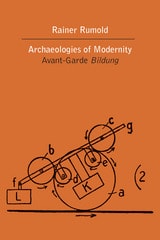
Archaeologies of Modernity
Avant-Garde BildungRainer Rumold
Northwestern University Press, 2015
Archaeologies of Modernity explores the shift from the powerful tradition of literary forms of Bildung—the education of the individual as the self—to the visual forms of “Bildung” (from Bild) that characterize German modernism and the European avant-garde. Interrelated chapters examine the work of Franz Kafka, Jean/Hans Arp, Walter Benjamin, and Carl Einstein, and of artists such as Oskar Kokoschka or Kurt Schwitters, in the light of the surge of an autoformation (Bildung) of verbal and visual images at the core of expressionist and surrealist aesthetics and the art that followed. In this first scholarly focus on modernist avant-garde Bildung in its entwinement of conceptual modernity with forms of the archaic, Rumold resituates the significance of the poet and art theorist Einstein and his work on the language of primitivism and the visual imagination. Archaeologies of Modernity is a major reconsideration of the conception of the modernist project and will be of interest to scholars across the disciplines.
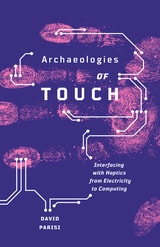
Archaeologies of Touch
Interfacing with Haptics from Electricity to ComputingDavid Parisi
University of Minnesota Press, 2018
A material history of haptics technology that raises new questions about the relationship between touch and media
Since the rise of radio and television, we have lived in an era defined increasingly by the electronic circulation of images and sounds. But the flood of new computing technologies known as haptic interfaces—which use electricity, vibration, and force feedback to stimulate the sense of touch—offering an alternative way of mediating and experiencing reality.
In Archaeologies of Touch, David Parisi offers the first full history of these increasingly vital technologies, showing how the efforts of scientists and engineers over the past three hundred years have gradually remade and redefined our sense of touch. Through lively analyses of electrical machines, videogames, sex toys, sensory substitution systems, robotics, and human–computer interfaces, Parisi shows how the materiality of touch technologies has been shaped by attempts to transform humans into more efficient processors of information.
With haptics becoming ever more central to emerging virtual-reality platforms (immersive bodysuits loaded with touch-stimulating actuators), wearable computers (haptic messaging systems like the Apple Watch’s Taptic Engine), and smartphones (vibrations that emulate the feel of buttons and onscreen objects), Archaeologies of Touch offers a timely and provocative engagement with the long history of touch technology that helps us confront and question the power relations underpinning the project of giving touch its own set of technical media.
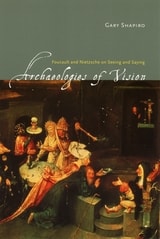
Archaeologies of Vision
Foucault and Nietzsche on Seeing and SayingGary Shapiro
University of Chicago Press, 2003
Shapiro explores the whole range of Foucault's writings on visual art, including the theory of visual resistance, the concept of the phantasm or simulacrum, and his interrogation of the relation of painting, language, and power in artists from Bosch to Warhol. Shapiro also shows through an excavation of little-known writings that the visual is a major theme in Nietzsche's thought. In addition to explaining the significance of Nietzsche's analysis of Raphael, Dürer, and Claude Lorrain, he examines the philosopher's understanding of the visual dimension of Greek theater and Wagnerian opera and offers a powerful new reading of Thus Spoke Zarathustra.
Archaeologies of Vision will be a landmark work for all scholars of visual culture as well as for those engaged with continental philosophy.
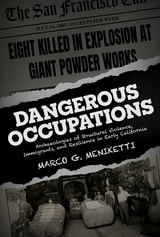
Dangerous Occupations
Archaeologies of Structural Violence, Immigrants, and Resilience in Early CaliforniaMarco G. Meniketti
University of Alabama Press, 2026
Addresses structural violence through history and archaeology of immigrant workers
Dangerous Occupations: Archaeologies of Structural Violence, Immigrants, and Resilience in Early California is an impactful work of historical archaeology combined with social history that addresses structural violence in key California industries from the Gold Rush in 1849 until 1920. Monopolistic industries, such as railroading, mining, timbering, explosive manufacturing, lime production, meatpacking, textile milling, and fishing/whaling, relied on immigrant laborers who were recruited and perceived as expendable. Restrictive laws and lack of employment opportunities based on bigotry often forced immigrants into the most dangerous occupations. In the days before workmen’s compensation insurance and strict labor safety laws, laborers often risked their health and even their lives for employment.
Marco G. Meniketti’s analysis comes from examining excavation of labor camps and housing, landscape studies, bioarchaeological data, architectural footprints, and archival sources. Each chapter offers a case study of industries to exemplify structural violence and its broader consequences among various immigrant labor groups, such as Chinese, Scandinavian, Irish, Italian, Chilean, Cornish, and Portuguese. The narrative includes a historical overview of the industries, identifies who the immigrant laborers were and how they came to be there, examines the dangers and health risks of their jobs, and details their living conditions and daily life, including foodways, leisure, and efforts to treat their job-inflicted maladies. Dangerous Occupations introduces a new generation of readers to how immigrants built the West Coast and at what great cost.
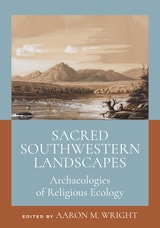
Sacred Southwestern Landscapes
Archaeologies of Religious EcologyEdited by Aaron M. Wright
University of Utah Press, 2024
Hailing from various academic and cultural backgrounds, contributors invoke a range of theoretical currents and methodological practices to examine how these relationships developed and evolved. Nearly all the places, people, and paradigms at play in contemporary southwestern scholarship find room among these pages, from the Sonoran and Chihuahuan Deserts to the Colorado Plateau; from diverse cultures, including Ancestral Pueblo, Mogollon, Hohokam, Pataya, Trincheras, Navajo (Diné), and Nuevomexicano; and from theoretical frameworks drawing upon phenomenology, materiality, bundling, and semiotics. This collective engagement showcases how religious ecologies can be studied from multiple perspectives and through sundry lines of evidence, leaving readers with appreciation and reverence for the rich and robust sacredness in southwestern landscapes.