Results by title
6 books match the query 'Archeology'
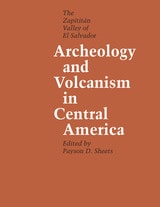
Archeology and Volcanism in Central America
The Zapotitán Valley of El SalvadorEdited by Payson D. Sheets
University of Texas Press, 1983
Scientists have long speculated on the impact of extreme natural catastrophes on human societies. Archeology and Volcanism in Central America provides dramatic evidence of the effects of several volcanic disasters on a major civilization of the Western Hemisphere, that of the Maya.
During the past 2,000 years, four volcanic eruptions have taken place in the Zapotitán Valley of southern El Salvador. One, the devastating eruption of Ilopango around A.D. 300, forced a major migration, pushing the Mayan people north to the Yucatán Peninsula. Although later eruptions did not have long-range implications for cultural change, one of the subsequent eruptions preserved the Cerén site—a Mesoamerican Pompeii where the bodies of the villagers, the palm-thatched roofs of their houses, the pots of food in their pantries, even the corn plants in their fields were preserved with remarkable fidelity.
Throughout 1978, a multidisciplinary team of anthropologists, archeologists, geologists, biologists, and others sponsored by the University of Colorado's Protoclassic Project researched and excavated the results of volcanism in the Zapotitan Valley—a key Mesoamerican site that contemporary political strife has since rendered inaccessible.
The result is an outstanding contribution to our understanding of the impact of volcanic eruptions on early Mayan civilization. These investigations clearly demonstrate that the Maya inhabited this volcanically hazardous valley in order to reap the short-term benefits that the volcanic ash produced—fertile soil, fine clays, and obsidian deposits.
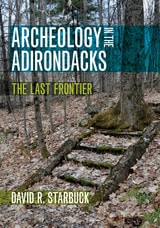
Archeology in the Adirondacks
The Last FrontierDavid R. Starbuck
University Press of New England, 2018
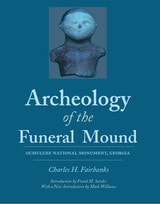
Archeology of the Funeral Mound
Ocmulgee National Monument, GeorgiaCharles H. Fairbanks, with a new introduction by Mark Williams
University of Alabama Press, 2003
The largest prehistoric mound site in Georgia is located in modern-day Macon and is known as Ocmulgee. It was first recorded in August 1739 by General James Oglethorpe’s rangers during an expedition to the territory of the Lower Creeks. The botanist William Bartram wrote extensively of the ecology of the area during his visit in 1773, but the 1873 volume by Charles C. Jones, Antiquities of the Southern Indians, Particularly of the Georgia Tribes, was the first to treat the archaeological significance of the site.
Professional excavations began at Ocmulgee in 1933 under the auspices of the Smithsonian Institution, using Civil Works Administration labor. Investigations continued under a variety of sponsorships until December 1936, when the locality was formally named a national monument. Excavation of the mounds, village sites, earth lodge, and funeral mound revealed an occupation of the Macon Plateau spanning more than 7,000 years. The funeral mound was found to contain log tombs, bundles of disarticulated bones, flexed burials, and cremations. Grave goods included uniquely patterned copper sun disks that were found at only one other site in the Southeast—the Bessemer site in Alabama—so the two ceremonial centers were established as contemporaries.
In this classic work of archaeological research and analysis, Charles Fairbanks has not only offered a full treatment of the cultural development and lifeways of the builders of Ocmulgee but has also related them effectively to other known cultures of the prehistoric Southeast.

Digging into Popular Culture
Theories and Methodologies in Archeology, Anthropology, and Other FieldsPat Browne
University of Wisconsin Press, 1991
This volume presents archeological studies in conjunction with cultural anthropological studies as a means to enhance popular culture studies. Scholar Malcolm K. Shuman points out that the study of archeology must be careful to chart the total human content of an artifact, because archeology “is a profoundly human (and humanizing) endeavor that cannot be divorced from the matrix of human life.” The other ten essays cover aspects of archeology and cultural anthropology, and the authors are meticulous in studying their subject in context.
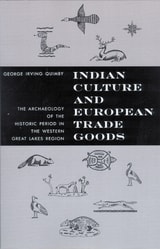
Indian Culture and European Trade Goods
The Archeology of the Historic Period in the Western Great Lakes RegionGeorge Irving Quimby
University of Wisconsin Press, 1970

The Archeology of New Hampshire
Exploring 10,000 Years in the Granite StateDavid Starbuck
University of New Hampshire Press, 2006
Several states already boast volumes showcasing their archeological history, but not New Hampshire—until now. David R. Starbuck's volume fills that void. Going beyond standard state guides that focus primarily on prehistoric sites, Starbuck also devotes equal time to historic, industrial, and nautical sites. This approach reflects the thinking of most contemporary archeologists who conduct research at a diverse range of sites.
A veteran of thirty years of field research throughout the Granite State, Starbuck revisits some of his own sites, including excavations at the New England Glassworks in Temple, two prehistoric sites on the Merrimack River, the Joseph Hazeltine pottery workshop outside Concord, the Governor Wentworth Estate in Wolfeboro, and his own long-term survey and excavation project at Canterbury Shaker Village. At the same time, though, Starbuck includes the work of other contemporary New Hampshire archeologists, representative sites of “old-timers” whose digs preceded his arrival, and the investigations of avocational diggers.
Starbuck's introduction offers an anecdotal history of archeological research in New Hampshire through the people who shaped it. Part I discusses discoveries that predate white settlement: the Paleo-Indian Period; the Archaic Period; and the Woodland Period. Part II moves from the seventeenth century to the present. Chapters include historical archeology (forts, farms, potters, Shakers); industrial archeology (mills, factories, railroads, dams, and bridges); and nautical archeology (discoveries in the state's lakes and on the seacoast).
In addition to summarizing some of the more interesting finds, Starbuck includes stories about archeologists and the techniques they have used to glean information from the past. Overall, he provides a lively account of what it is like to practice archeology in a small but dynamic New England state.