Results by title
9 books match the query 'Architect'
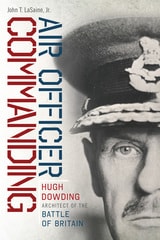
Air Officer Commanding
Hugh Dowding, Architect of the Battle of BritainJohn T. LaSaine
University Press of New England, 2018
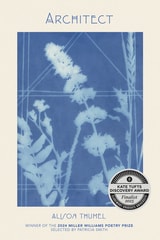
Architect
Alison Thumel
University of Arkansas Press, 2024
Finalist, 2025 Kate Tufts Discovery Award
“When he died, my brother became the architect of the rest of my life,” writes Alison Thumel in Architect, which interweaves poems, lyric essays, and visual art to great emotional effect. In this debut collection, the buildings of Frank Lloyd Wright become a blueprint for elegy, as Thumel overlays the language of architecture with the language of grief to raze and reconstruct memories, metaphors, and myths. With obsessive and exacting focus, the poet leads us through room after room in a search to answer whether it is possible to rebuild in the wake of loss. Meanwhile, the midwestern landscape beyond these rooms—the same landscape that infuses the low, horizontal forms of Wright’s Prairie Style buildings—shapes the figures in Architect as well as their fates: “For years after my brother’s death, I collected news articles on people who died young and tragically in landlocked states. Prairie Style deaths—boys sucked down into grain silos or swept up by tornadoes or fallen through a frozen pond. The boys I didn’t know, but the landscape I did. The dread of it. How many miles you can look ahead. For how long you see what is coming.”
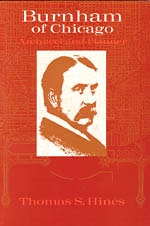
Burnham of Chicago
Architect and PlannerThomas S. Hines
University of Chicago Press, 1979
"Professor Hines has written what may prove to be an epoch-making book in the study of American civilization."—Reyner Banham, Times Literary Supplement
"Indeed, the book as a whole is a model of the balanced portrait, sure of Burnham's importance but always conscious of his failings."—Paul Goldberger, New York Times Book Review
"In every sense this is the definitive biography, and it is long overdue."—Harry Weese, Chicago Tribune
"This is a many-faceted book. Even if one were not interested in architecture or city planning, nor especially in Burnham the man, one would likely find the book rewarding because of the window it provides on a significant period of American history. . . . Hines brings alive many of the forces that were beating upon Burnham and his contemporaries, and which are shaping our lives today."—Edmund M. Bacon, Architectural Record
"Hines has provided an intelligently organized, well-written, and fascinating account of Burnham's entire career. The analysis [is] a model of scholarship, good judgment, and literary grace that satisfies a long felt need."—Kenneth T. Jackson, American Historical Review
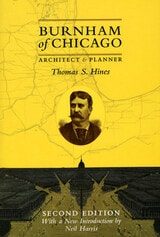
Burnham of Chicago
Architect and Planner, Second EditionThomas S. Hines
University of Chicago Press, 2008
“In every sense this is the definitive biography.”—Harry Weese, Chicago Tribune
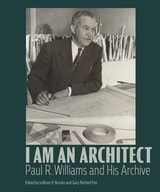
I Am an Architect
Paul R. Williams and His ArchiveLeRonn P. Brooks
J. Paul Getty Trust, The, 0
Discover the visionary legacy of the groundbreaking architect Paul R. Williams, FAIA, one of the most prolific Black architects of the 20th century.
Paul R. Williams (1894–1980), among the first Black members of the American Institute of Architects, was a defining force in shaping the city of Los Angeles and Southern California, yet his impact was undoubtedly global.
Threading together Williams’s biography, social histories of Los Angeles, and transformations in the profession, this richly researched monograph traces his remarkable career against the evolving landscape of Los Angeles and the wider architectural world.
- Presents the first research-driven monograph on preeminent architect Paul R. Williams.
- Features nearly 200 images, including many never-before published drawings, renderings, and archival materials.
- Williams’s expansive oeuvre spans everything from early residential commissions in the 1920s to civic, religious, commercial, and cultural landmarks that came to define Los Angeles’s identity at midcentury.
- Examines the intersection of race, space, and professional practice in twentieth-century American architecture.
- Highlights Williams’s commitment to designing for Black communities and advancing social change through architecture.
Step into the world of a visionary who transformed cities and challenged barriers—this volume invites you to get to know Paul R. Williams and the enduring power of architecture to shape society.
This volume is published to accompany an exhibition on view at the Fisher Museum of Art at the University of Southern California from August 18, 2026, to March 13, 2027, Los Angeles County Museum of Art from November 15, 2026, to May 31, 2027, and Getty Research Institute at the Getty Center from December 16, 2026, to July 18, 2027.
In the Shadow of the Architect
Bradley Bazzle
University of Wisconsin Press, 2026
Coalescing around themes of family and belonging, the past’s influence on the present, and the ways we define ourselves, these stories show us people forced to grapple with who they are—and who they could become. A closeted teenager learns from the nude model in his life-drawing class what it might mean to be a gay man in Fort Worth. A lifestyle blogger looking to expand her influence hires a photographer whose work destabilizes her family. A boy finds friendship in the precocious daughter of a recently deceased architect whose fame and force of personality continue to dominate their lives. In Bradley Bazzle’s deft hands, these characters—on the cusp of change, willingly or not—discover truths about themselves, some of which they might regret learning.

Medicine by Design
The Architect and the Modern Hospital, 1893–1943Annmarie Adams
University of Minnesota Press, 2008
In the history of medicine, hospitals are usually seen as passive reflections of advances in medical knowledge and technology. In Medicine by Design, Annmarie Adams challenges these assumptions, examining how hospital design influenced the development of twentieth-century medicine and demonstrating the importance of these specialized buildings in the history of architecture.
At the center of this work is Montreal’s landmark Royal Victoria Hospital, built in 1893. Drawing on a wide range of visual and textual sources, Adams uses the “Royal Vic”—along with other hospitals built or modified over the next fifty years—to explore critical issues in architecture and medicine: the role of gender and class in both fields, the transformation of patients into consumers, the introduction of new medical concepts and technologies, and the use of domestic architecture and regionally inspired imagery to soften the jarring impact of high-tech medicine.
Identifying the roles played by architects in medical history and those played by patients, doctors, nurses, and other medical professionals in the design of hospitals, Adams also links architectural spaces to everyday hospital activities, from meal preparation to the ways in which patients entered the hospital and awaited treatment.
Methodologically and conceptually innovative, Medicine by Design makes a significant contribution to the histories of both architectural and medical practices in the twentieth century.
Annmarie Adams is William C. Macdonald Professor of Architecture at McGill University and the author of Architecture in the Family Way: Doctors, Houses, and Women, 1870–1900 and coauthor of Designing Women: Gender and the Architectural Profession.
The Architect of Genocide
Himmler and the Final SolutionRichard Breitman
Brandeis University Press, 1992
Think Like an Architect
By Hal Box
University of Texas Press, 2007
The design of cities and buildings affects the quality of our lives. Making the built environment useful, safe, comfortable, efficient, and as beautiful as possible is a universal quest. We dream about how we might live, work, and play. From these dreams come some 95 percent of all private and public buildings; professional architects design only about 5 percent of the built environment. While much of what non-architects build is beautiful and useful, the ugliness and inconveniences that blight many urban areas demonstrate that an understanding of good architectural design is vital for creating livable buildings and public spaces. To help promote this understanding among non-architects, as well as among those considering architecture as a profession, award-winning architect and professor Hal Box explains the process of making architecture from concept to completed building, using real-life examples to illustrate the principles involved in designing buildings that enhance the quality of life for those who live with them.
To cause what we build to become architecture, we have three choices: hire an architect, become an architect, or learn to think like an architect. Box believes that everyone should be involved in making architecture and has organized this book as a series of letters to friends and students about the process of creating architecture. He describes what architecture should be and do; how to look at and appreciate good buildings; and how to understand the design process, work with an architect, or become an architect. He also provides an overview of architectural history, with lists of books to read and buildings to see. For those involved in building projects, Box offers practical guidance about what goes into constructing a building, from the first view of the site to the finished building. For students thinking of becoming architects, he describes an architect's typical training and career path. And for the wide public audience interested in architecture and the built environment, Box addresses how architecture relates to the city, where the art of architecture is headed, and why good architecture matters.