Results by title
6 books match the query 'Architectural photography'
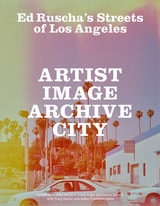
Ed Ruscha's Streets of Los Angeles
Artist, Image, Archive, CityAndrew Perchuk
J. Paul Getty Trust, The, 2025
In 1966, Ed Ruscha drove a car rigged with a motorized camera to capture Los Angeles’ most iconic street: Sunset Boulevard. He created a time capsule of its famed facades, beginning a sixty-year-long commitment to documenting the changing urban landscape of postwar Los Angeles. The Streets of Los Angeles project that comprises these photographs is likely the most comprehensive artistic record of any city, with over 900,000 images of major thoroughfares. Ruscha’s photographs constitute an unparalleled visual chronicle of both iconic and everyday sites in L.A., including popular music venues, neighborhood restaurants, and billboards promoting Hollywood’s latest blockbusters.
In this volume, scholars from disciplines such as urban planning, cultural geography, architecture, art history, and musicology explore the Streets of Los Angeles Archive as a rich repository for analyzing Ruscha’s practice and the city’s visual culture. Using his photographs and new data visualizations, the authors consider what it means to interpret an archive mostly accessible through digital technologies, and they demonstrate how histories of art have been indelibly reshaped since the advent of the information age in the 1960s.
This publication was created using Quire™, a multiformat publishing tool from Getty. The free online edition of this open-access publication is available at www.getty.edu/publications/ruscha/ and includes video, data visualizations, and zoomable illustrations. Free PDF and EPUB downloads of the book are also available.

For Love and Money
Portraits of Wisconsin Family BusinessesCarl Corey
Wisconsin Historical Society Press, 2014

Harker's Barns
Visions of an American IconMichael Harker
University of Iowa Press, 2003
Michael Harker drove past old barns on gravel roads and blacktop highways for years. He generally dismissed them as obsolete outbuildings until November 1993, when he felt compelled to photograph a windmill in Clutier, Iowa. This single photograph launched him on a seven-and-a-half-year mission to document Iowa's barns and all they represent. The result is Harker's Barns: Visions of an American Icon.
Each of the seventy-five black-and-white images featured in Harker's Barns beautifully and heartbreakingly captures the glory and ultimate demise of one of rural America's most enduring icons. From square to round, wood to brick, Dutch to Swedish, occupied or abandoned, the barns documented in this stunning collection are a testament to a passing way of life that was once the lifeblood of Iowa and the Midwest.
Complementing Harker's photographs are vignettes by poet and writer Jim Heynen. Both whimsical and endearing, each vignette treats barns as organic and intelligent entities, reflecting the living history that can be found inside each rural structure.
Iowa's barns are disappearing and with them a way of life; Harker's Barns brilliantly documents their heritage for future generations. As Jim Heynen says, “A good photograph can maintain an old barn through blizzards and hail storms and tornadoes. It is the best support beam and wood preservative an old barn can have.”
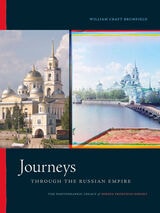
Journeys through the Russian Empire
The Photographic Legacy of Sergey Prokudin-GorskyWilliam Craft Brumfield
Duke University Press, 2020
In 1918 Prokudin-Gorsky escaped an increasingly chaotic, violent Russia and regained nearly 2,000 of his bulky glass negatives. His subsequent peripatetic existence before settling in Paris makes his collection's survival all the more miraculous. The U.S. Library of Congress acquired Prokudin-Gorsky's collection in 1948, and since then it has become a touchstone for understanding pre-revolutionary Russia. Now digitized and publicly available, his images are a sensation in Russia, where people visit websites dedicated to them.
William Craft Brumfield—photographer, scholar, and the leading authority on Russian architecture in the West—began working with Prokudin-Gorsky's photographs in 1985. He curated the first public exhibition of them in the United States and has annotated the entire collection. In Journeys through the Russian Empire, Brumfield—who has spent decades traversing Russia and photographing buildings and landscapes in their various stages of disintegration or restoration—juxtaposes Prokudin-Gorsky's images against those he took of the same buildings and areas. In examining the intersections between his own photography and that of Prokudin-Gorsky, Brumfield assesses the state of preservation of Russia's architectural heritage and calls into question the nostalgic assumptions of those who see Prokudin-Gorsky's images as the recovery of the lost past of an idyllic, pre-Soviet Russia.
This lavishly illustrated volume—which features some 400 stunning full-color images of ancient churches and mosques, railways and monasteries, towns and remote natural landscapes—is a testament to two brilliant photographers whose work prompts and illuminates, monument by monument, questions of conservation, restoration, and cultural identity and memory.
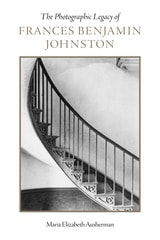
The Photographic Legacy of Frances Benjamin Johnston
Maria Elizabeth Ausherman
University of Alabama Press, 2022
An illustrated account of the life and work of the pioneering photographer
The Photographic Legacy of Frances Benjamin Johnston (1864–1952) draws on original papers and photographs from the Library of Congress to document the extraordinary life and nearly seventy-year career of this pioneering photographer. Maria Elizabeth Ausherman illuminates the early origins of Johnston’s style and vision, and her attempts to change society through her art. One of the first women to work in an emerging field dominated by men, Johnston achieved acclaim as an accomplished photographer and photojournalist.
As the official White House photographer for five administrations, she was instrumental in defining the medium and inspiring women to train in and appreciate photography. But it is her monumental nine-state survey of southern American architecture that stands as her most significant contribution to the history and development of photography both as art and as documentary. Through her photography, Johnston showed reverence for the beautiful historic buildings she appreciated and also helped shape architectural and photographic preservation in the United States.
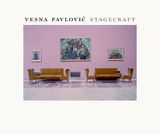
Vesna Pavlovic
StagecraftVesna Pavlovic
Vanderbilt University Press, 2021
The book includes critical essays that contextualize and expound on Pavlović's unique treatment of the photographic medium, in which a photographic moment is expanded to include the conditions of image making, production, documentation, and representation.