Results by title
2 books match the query 'Architecture, Colonial'
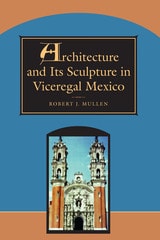
Architecture and Its Sculpture in Viceregal Mexico
By Robert J. Mullen
University of Texas Press, 1997
From monumental cathedrals to simple parish churches, perhaps as many as 100,000 churches and civic buildings were constructed in Mexico during the viceregal or colonial period (1535-1821). Many of these structures remain today as witnesses to the fruitful blending of Old and New World forms and styles that created an architecture of enduring vitality.
In this profusely illustrated book, Robert J. Mullen provides a much-needed overview of Mexican colonial architecture and its attendant sculpture. Writing with just the right level of detail for students and general readers, he places the architecture in its social and economic context. He shows how buildings in the larger cities remained closer to European designs, while buildings in the pueblos often included prehispanic indigenous elements.
This book grew out of the author's twenty-five-year exploration of Mexico's architectural and sculptural heritage. Combining an enthusiast's love for the subject with a scholar's care for accuracy, it is the perfect introduction to the full range of Mexico's colonial architecture.
The Earth That Modernism Built
Empire and the Rise of Planetary DesignKenny Cupers
University of Texas Press, 2024
An intellectual history of architectural modernism for an age of rising global inequality and environmental crisis.
The Earth That Modernism Built traces the rise of planetary design to an imperialist discourse about the influence of the earthly environment on humanity. Kenny Cupers argues that to understand how the earth became an object of design, we need to radically shift the terms of analysis. Rather than describing how new design ideas and practices traveled and transformed people and places across the globe, this book interrogates the politics of life and earth underpinning this process. It demonstrates how approaches to modern housing, landscape design, and infrastructure planning are indebted to an understanding of planetary and human ecology fueled by settler colonialism and imperial ambition.
Cupers draws from both canonical and unknown sources and archives in Germany, Namibia, and Poland to situate Wilhelmine and Weimar design projects in an expansive discourse about the relationship between soil, settlement, and race. This reframing reveals connections between colonial officials planning agricultural hinterlands, garden designers proselytizing geopolitical theory, soil researchers turning to folklore, and Bauhaus architects designing modern communities according to functionalist principles. Ultimately, The Earth That Modernism Built shows how the conviction that we can design our way out of environmental crisis is bound to exploitative and divisive ways of inhabiting the earth.