Results by title
3 books match the query 'Architecture and race'

Little White Houses
How the Postwar Home Constructed Race in AmericaDianne Harris
University of Minnesota Press, 2013
A rare exploration of the racial and class politics of architecture, Little White Houses examines how postwar media representations associated the ordinary single-family house with middle-class whites to the exclusion of others, creating a powerful and invidious cultural iconography that continues to resonate today. Drawing from popular and trade magazines, floor plans and architectural drawings, television programs, advertisements, and beyond, Dianne Harris shows how the depiction of houses and their interiors, furnishings, and landscapes shaped and reinforced the ways in which Americans perceived white, middle-class identities and helped support a housing market already defined by racial segregation and deep economic inequalities.
After describing the ordinary postwar house and its orderly, prescribed layout, Harris analyzes how cultural iconography associated these houses with middle-class whites and an ideal of white domesticity. She traces how homeowners were urged to buy specific kinds of furniture and other domestic objects and how the appropriate storage and display of these possessions was linked to race and class by designers, tastemakers, and publishers. Harris also investigates lawns, fences, indoor-outdoor spaces, and other aspects of the postwar home and analyzes their contribution to the assumption that the rightful owners of ordinary houses were white.
Richly detailed, Little White Houses adds a new dimension to our understanding of race in America and the inequalities that persist in the U.S. housing market.
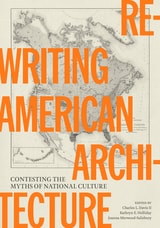
Rewriting American Architecture
Contesting the Myths of National CultureEdited by Charles L. Davis II, Kathryn E. Holliday, and Joanna Merwood-Salisbury
University of Texas Press, 2026
A critical reassessment of nineteenth‑century American architecture that uncovers how race, settler colonialism, and contested national identities shaped the built environment and its historiography.
Rewriting American Architecture offers a revisionist riposte to the canonical story of nineteenth-century American architecture. Drawing on new archival research and revisionist historiography, the essays in this volume reveal how American architecture was shaped not by inevitable progress toward a unified national culture but by the turbulent realities of race, labor, settler colonialism, and territorial expansion. Rather than treating architecture as an apolitical aesthetic expression, the contributors expose it as an active arena in which the meanings of nationhood were constructed, contested, and often violently enforced. From Indigenous spatial practices and Black institutional building to transnational exchanges and the racial politics embedded in professionalization, this collection reframes the built environment as central to the competing cultural, political, and geographic claims that defined the United States during this period.

The Aesthetics of Equity
Notes on Race, Space, Architecture, and MusicCraig L. Wilkins
University of Minnesota Press, 2007
Architecture is often thought to be a diary of a society, filled with symbolic representations of specific cultural moments. However, as Craig L. Wilkins observes, that diary includes far too few narratives of the diverse cultures in U.S. society. Wilkins states that the discipline of architecture has a resistance to African Americans at every level, from the startlingly small number of architecture students to the paltry number of registered architects in the United States today.
Working to understand how ideologies are formed, transmitted, and embedded in the built environment, Wilkins deconstructs how the marginalization of African Americans is authorized within the field of architecture. He then outlines how activist forms of expression shape and sustain communities, fashioning an architectural theory around the site of environmental conflict constructed by hip-hop culture.
Wilkins places his concerns in a historical context, and also offers practical solutions to address them. In doing so, he reveals new possibilities for an architecture that acknowledges its current shortcomings and replies to the needs of multicultural constituencies.
Craig L. Wilkins, a registered architect, teaches architecture and urban planning at the University of Michigan.