Results by title
3 books match the query 'Archival'

Archival and Special Collections Facilities
GuidelinesMichele Pacifico
Society of American Archivists, 2009
Archival facilities are a critical element in preserving and making accessible our nation’s cultural heritage. This SAA-approved standard provides guidance on site evaluation, construction, environmental systems, fire protection, security, lighting, materials and finishes, equipment, and the functional spaces for an archival facility that meets the needs of staff and researchers and ensures the preservation of collections. It is required reading for archivists, librarians, and the building professions planning a new or remodeled archival facility.
Archival and Special Collections Facilities: Guidelines for Archivists, Librarians, Architects, and Engineers were officially adopted as a standard by the Council of the Society of American Archivists in February 2009, following review by the SAA Standards Committee and the general archival community.
[more]

Archival and Special Collections Facilities
Guidelines for Archivists, Librarians, Architects, and EngineersMichele F. Pacifico
American Library Association, 2010
[more]
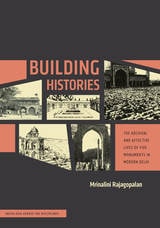
Building Histories
The Archival and Affective Lives of Five Monuments in Modern DelhiMrinalini Rajagopalan
University of Chicago Press, 2016
Building Histories offers innovative accounts of five medieval monuments in Delhi—the Red Fort, Rasul Numa Dargah, Jama Masjid, Purana Qila, and the Qutb complex—tracing their modern lives from the nineteenth century into the twentieth.
Mrinalini Rajagopalan argues that the modern construction of the history of these monuments entailed the careful selection, manipulation, and regulation of the past by both the colonial and later postcolonial states. Although framed as objective “archival” truths, these histories were meant to erase or marginalize the powerful and persistent affective appropriations of the monuments by groups who often existed outside the center of power. By analyzing these archival and affective histories together, Rajagopalan works to redefine the historic monument—far from a symbol of a specific past, the monument is shown in Building Histories to be a culturally mutable object with multiple stories to tell.
Mrinalini Rajagopalan argues that the modern construction of the history of these monuments entailed the careful selection, manipulation, and regulation of the past by both the colonial and later postcolonial states. Although framed as objective “archival” truths, these histories were meant to erase or marginalize the powerful and persistent affective appropriations of the monuments by groups who often existed outside the center of power. By analyzing these archival and affective histories together, Rajagopalan works to redefine the historic monument—far from a symbol of a specific past, the monument is shown in Building Histories to be a culturally mutable object with multiple stories to tell.
[more]