Results by title
24 books match the query 'Archival resources'
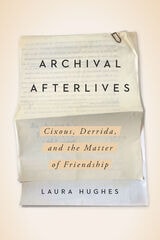
Archival Afterlives
Cixous, Derrida, and the Matter of FriendshipLaura Hughes
Northwestern University Press, 2024
A capacious analysis of a legendary intellectual friendship and the material legacies it left behind
Over the course of their decades-long friendship, Hélène Cixous and Jacques Derrida assembled overlapping archives of written experiments and exchanges that document a shared interest in their literary afterlives. In this incisive account, Laura Hughes shows how pushing against the limits of writing and of life itself means not only imagining but manifesting a community of future readers.
Archival Afterlives: Cixous, Derrida, and the Matter of Friendship examines the embodied nature of literary creation, taking letters, fragments, notes, and other ephemera as objects of critical analysis and care. Combining close readings of key texts and previously unexamined archival materials, Hughes traces critical connections between Cixous and Derrida, between the theoretical and the autobiographical, and between life writing and its limits. In putting deconstruction into dialogue with new material analyses and archive studies, Archival Afterlives positions this historical and intellectual relationship as a lens through which to reexamine the legacy of critical theory itself.
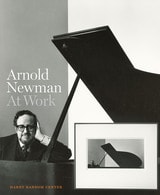
Arnold Newman
At WorkBy Roy Flukinger
University of Texas Press, 2013
A driven perfectionist with inexhaustible curiosity about people, Arnold Newman was one of the twentieth century’s greatest and most prolific photographers. In a career that spanned nearly seven decades and produced many iconic works, Newman became renowned for making “pictures of people” (he objected to the term “portraits”) in the places where they worked and lived—the spaces that were most expressive of their inner lives. Refusing the label of “art photographer,” Newman also accepted magazine and advertising commissions and executed them to the same exacting standards that characterized all of his work. He spent countless hours training aspiring photographers, sharing his own vast experience, but allowing them the freedom to experiment and discover.
Rich with materials from Newman’s extensive archive in the Harry Ransom Center at the University of Texas at Austin, Arnold Newman offers unprecedented, firsthand insights into the evolution of the photographer’s creativity. Reproduced here are not only many of Newman’s signature images, but also contact sheets, Polaroids, and work prints with his handwritten notes, which allow us to see the process by which he produced the images. Pages from his copious notebooks and calendars reveal Newman’s meticulous preparation and exhausting schedule. Adsheets and magazine covers from Holiday, LIFE, Newsweek, Look, Esquire, Seventeen, Time, and Sports Illustrated show the range of Newman’s largely unknown editorial work. Roy Flukinger provides a contextual overview of the archive, and Marianne Fulton’s introduction highlights the essential moments in the development of Newman’s life and work.
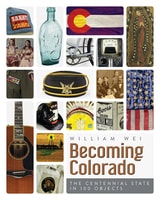
Becoming Colorado
The Centennial State in 100 ObjectsWilliam Wei
University Press of Colorado, 2021
In Becoming Colorado, historian William Wei paints a vivid portrait of Colorado history using 100 of the most compelling artifacts from Colorado’s history. These objects reveal how Colorado has evolved over time, allowing readers to draw multiple connections among periods, places, and people. Collectively, the essays offer a treasure trove of historical insight and unforgettable detail.
Beginning with Indigenous people and ending in the early years of the twenty-first century, Wei traces Colorado’s story by taking a close look at unique artifacts that bring to life the cultures and experiences of its people. For each object, a short essay accompanies a full-color photograph. These accessible accounts tell the human stories behind the artifacts, illuminating each object’s importance to the people who used it and its role in forming Colorado’s culture. Together, they show how Colorado was shaped and how Coloradans became the people they are. Theirs is a story of survival, perseverance, enterprise, and luck.
Providing a fresh lens through which to view Colorado’s past, Becoming Colorado tells an inclusive story of the Indigenous and the immigrant, the famous and the unknown, the vocal and the voiceless—for they are all Coloradans.
Beyond the Archives
Research as a Lived ProcessEdited by Gesa E. Kirsch and Liz Rohan Foreword by Lucille M. Schultz
Southern Illinois University Press, 2008
This collection of highly readable essays reveals that research is not restricted to library archives. When researchers pursue information and perspectives from sources beyond the archives—from existing people and places— they are often rewarded with unexpected discoveries that enrich their research and their lives.
Beyond the Archives: Research as a Lived Process presents narratives that demystify and illuminate the research process by showing how personal experiences, family history, and scholarly research intersect. Editors Gesa E. Kirsch and Liz Rohan emphasize how important it is for researchers to tap into their passions, pursuing research subjects that attract their attention with creativity and intuition without limiting themselves to traditional archival sources and research methods.
Eighteen contributors from a number of disciplines detail inspiring research opportunities that led to recently published works, while offering insights on such topics as starting and finishing research projects, using a wide range of types of sources and methods, and taking advantage of unexpected leads, chance encounters and simple clues. In addition, the narratives trace the importance of place in archival research, the parallels between the lives of research subjects and researchers, and explore archives as sites that resurrect personal, cultural, and historical memory.
Beyond the Archives sheds light on the creative, joyful, and serendipitous nature of research, addressing what attracts researchers to their subjects, as well as what inspires them to produce the most thorough, complete, and engaged scholarly work. This timely and essential volume supplements traditional-method textbooks and effectively models concrete practices of retrieving and synthesizing information by professional researchers.
Digital Memory and the Archive
Wolfgang Ernst
University of Minnesota Press, 2012
In the popular imagination, archives are remote, largely obsolete institutions: either antiquated, inevitably dusty libraries or sinister repositories of personal secrets maintained by police states. Yet the archive is now a ubiquitous feature of digital life. Rather than being deleted, e-mails and other computer files are archived. Media software and cloud storage allow for the instantaneous cataloging and preservation of data, from music, photographs, and videos to personal information gathered by social media sites.
In this digital landscape, the archival-oriented media theories of Wolfgang Ernst are particularly relevant. Digital Memory and the Archive, the first English-language collection of the German media theorist’s work, brings together essays that present Ernst’s controversial materialist approach to media theory and history. His insights are central to the emerging field of media archaeology, which uncovers the role of specific technologies and mechanisms, rather than content, in shaping contemporary culture and society.
Ernst’s interrelated ideas on the archive, machine time and microtemporality, and the new regimes of memory offer a new perspective on both current digital culture and the infrastructure of media historical knowledge. For Ernst, different forms of media systems—from library catalogs to sound recordings—have influenced the content and understanding of the archive and other institutions of memory. At the same time, digital archiving has become a contested site that is highly resistant to curation, thus complicating the creation and preservation of cultural memory and history.
Elizabeth Bishop and the Literary Archive
Bethany Hicok
Lever Press, 2020
Exploring Civil War Wisconsin
A Survival Guide for ResearchersBrett Barker
Wisconsin Historical Society Press, 2003
The innovative format of Exploring Civil War Wisconsin makes it easy for Civil War buffs, genealogists, and students to find and effectively use the vast array of historical materials about the Civil War found in archives, military and census records, published firsthand accounts, newspapers, and even on the Internet. This lively, illustrated guide focuses on Wisconsin in the Civil War, but is broadly applicable to Civil War research anywhere. Images of original documents and historic photographs illustrate every chapter, acquainting readers with both the Civil War and its sources. The easy-to-use and informative text is unlike anything else currently on the market.
Throughout the book, boxed features and sidebars provide background information and tips on how to do research. Author Brett Barker explains how to uncover the history of an individual soldier, his regiment, and his role in the Union Army using rosters, military records, pension files, and memoirs. And, he shows how to explore the home front during the war using the census, newspapers, city directories, and government records.
Information Activism
A Queer History of Lesbian Media TechnologiesCait McKinney
Duke University Press, 2020
Knowing by Ear
Listening to Voice Recordings with African Prisoners of War in German Camps (1915–1918)Anette Hoffmann
Duke University Press, 2024
Migrant Feelings, Migrant Knowledge
Building a Community ArchiveRobert McKee Irwin
University of Texas Press, 2022
The digital storytelling project Humanizing Deportation invites migrants to present their own stories in the world’s largest and most diverse archive of its kind. Since 2017, more than 300 community storytellers have created their own audiovisual testimonial narratives, sharing their personal experiences of migration and repatriation. With Migrant Feelings, Migrant Knowledge, the project’s coordinator, Robert Irwin, and other team members introduce the project’s innovative participatory methodology, drawing out key issues regarding the human consequences of contemporary migration control regimes, as well as insights from migrants whose world-making endeavors may challenge what we think we know about migration.
In recent decades, migrants in North America have been treated with unprecedented harshness. Migrant Feelings, Migrant Knowledge outlines this recent history, revealing stories both of grave injustice and of seemingly unsurmountable obstacles overcome. As Irwin writes, “The greatest source of expertise on the human consequences of contemporary migration control are the migrants who have experienced them,” and their voices in this searing collection jump off the page and into our hearts and minds.
Northern New Spain
A Research GuideThomas C. Barnes, Thomas H. Naylor, and Charles W. Polzer
University of Arizona Press, 1981
Profiting from the Peak
Landscape and Liberty in Colorado SpringsJohn Harner
University Press of Colorado, 2021
Colorado Springs, Colorado, has long profited from Pikes Peak and built an urban infrastructure to sustain that relationship. In Profiting from the Peak, geographer John Harner surveys the events and socioeconomic conditions that formed the city, analyzing the built landscape to offer insight into the origins of its urban forms and spatial layout, focusing particularly on historic downtown architecture and public spaces. He examines the cultural values that have come to define the city, showing how military and other institutions, tourism, political and economic conditions, cultural movements, key individual actors, and administrative policies have created a singular urban personality.
Capital accumulation has been a defining theme of Colorado Springs from its very beginning, with enormous profits generated from regional industrialization, railroads, land sales, water appropriation, and extraction of coal and gold. These conditions and its setting in the Rocky Mountain West formed a libertarian-oriented, limited governance philosophy.
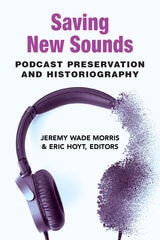
Saving New Sounds
Podcast Preservation and HistoriographyJeremy Wade Morris and Eric Hoyt, editors
University of Michigan Press, 2021
Over seventy-five million Americans listen to podcasts every month, and the average weekly listener spends over six hours tuning into podcasts from the more than thirty million podcast episodes currently available. Yet despite the excitement over podcasting, the sounds of podcasting’s nascent history are vulnerable and they remain mystifyingly difficult to research and preserve. Podcast feeds end abruptly, cease to be maintained, or become housed in proprietary databases, which are difficult to search with any rigor. Podcasts might seem to be highly available everywhere, but it’s necessary to preserve and analyze these resources now, or scholars will find themselves writing, researching, and thinking about a past they can’t fully see or hear.
This collection gathers the expertise of leading and emerging scholars in podcasting and digital audio in order to take stock of podcasting’s recent history and imagine future directions for the format. Essays trace some of the less amplified histories of the format and offer discussions of some of the hurdles podcasting faces nearly twenty years into its existence. Using their experiences building and using the PodcastRE database—one of the largest publicly accessible databases for searching and researching podcasts—the volume editors and contributors reflect on how they, as media historians and cultural researchers, can best preserve podcasting’s booming audio cultures and the countless voices and perspectives podcasting adds to our collective soundscape.
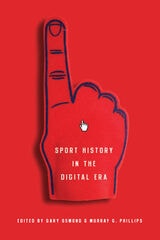
Sport History in the Digital Era
Edited by Gary Osmond and Murray G. Phillips
University of Illinois Press, 2015
Chapters consider how the philosophical and theoretical understanding of the meaning of history influence a willingness to engage with digital history, and conceptualize the relationship between history making and the digital era. As the writers show, digital media's mostly untapped potential for studying the recent past via blogs, chat rooms, gambling sites, and the like forge a symbiosis between sports and the internet, and offer historians new vistas to explore and utilize.
Sport History in the Digital Era also shows how the best digital history goes beyond a static cache of curated documents. Instead, it becomes a truly public history that serves as a dynamic site of enquiry and discussion. In such places, scholars enter into a give-and-take with individuals while inviting the audience to grapple with, rather than passively absorb, the evidence being offered.
Timely and provocative, Sport History in the Digital Era affirms how the information revolution has transformed sport and sport history--and shows the road ahead.
Contributors include Douglas Booth, Mike Cronin, Martin Johnes, Matthew Klugman, Geoffery Z. Kohe, Tara Magdalinski, Fiona McLachlan, Bob Nicholson, Rebecca Olive, Gary Osmond, Murray G. Phillips, Stephen Robertson, Synthia Sydnor, Holly Thorpe, and Wayne Wilson.
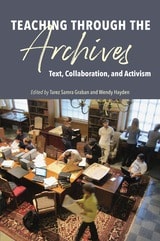
Teaching through the Archives
Text, Collaboration, and ActivismEdited by Tarez Samra Graban and Wendy Hayden
Southern Illinois University Press, 2022
Disruptive pedagogies for archival research
In a cultural moment when institutional repositories carry valuable secrets to the present and past, this collection argues for the critical, intellectual, and social value of archival instruction. Graban and Hayden and 37 other contributors examine how undergraduate and graduate courses in rhetoric, history, community literacy, and professional writing can successfully engage students in archival research in its many forms, and successfully model mutually beneficial relationships between archivists, instructors, and community organizations.
Combining new and established voices from related fields, each of the book’s three sections includes a range of form-disrupting pedagogies. Section I focuses on how approaching the archive primarily as text fosters habits of mind essential for creating and using archives, for critiquing or inventing knowledge-making practices, and for being good stewards of private and public collections. Section II argues for conducting archival projects as collaboration through experiential learning and for developing a preservationist consciousness through disciplined research. Section III details praxis for revealing, critiquing, and intervening in historic racial omissions and gaps in the archives in which we all work.
Ultimately, contributors explore archives as sites of activism while also raising important questions that persist in rhetoric and composition scholarship, such as how to decolonize research methodologies, how to conduct teaching and research that promote social justice, and how to shift archival consciousness toward more engaged notions of democracy. This collection highlights innovative classroom and curricular course models for teaching with and through the archives in rhetoric and composition and beyond.
Teaching with Primary Sources
Christopher Prom
Society of American Archivists, 2016
Temptation in the Archives
Essays in Golden Age Dutch CultureLisa Jardine
University College London, 2015
The Archive and the Aural City
Sound, Knowledge, and the Politics of ListeningAlejandro L. Madrid
Duke University Press, 2025
The Future of Memory
A History of Lossless Format Standards in the Moving Image ArchiveJimi Jones and Marek Jancovic
University of Illinois Press, 2025
Drawing on interviews with archivists and developers, Jones and Jancovic reveal the archive as a dynamic space where deeply entrenched social practices produce disagreements but also resourceful collaborations. They contrast the unprecedented rise of archivist-driven standardization and controversies around non-standard technology with the historical dominance of the film and broadcast industries. Throughout, the authors clarify the role of tech companies, software developers, film pirates, hackers, and other players with poorly understood roles in the process.
A timely look at the state of audiovisual preservation, The Future of Memory provides a history of recent innovations alongside a snapshot of a field in the midst of profound technological change.
The Invention of the Colonial Americas
Data, Architecture, and the Archive of the Indies, 1781–1844Byron Ellsworth Hamann
J. Paul Getty Trust, The, 2022
The Invention of the Colonial Americas is an architectural history and media-archaeological study of changing theories and practices of government archives in Enlightenment Spain. It centers on an archive created in Seville for storing Spain’s pre-1760 documents about the New World. To fill this new archive, older archives elsewhere in Spain—spaces in which records about American history were stored together with records about European history—were dismembered. The Archive of the Indies thus constructed a scholarly apparatus that made it easier to imagine the history of the Americas as independent from the history of Europe, and vice versa.
In this meticulously researched book, Byron Ellsworth Hamann explores how building layouts, systems of storage, and the arrangement of documents were designed to foster the creation of new knowledge. He draws on a rich collection of eighteenth-century architectural plans, descriptions, models, document catalogs, and surviving buildings to present a literal, materially precise account of archives as assemblages of spaces, humans, and data—assemblages that were understood circa 1800 as capable of actively generating scholarly innovation.
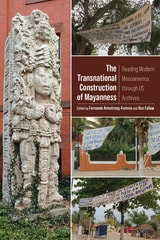
Transnational Construction of Mayanness
Reading Modern Mesoamerica through US ArchivesFernando Armstrong-Fumero
University Press of Colorado, 2023
Contributors tap documentary, ethnographic, and ethnoarchaeological sources from North America to expand established categories of fieldwork and archival research conducted within the national spaces of Mexico and Central America. A particularly rich and diverse set of case studies interrogate the historical processes that remove sources from their place of production in the “field” to the US, challenge the conventional wisdom regarding the geography of data sources that are available for research, and reveal a range of historical relationships that enabled US actors to shape the historical experience of Maya-speaking peoples.
The Transnational Construction of Mayanness offers rich insight into transnational relations and suggests new avenues of research that incorporate an expanded corpus of materials that embody the deep-seated relationship between Maya-speaking peoples and various gringo interlocutors. The work is an important bridge between Mayanist anthropology and historiography and broader literatures in American, Atlantic, and Indigenous studies.
Contributors: David Carey, M. Bianet Castellanos, Matilde Córdoba Azcárate, Lydia Crafts, John Gust, Julio Cesar Hoil Gutierréz, Jennifer Mathews, Matthew Watson
Turning Archival
The Life of the Historical in Queer StudiesDaniel Marshall and Zeb Tortorici, editors
Duke University Press, 2022
Contributors. Anjali Arondekar, Kate Clark, Ann Cvetkovich, Carolyn Dinshaw, Kate Eichhorn, Javier Fernández-Galeano, Emmett Harsin Drager, Elliot James, Marget Long, Martin F. Manalansan IV, Daniel Marshall, María Elena Martínez, Joan Nestle, Iván Ramos, David Serlin, Zeb Tortorici
Unsettling History
Archiving and Narrating in HistoriographyEdited by Sebastian Jobs and Alf Lüdtke
Campus Verlag, 2010
In recent decades, scholars working in postcolonial history have successfully challenged the primacy of Western historiography and its Eurocentric worldview. With Unsettling History, a group of historians extend that challenge to two central components of work in history: archiving and narrating. Archival resources, they argue, despite their air of impartiality, are the product of established interests and subject to various practices of selection, cataloguing, and preservation. Narrating, too, is more complicated than it might at first seem, especially as the range of genres available to the historians for presenting their findings has expanded in recent years.
Working in the Archives
Practical Research Methods for Rhetoric and CompositionEdited by Alexis E. Ramsey, Wendy B. Sharer, Barbara L'Eplattenier, Lisa S. Mastrangelo
Southern Illinois University Press, 2010
Archival research of any magnitude can be daunting. With this in mind, Alexis E. Ramsey, Wendy B. Sharer, Barbara L’Eplattenier, and Lisa Mastrangelo have developed an indispensable volume for the first-time researcher as well as the seasoned scholar. Working in the Archives is a guide to the world of rhetoric and composition archives, from locating an archival source and its materials to establishing one’s own collection of archival materials. This practical volume provides insightful information on a variety of helpful topics, such as basic archival theory, processes, and principles; the use of hidden or digital archives; the intricacies of searching for and using letters and photographs; strategies for addressing the dilemmas of archival organization without damaging the provenance of materials; the benefits of seeking sources outside academia; and the difficult (yet often rewarding) aspects of research on the Internet.
Working in the Archives moves beyond the basics to discuss the more personal and emotional aspects of archival work through the inclusion of interviews with experienced researchers such as Lynée Lewis Gaillet, Peter Mortensen, Kathryn Fitzgerald, Kenneth Lindblom, and David Gold. Each shares his or her personal stories of the joys and challenges that face today’s researchers.
Packed with useful recommendations, this volume draws on the knowledge and experiences of experts to present a well-rounded guidebook to the often winding paths of academic archival investigation. These in-depth yet user-friendly essays provide crucial answers to the myriad questions facing both fledgling and practiced researchers, making Working in the Archives an essential resource.