Results by title
7 books match the query 'Arctic'
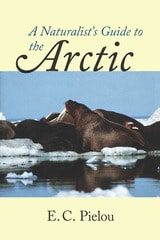
A Naturalist's Guide to the Arctic
E. C. Pielou
University of Chicago Press, 1994
This book is a practical, portable guide to all of the Arctic's natural history—sky, atmosphere, terrain, ice, the sea, plants, birds, mammals, fish, and insects—for those who will experience the Arctic firsthand and for armchair travelers who would just as soon read about its splendors and surprises. It is packed with answers to naturalists' questions and with questions—some of them answered—that naturalists may not even have thought of.
[more]
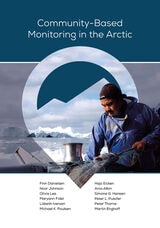
Community-Based Monitoring in the Arctic
Finn Danielsen, Noor Johnson, Olivia Lee, Maryann Fidel, Lisbeth Iversen, Michael K. Poulsen, Hajo Eicken, Ania Albin, Simone G. Hansen, Peter L. Pulsifer, Peter Thorne, and Martin Enghoff
University of Alaska Press, 2020
Community Based Monitoring Programs in the Arctic explores the concept and use of community-based monitoring (CBM) of ecological conditions in the Arctic. The authors analyze current programs and determines that CBM, while widespread and effective, nonetheless still has untapped potential. Presenting numerous examples and substantial data from a pan-Arctic survey and several workshops around the Arctic, Ths book offers a state of the field and a guide for mapping out the next steps.
Contributors include Finn Danielsen, Noor Johnson, Olivia Lee, Maryann Fidel, Lisbeth Iversen, Michael K. Poulsen, Hajo Eicken, Ania Albin, Simone G. Hansen, Peter L. Pulsifer, Peter Thorne, and Martin Enghoff.
Contributors include Finn Danielsen, Noor Johnson, Olivia Lee, Maryann Fidel, Lisbeth Iversen, Michael K. Poulsen, Hajo Eicken, Ania Albin, Simone G. Hansen, Peter L. Pulsifer, Peter Thorne, and Martin Enghoff.
[more]
Finding the Arctic
History and Culture Along a 2,500-Mile Snowmobile Journey from Alaska to Hudson’s BayMatthew Sturm
University of Alaska Press, 2012
The history of the Arctic is rich, filled with fascinating and heroic stories of exploration, multicultural interactions, and humans facing nature at its most extreme. In Finding the Arctic, the accomplished arctic researcher Matthew Sturm collects some of the most memorable and moving of these stories and weaves them around his own story of a 2,500-mile snowmobile expedition across arctic Alaska and Canada.
During that trip, Sturm and six companions followed a circuitous route that brought them to many of the most historic spots in the North. They stood in the footsteps of their predecessors, experienced the landscape and the weather, and gained an intimate perspective on notable historical events, all chronicled here by Sturm. Written with humor and pathos, Finding the Arctic is a classic tale of adventure travel. And throughout the book,Sturm, with his thirty-eight years of experience in the North, emerges as an excellent guide for any who wish to understand the Arctic of today and yesterday.
[more]
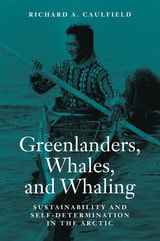
Greenlanders, Whales, and Whaling
Sustainability and Self-Determination in the ArcticRichard A. Caulfield
Dartmouth College Press, 2000
Whaling has been central to the life of Greenland's Inuit peoples for at least 4000 years, but political, economic, technological, and regulatory changes have altered this ancient practice. Richard A. Caulfield reveals these impacts first by analyzing Home Rule and its success in Greenland, and then by looking at whaling's place in the contemporary Greenlandic economy and its evolving co-management regime. What emerges from his investigation is an intricate web connecting traditions of indigenous peoples, the promises and pitfalls of co-management, the influence of international whaling policies, the complexities of sustainability, and the power of culturally determined views shaping relationships between humans and their environment. Caulfield finds that controversy over whaling often arises from conflicting idea systems, rather than disagreement over biological resource management. Understanding the ways Greenlanders and outside interests have defined and negotiated these conflicts "gives us more than just an insight into how indigenous peoples are coping with a changing world," he writes. "It also provides us with a sense of the challenges we face as well."
[more]
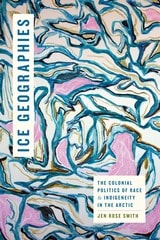
Ice Geographies
The Colonial Politics of Race and Indigeneity in the ArcticJen Rose Smith
Duke University Press, 2025
Ice animates the look and feel of climate change. It is melting faster than ever before, causing social upheaval among northern coastal communities and disrupting a more southern, temperate world as sea levels rise. Economic, academic, and activist stakeholders are increasingly focused on the unsettling potential of ice as they plan for a future shaped by rapid transformation. Yet, in Ice Geographies, Jen Rose Smith demonstrates that ice has always been at the center of making sense of the world. Ice as homeland is often at the heart of Arctic and sub-Arctic ontologies, cosmologies, and Native politics. Reflections on ice have also long been a constitutive element of Western political thought, but it often privileges a pristine or empty “nature” stripped of power relations. Smith centers ice to study race and indigeneity by investigating ice relations as sites and sources of analysis that are bound up with colonial and racial formations as well as ice geographies beyond those formations. Smith asks, How is ice a racialized geography and imaginary, and how does it also exceed those frameworks?
[more]

To the Arctic!
The Story of Northern Exploration from Earliest TimesJeannette Mirsky
University of Chicago Press, 1970
"Who Reached the North Pole First?" A recent article in the New York Times (February 17, 1997) presented new evidence from the journals of Admiral Robert E. Peary and Dr. Frederick A. Cook that sheds light on this long-argued debate. Questioning whether the journal entries are truthful, new theories indicate that neither explorer was first, despite their individual claims. To the Arctic contributes valuable information to this debate in its lively narrative of Arctic exploration from the time of the ancient Greeks to the mid-1940s. Revealing stories of the many men who attempted to map the lands or search for means to live there, Mirsky describes the weather and resources they encountered, the temptations and odds of success, and the role of nationalism and individual character in the many conflicting accounts of Arctic exploration.
"Excellent. . . . This is a book which anyone interested in almost any facet of the north will find of value."—William Cody, Canadian Field Naturalist
"A book filled with adventure."—Daily News Journal
"Excellent. . . . This is a book which anyone interested in almost any facet of the north will find of value."—William Cody, Canadian Field Naturalist
"A book filled with adventure."—Daily News Journal
[more]
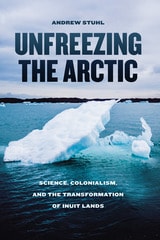
Unfreezing the Arctic
Science, Colonialism, and the Transformation of Inuit LandsAndrew Stuhl
University of Chicago Press, 2016
In recent years, journalists and environmentalists have pointed urgently to the melting Arctic as a leading indicator of the growing effects of climate change. While climate change has unleashed profound transformations in the region, most commentators distort these changes by calling them unprecedented. In reality, the landscapes of the North American Arctic—as well as relations among scientists, Inuit, and federal governments— are products of the region’s colonial past. And even as policy analysts, activists, and scholars alike clamor about the future of our world’s northern rim, too few truly understand its history.
In Unfreezing the Arctic, Andrew Stuhl brings a fresh perspective to this defining challenge of our time. With a compelling narrative voice, Stuhl weaves together a wealth of distinct episodes into a transnational history of the North American Arctic, proving that a richer understanding of its social and environmental transformation can come only from studying the region’s past. Drawing on historical records and extensive ethnographic fieldwork, as well as time spent living in the Northwest Territories, he closely examines the long-running interplay of scientific exploration, colonial control, the testimony and experiences of Inuit residents, and multinational investments in natural resources. A rich and timely portrait, Unfreezing the Arctic offers a comprehensive look at scientific activity across the long twentieth century. It will be welcomed by anyone interested in political, economic, environmental, and social histories of transboundary regions the world over.
The author intends to donate all royalties from this book to the Alaska Youth for Environmental Action (AYEA) and East Three School's On the Land Program.
[more]