Results by title

4 books match the query 'Area'
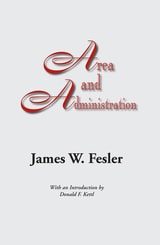
cover of Area and Administration

Area and Administration

James W. Fesler

University of Alabama Press, 2008

A foundational classic on the organization and coordination of modern government.

This fresh publication of James W. Fesler’s classic, Area and Administration is a powerful work of intellectual history. Richly illustrating how the Great Depression and World War II shaped the thinking of scholars who helped build modern American government.

It is also an authoritative work of powerful insight. The challenges of linking the center with the front lines, or securing vertical and horizonal coordination, and of connecting area and function, have only become more important in twenty-first century government. Fesler’s path-breaking book provides an extraordinarily useful foundation for grappling with issues that have become even more important for governance.
 

[more]
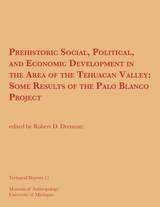
cover of Prehistoric Social, Political, and Economic Development in the Area of the Tehuacan Valley: Some Results of the Palo Blanco Project

Prehistoric Social, Political, and Economic Development in the Area of the Tehuacan Valley

Some Results of the Palo Blanco Project

Edited by Robert D. Drennan

University of Michigan Press, 1979
In this volume, editor Robert D. Drennan presents a series of reports on archaeological research in the Tehuacán Valley of Mexico. Charles S. Spencer writes about irrigation in the Formative period; Elsa M. Redmond reports on a Terminal Formative ceramic workshop; John R. Alden writes about a survey at Quachilco; Drennan provides a preliminary report on excavations at Cuayucatepec; Spencer and Redmond report on Formative and Classic developments in the Cuicatlan Cañada; and Judith E. Smith provides an analysis of carbonized botanical remains from Quachilco, Cuayucatepec, and La Coyotera.
[more]
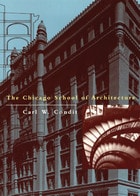
cover of The Chicago School of Architecture: A History of Commercial and Public Building in the Chicago Area, 1875-1925

The Chicago School of Architecture

A History of Commercial and Public Building in the Chicago Area, 1875-1925

Carl W. Condit

University of Chicago Press, 1973

This thoroughly illustrated classic study traces the history of the world-famous Chicago school of architecture from its beginnings with the functional innovations of William Le Baron Jenney and others to their imaginative development by Louis Sullivan and Frank Lloyd Wright. The Chicago School of Architecture places the Chicago school in its historical setting, showing it at once to be the culmination of an iron and concrete construction and the chief pioneer in the evolution of modern architecture. It also assesses the achievements of the school in terms of the economic, social, and cultural growth of Chicago at the turn of the century, and it shows the ultimate meaning of the Chicago work for contemporary architecture.

"A major contribution [by] one of the world's master-historians of building technique."—Reyner Banham, Arts Magazine

"A rich, organized record of the distinguished architecture with which Chicago lives and influences the world."—Ruth Moore, Chicago Sun-Times

[more]
cover of The End of Area: Biopolitics, Geopolitics, History

The End of Area

Biopolitics, Geopolitics, History

Gavin Walker and Naoki Sakai, special issue editors

Duke University Press, 0

As technological innovation and cultural exchange challenge conventional borders, national identities, and notions of the nation-state, scholars have increasingly argued that the traditional concepts of “area” are ideological and political constructs tied to a schema of the world that no longer exists. This special issue of positions: asia critique posits that this “end of area” does not necessarily mean the end of area studies as a discipline. Rather, contributors suggest that “area” has detached itself from the realm of geopolitics and entered into the realm of biopolitics and biopower, which provides an opportunity to reevaluate and remap the goals of area studies. To address that change, this issue centers translation and the biopolitical as new theoretical mechanisms for area studies to order, combine, separate, and classify life. Topics include the concept of “area” itself; the philosophy of translation; reflections on Jean-François Lyotard, Jacques Derrida, and Edward Said; governmentality and biopower in the time of global capital; and biopolitical management of geocultural areas. 

Contributors:  Étienne Balibar, Ken C. Kawashima, Sandro Mezzadra, Tessa Morris-Suzuki, Naoki Sakai, Shu-Mei Shih, Jon Solomon, Tazaki Hideaki, Gavin Walker
[more]