Results by title
4 books match the query 'Arenas'
Arenas of Language Use
Herbert H. Clark
University of Chicago Press, 1993
According to Clark, in order for one person to understand another, there must be a "common ground" of knowledge between them. He shows how people infer this "common ground" from their past conversations, their immediate surroundings, and their shared cultural background. Clark also discusses the means by which speakers design their utterances for particular audiences and coordinate their use of language with other participants in a language arena. He argues that language use in conversation is a collaborative process, where speaker and listener work together to establish that the listener understands the speaker's meaning. Since people often use words to mean something quite different from the dictionary definitions of those words, Clark offers a realistic perspective on how speakers and listeners coordinate on the meanings of words.
This collection presents outstanding examples of Clark's pioneering work on the pragmatics of language use and it will interest psychologists, linguists, computer scientists, and philosophers.
Bulls Markets
Chicago's Basketball Business and the New InequalitySean Dinces
University of Chicago Press, 2018
The 1990s were a glorious time for the Chicago Bulls, an age of historic championships and all-time basketball greats like Scottie Pippen and Michael Jordan. It seemed only fitting that city, county, and state officials would assist the team owners in constructing a sparkling new venue to house this incredible team that was identified worldwide with Chicago. That arena, the United Center, is the focus of Bulls Markets, an unvarnished look at the economic and political choices that forever reshaped one of America’s largest cities—arguably for the worse.
Sean Dinces shows how the construction of the United Center reveals the fundamental problems with neoliberal urban development. The pitch for building the arena was fueled by promises of private funding and equitable revitalization in a long-blighted neighborhood. However, the effort was funded in large part by municipal tax breaks that few ordinary Chicagoans knew about, and that wound up exacerbating the rising problems of gentrification and wealth stratification. In this portrait of the construction of the United Center and the urban life that developed around it, Dinces starkly depicts a pattern of inequity that has become emblematic of contemporary American cities: governments and sports franchises collude to provide amenities for the wealthy at the expense of poorer citizens, diminishing their experiences as fans and—far worse—creating an urban environment that is regulated and surveilled for the comfort and protection of that same moneyed elite.
Eminent Maricones
Arenas, Lorca, Puig, and MeJaime Manrique
University of Wisconsin Press, 2001
Jaime Manrique weaves into his own memoir the lives of three important twentieth-century Hispanic writers: the Argentine Manuel Puig, author of Kiss of the Spider Woman; the Cuban Reinaldo Arenas, author of Before Night Falls; and Spanish poet and playwright Federico García Lorca. Manrique celebrates the lives of these heroic writers who were made outcasts for both their homosexuality and their politics.
"Manrique's double vision yields insights into Puig, Arenas, and Lorca unavailable to a writer less attuned to the complex interplay of culture and sexuality, as well as that of race and class in Latino and Anglo societies."—George DeStefano, The Nation
"A splendid memoir of Manuel Puig. It evokes him—how he really was—better than anything I've read."—Susan Sontag
"Where Manrique's tale differs from others is in its unabashed and sensitive treatment of sexuality. One reads his autobiographical account with pleasure and fascination."—Jose Quiroga, George Washington University
"Manrique's voice is wise, brave, and wholly original. This chronicle of self-discovery and literary encounters is heartening and deep."—Kennedy Fraser
"In this charmingly indiscreet memoir, Jaime Manrique writes with his customary humor and warm sympathy, engaging our delighted interest on every page. He has the rare gift of invoking and inviting intimacy, in this case a triangulated intimacy between himself, his readers, and his memories. These are rich double portraits."—Phillip Lopate
Mesoamerican Plazas
Arenas of Community and PowerEdited by Kenichiro Tsukamoto and Takeshi Inomata
University of Arizona Press, 2014
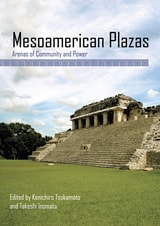
The primary question that has motivated the contributors is how Mesoamerican plazas became arenas for the creation and negotiation of social relations and values in a community. The thirteen contributions stress the significance of interplay between power relations and embodied practices set in specific historical and material settings, as outlined by practice theory and performance theory. This approach allows the contributors to explore broader anthropological issues, such as the negotiation of power relations, community making, and the constitution of political authorities.
Overall, the contributions establish that physical interactions among people in communal events were not the outcomes of political machinations held behind the scenes, but were the actual political processes through which people created, negotiated, and subverted social realities. If so, spacious plazas that were arguably designed for interactions among a large number of individuals must have also provided critical arenas for the constitution and transformation of society.