Results by title
7 books match the query 'Arguments'
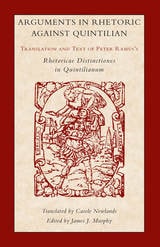
Arguments in Rhetoric Against Quintilian
Translation and Text of Peter Ramus's Rhetoricae Distinctiones in QuintilianumPeter Ramus, Translated by Carole Newlands, Edited by James J. Murphy,
Southern Illinois University Press, 2010
First published in 1986, this book offers the Latin text and English translation of a pivotal work by one of the most influential and controversial writers of early modern times. Pierre de la Ramée, better known as Peter Ramus, was a college instructor in Paris who published a number of books attacking and attempting to refute foundational texts in philosophy and rhetoric. He began in the early 1540s with books on Aristotle—which were later banned and burned—and Cicero, and later, in 1549, he published Rhetoricae Distinctiones in Quintilianum. The purpose of Ramus’s book is announced in the opening paragraph of its dedication to Charles of Lorraine: “I have a single argument, a single subject matter, that the arts of dialectic and rhetoric have been confused by Aristotle, Cicero, and Quintilian. I have previously argued against Aristotle and Cicero. What objection then is there against calling Quintilian to the same account?”
Carole Newlands’s excellent translation—the first in modern English—remains the standard English version. This volume also provides the original Latin text for comparative purposes. In addition, James J. Murphy’s insightful introduction places the text in historical perspective by discussing Ramus’s life and career, the development of his ideas, and the milieu in which his writings were produced. This edition includes an updated bibliography of works concerning Ramus, rhetoric, and related topics.
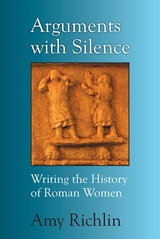
Arguments with Silence
Writing the History of Roman WomenAmy Richlin
University of Michigan Press, 2014
Women in ancient Rome challenge the historian. Widely represented in literature and art, they rarely speak for themselves. Amy Richlin, among the foremost pioneers in ancient studies, gives voice to these women through scholarship that scours sources from high art to gutter invective.
In Arguments with Silence, Richlin presents a linked selection of her essays on Roman women’s history, originally published between 1981 and 2001 as the field of “women in antiquity” took shape, and here substantially rewritten and updated. The new introduction to the volume lays out the historical methodologies these essays developed, places this process in its own historical setting, and reviews work on Roman women since 2001, along with persistent silences. Individual chapter introductions locate each piece in the social context of Second Wave feminism in Classics and the academy, explaining why each mattered as an intervention then and still does now.
Inhabiting these pages are the women whose lives were shaped by great art, dirty jokes, slavery, and the definition of adultery as a wife’s crime; Julia, Augustus’ daughter, who died, as her daughter would, exiled to a desert island; women wearing makeup, safeguarding babies with amulets, practicing their religion at home and in public ceremonies; the satirist Sulpicia, flaunting her sexuality; and the praefica, leading the lament for the dead.
Amy Richlin is one of a small handful of modern thinkers in a position to consider these questions, and this guided journey with her brings surprise, delight, and entertainment, as well as a fresh look at important questions.
Memory against Culture
Arguments and RemindersJohannes Fabian
Duke University Press, 2007
Fabian returns to his landmark book Time and the Other to consider how the role of the other in anthropological inquiry has been transformed over the past two decades. He explores the place of linguistics in contemporary language-centered anthropology, and he ponders how studies of material culture imbue objects with “otherness.” Meditating on the place of memory and forgetting in ethnography, he draws from his own ethnographic work in the Congo to ask why Africa, the site of so much early anthropological study, continues to be forgotten in the wake of colonization. Arguing for the importance of remembering Africa, Fabian focuses on the relationship between thought and memory in the Swahili language. In so doing, he suggests new methods for investigating memory practices across cultures. Turning to the practice of ethnography, he examines the role of the Internet and the place of field notes and other memoranda in ethnographic writing. At once wide-ranging and incisive, Memory against Culture is a significant reflection on the state of the field by one of its most thoughtful and engaged practitioners.

Novels and Arguments
Inventing Rhetorical CriticismZahava K. McKeon
University of Chicago Press, 1982
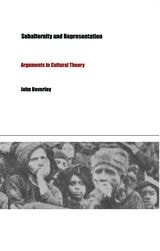
Subalternity and Representation
Arguments in Cultural TheoryJohn Beverley
Duke University Press, 1999
Dismissed by some as simply another new fashion in the critique of culture and by others as a postmarxist heresy, subaltern studies began with the work of Ranajit Guha and the South Asian Subaltern Studies collective in the 1980s. Beverley’s focus on Latin America, however, is evidence of the growing province of this field. In assessing subaltern studies’ purposes and methods, the potential dangers it presents, and its interactions with deconstruction, poststructuralism, cultural studies, Marxism, and political theory, Beverley builds his discussion around a single, provocative question: How can academic knowledge seek to represent the subaltern when that knowledge is itself implicated in the practices that construct the subaltern as such? In his search for answers, he grapples with a number of issues, notably the 1998 debate between David Stoll and Rigoberta Menchú over her award-winning testimonial narrative, I, Rigoberta Menchú. Other topics explored include the concept of civil society, Florencia Mallon’s influential Peasant and Nation, the relationship between the Latin American “lettered city” and the Túpac Amaru rebellion of 1780–1783, the ideas of transculturation and hybridity in postcolonial studies and Latin American cultural studies, multiculturalism, and the relationship between populism, popular culture, and the “national-popular” in conditions of globalization.
This critique and defense of subaltern studies offers a compendium of insights into a new form of knowledge and knowledge production. It will interest those studying postcolonialism, political science, cultural studies, and Latin American culture, history, and literature.

The Bottom Line
Observations and Arguments on the Sports BusinessAndrew Zimbalist
Temple University Press, 2006
The Projection of Arguments
Lexical and Compositional FactorsEdited by Miriam Butt and Wilhelm Geuder
CSLI, 1998