Results by title
7 books match the query 'Aristocracy (Social class)'
Access to Origins
Affines, Ancestors, and AristocratsBy Mary W. Helms
University of Texas Press, 1998
In many non-industrial, non-Western societies, power and prestige are closely linked to the extent of an individual's or group's perceived connection to the supernatural realm, which also explains and validates tangible activities such as economic success, victories in war, or control over lucrative trade. Affines (in-laws), ancestors, and aristocrats, in particular, are connected to the realm of creative cosmological origins (i.e., to Genesis), which accords them distinctive, supernatural powers and gives them a natural and legitimate right to worldly authority.
This is the hypothesis that Mary W. Helms pursues in this broadly cross-cultural study of aristocracy in chiefly societies. She begins with basic ideas about the dead, ancestors, affines, and concepts of cosmological origins. This leads her to a discussion of cosmologically defined hierarchies, the qualities that characterize aristocracy, and the political and ideological roles of aristocrats as wife-givers and wife-takers (that is, as in-laws). She concludes by considering various models that explain how societies may develop or define aristocracies.
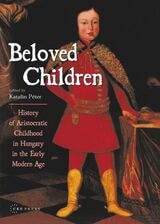
Beloved Children
History of Aristocratic Childhood in Hungary in the Early Modern AgeKatalin Peter
Central European University Press, 2001
Drawing on evidence from a wide collection of surviving family papers, Beloved Children is a valuable contribution to literature available concerning childhood history in pre-industrial Central Europe.
With the aid of detailed case studies, the volume illustrates every aspect of Hungarian childhood in the early modern age from a variety of contrasting perspectives—birth, care, education, marriage, orphanhood and death. The book also includes a unique portrayal of family life in the Hungarian aristocracy.
Beloved Children is a comprehensive study examining topics such as family intimacy, paternal and maternal attitudes, providing the reader with a valuable insight into a child’s life in Hungary during the sixteenth and seventeenth centuries.
Old Wine
Phyllis Bottome
Northwestern University Press, 1998
Rakes of the Old Court
A NovelMateiu Caragiale, Translated from the Romanian by Sean Cotter
Northwestern University Press, 2020
Originally published in 1929, Rakes of the Old Court is considered a jewel of Romanian modernism. Devoted “Mateists” have long read, memorized, and reenacted the novel, and after the Romanian Revolution, it became part of the high school curriculum. Now canonical, Mateiu’s work has been celebrated for its opulent literary style and enigmatic tone.
The Lettered Knight
Knowledge and aristocratic behaviour in the twelfth and thirteenth centuriesMartin Aurell
Central European University Press, 2017
The Medieval Risk-Reward Society
Courts, Adventure, and Love in the European Middle AgesWill Hasty
The Ohio State University Press, 2016
The Medieval Risk-Reward Society: Courts, Adventure, and Love in the European Middle Ages takes a descriptive approach to the competitions in religion, politics, and poetry that are constitutive of medieval culture. Culture is considered always to be happening, and to be happening on the cultural cutting edge as competitions for rewards involving the element of chance. This study finds adventure and love—the principal concerns of medieval European romance poetry—to be cultural game changers, and thereby endeavors to make a humanist contribution to the development of a cultural game theory.
The Mexican Aristocracy
An Expressive Ethnography, 1910–2000By Hugo G. Nutini
University of Texas Press, 2004
The Mexican aristocracy today is simultaneously an anachronism and a testimony to the persistence of social institutions. Shut out from political power by the democratization movements of the twentieth century, stripped of the basis of its great wealth by land reforms in the 1930s, the aristocracy nonetheless maintains a strong sense of group identity through the deeply held belief that their ancestors were the architects and rulers of Mexico for nearly four hundred years.
This expressive ethnography describes the transformation of the Mexican aristocracy from the onset of the Mexican Revolution of 1910, when the aristocracy was unquestionably Mexico's highest-ranking social class, until the end of the twentieth century, when it had almost ceased to function as a superordinate social group. Drawing on extensive interviews with group members, Nutini maps out the expressive aspects of aristocratic culture in such areas as perceptions of class and race, city and country living, education and professional occupations, political participation, religion, kinship, marriage and divorce, and social ranking. His findings explain why social elites persist even when they have lost their status as ruling and political classes and also illuminate the relationship between the aristocracy and Mexico's new political and economic plutocracy.