Results by title
7 books match the query 'Armenian massacres, 1915-1923'
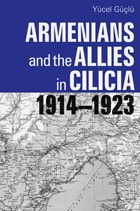
Armenians and the Allies in Cilicia, 1914-1923
Yucel Guclu
University of Utah Press, 2010
Güçlü bases his claim largely on evidence from state and military archives in Turkey, Britain, France, and the United States that look specifically into the Ottoman version of history, placing the whole question of forced population displacements in a wider and more nuanced perspective than that in which it is usually depicted. According to the author, revolutionary Armenian forces were threatening the Ottoman Empire from within as it was simultaneously threatened by external forces. Armenians were also actively involved with Allied forces throughout World War I. In response, the Ottoman government ordered the movement of the Armenian population away from protected and sensitive war zones. The actions taken by the Ottoman Empire to control the Armenian population were those of relocation, not extermination.
Working to explain why the Armenian conflict emerged and how it was eventually resolved, this book discusses the Armenian revolutionary and separatist movements, Turkish measures of self defense, and Allied schemes regarding the region during the period. It places special emphasis on the influence of Allied forces on the actions of Armenians in Cilicia.
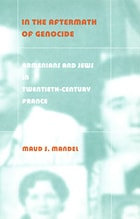
In the Aftermath of Genocide
Armenians and Jews in Twentieth-Century FranceMaud S. Mandel
Duke University Press, 2003
In the Aftermath of Genocide reveals that Armenian and Jewish survivors rarely sought to shed the obvious symbols of their ethnic and religious identities. Mandel shows that following the 1915 genocide and the Holocaust, these communities, if anything, seemed increasingly willing to mobilize in their own self-defense and thereby call attention to their distinctiveness. Most Armenian and Jewish survivors were neither prepared to give up their minority status nor willing to migrate to their national homelands of Armenia and Israel. In the Aftermath of Genocide suggests that the consolidation of the nation-state system in twentieth-century Europe led survivors of genocide to fashion identities for themselves as ethnic minorities despite the dangers implicit in that status.
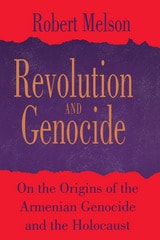
Revolution and Genocide
On the Origins of the Armenian Genocide and the HolocaustRobert Melson
University of Chicago Press, 1992
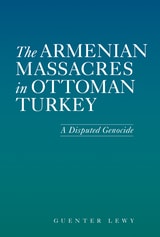
The Armenian Massacres in Ottoman Turkey
A Disputed GenocideGuenter Lewy
University of Utah Press, 2007
In 1915, the Ottoman government, then run by the Young Turks, deported most of its Armenian citizens from their eastern Anatolian lands. According to reliable estimates, close to forty percent of the prewar population perished, many in brutal massacres. Armenians call it the first genocide of the twentieth century. Turks speak of an instance of intercommunal warfare and wartime relocation made necessary by the treasonous conduct of their Armenian minority.
The voluminous literature on this tragic episode of World War I is characterized by acrimony and distortion in which both sides have simplified a complex historical reality and have resorted to partisan special pleading.
The Armenian Massacres in Ottoman Turkey examines the rich historical evidence without political preconceptions. Relying on archival materials as well as eye-witness testimony, Guenter Lewy avoids the sterile “was-it-genocide-or-not” debate and presents a detailed account of what actually happened. The result is a book that will open a new chapter in this contentious controversy and may help achieve a long-overdue reconciliation of Armenians and Turks.
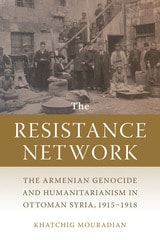
The Resistance Network
The Armenian Genocide and Humanitarianism in Ottoman Syria, 1915–1918Khatchig Mouradian
Michigan State University Press, 2021
The Turk in America
The Creation of an Enduring PrejudiceJustin McCarthy
University of Utah Press, 2010
Utah Series in Middle East Studies
In The Turk in America, historian Justin McCarthy seeks to explain the historical basis for American prejudice towards Turks in the nineteenth and early twentieth centuries. The volume focuses on fraudulent characterizations of Turks, mostly stemming from an antipathy in Europe and America toward non-Christians, and especially Muslims. Spanning one hundred and fifty years, this history explores the misinformation largely responsible for the negative stereotypes of Turks during this period.

The Unspoken as Heritage
The Armenian Genocide and Its Unaccounted LivesHarry Harootunian
Duke University Press, 2019