Results by title
10 books match the query 'Armenians'
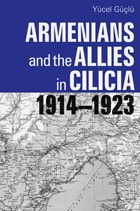
Armenians and the Allies in Cilicia, 1914-1923
Yucel Guclu
University of Utah Press, 2010
Güçlü bases his claim largely on evidence from state and military archives in Turkey, Britain, France, and the United States that look specifically into the Ottoman version of history, placing the whole question of forced population displacements in a wider and more nuanced perspective than that in which it is usually depicted. According to the author, revolutionary Armenian forces were threatening the Ottoman Empire from within as it was simultaneously threatened by external forces. Armenians were also actively involved with Allied forces throughout World War I. In response, the Ottoman government ordered the movement of the Armenian population away from protected and sensitive war zones. The actions taken by the Ottoman Empire to control the Armenian population were those of relocation, not extermination.
Working to explain why the Armenian conflict emerged and how it was eventually resolved, this book discusses the Armenian revolutionary and separatist movements, Turkish measures of self defense, and Allied schemes regarding the region during the period. It places special emphasis on the influence of Allied forces on the actions of Armenians in Cilicia.
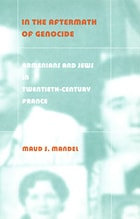
In the Aftermath of Genocide
Armenians and Jews in Twentieth-Century FranceMaud S. Mandel
Duke University Press, 2003
In the Aftermath of Genocide reveals that Armenian and Jewish survivors rarely sought to shed the obvious symbols of their ethnic and religious identities. Mandel shows that following the 1915 genocide and the Holocaust, these communities, if anything, seemed increasingly willing to mobilize in their own self-defense and thereby call attention to their distinctiveness. Most Armenian and Jewish survivors were neither prepared to give up their minority status nor willing to migrate to their national homelands of Armenia and Israel. In the Aftermath of Genocide suggests that the consolidation of the nation-state system in twentieth-century Europe led survivors of genocide to fashion identities for themselves as ethnic minorities despite the dangers implicit in that status.
Sasun
The History of an 1890s Armenian RevoltJustin McCarthy
University of Utah Press, 2014
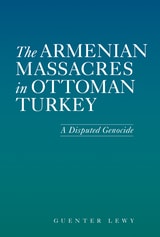
The Armenian Massacres in Ottoman Turkey
A Disputed GenocideGuenter Lewy
University of Utah Press, 2007
In 1915, the Ottoman government, then run by the Young Turks, deported most of its Armenian citizens from their eastern Anatolian lands. According to reliable estimates, close to forty percent of the prewar population perished, many in brutal massacres. Armenians call it the first genocide of the twentieth century. Turks speak of an instance of intercommunal warfare and wartime relocation made necessary by the treasonous conduct of their Armenian minority.
The voluminous literature on this tragic episode of World War I is characterized by acrimony and distortion in which both sides have simplified a complex historical reality and have resorted to partisan special pleading.
The Armenian Massacres in Ottoman Turkey examines the rich historical evidence without political preconceptions. Relying on archival materials as well as eye-witness testimony, Guenter Lewy avoids the sterile “was-it-genocide-or-not” debate and presents a detailed account of what actually happened. The result is a book that will open a new chapter in this contentious controversy and may help achieve a long-overdue reconciliation of Armenians and Turks.
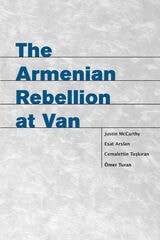
The Armenian Rebellion at Van
McCarthy, Justin
University of Utah Press, 2006
Before World War I, the ancient city of Van in southeastern Anatolia had a population of approximately 100,000 people, while the population of Van Province was about 500,000. Armenians formed a large minority, with Kurdish tribes and Turks in the majority.
The Armenian Rebellion at Van presents a long-overdue examination of Van from the 1870s to 1919. As the authors state, "The Armenian Revolt was an integral part of the great disaster that overcame the people of the Ottoman East. The slaughter of Muslims that accompanied the Armenian revolt in Van Province inexorably led first to Kurdish reprisals on the Armenians, then to a general and mutual massacre of the people of the East."
The actions at Van offer a window into the far-reaching events that soon followed in other parts of Anatolia.
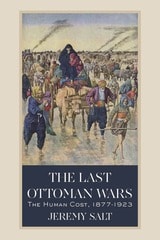
The Last Ottoman Wars
The Human Cost, 1877–1923Jeremy Salt
University of Utah Press, 2019
Jeremy Salt brings to the surface previously ignored facts that disrupt the conventional narrative of an ethno-religious division between Muslim perpetrators and Christian victims of violence. Salt shows instead that all major ethno-religious groups—including Armenians, Turks, Kurds, and Greeks—were guilty of violent acts. The result is a more balanced picture of European involvement in the Ottoman Empire and the Balkans, one that highlights the destructive role of British Prime Minister David Lloyd George and other European leaders grabbing for Ottoman resources up to the end of World War I. The effects of these events are felt to the present day.
This extraordinary story centers not on military campaigns but on ordinary civilians whose lives were disrupted and in many cases destroyed by events over which they had no control. Disease, malnutrition, massacre and inter-communal fighting killed millions of people during the First World War alone. Until now this epic saga of human suffering has remained a story largely untold.
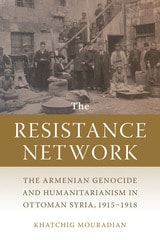
The Resistance Network
The Armenian Genocide and Humanitarianism in Ottoman Syria, 1915–1918Khatchig Mouradian
Michigan State University Press, 2021
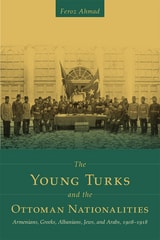
The Young Turks and the Ottoman Nationalities
Armenians, Greeks, Albanians, Jews, and Arabs, 1908–1918Feroz Ahmad
University of Utah Press, 2014
Ahmad holds that nationalism was introduced into the Ottoman Empire during the French Revolution, providing kindling for the struggles that later emerged. Setting the stage with this nineteenth-century background, Ahmad then examines each Ottoman nationality in the wake of the restoration of the Ottoman constitution in 1908. Officially known as the Committee of Union and Progress (CUP), the Young Turks made up a nationalist political party that ruled the Ottoman Empire from 1908 until the end of World War I. Ahmad illuminates the relationships and conflicts between the Young Turks and the Greek, Armenian, Albanian, Jewish, and Arab ethnic groups during this period. Placing these nationalities in their historical context, he shows their relationships not only to the Young Turks but also to one anotherno other single book has attempted to look closely at all of these connections.
Anyone interested in understanding the roots of current-day relations in the Balkans and Middle East will find this book very informative. Clearly organized and written, the book will enlighten both readers and scholars.
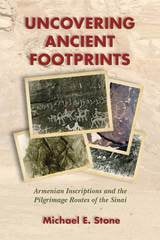
Uncovering Ancient Footprints
Armenian Inscriptions and the Pilgrimage Routes of the SinaiMichael E. Stone
SBL Press, 2017
Explore pilgrimage routes, epigraphy, and the history of writing with an expert guide
From the late 1970s through 1982, Michael E. Stone conducted a number of expeditions to the Sinai peninsula, searching for ancient inscriptions. In this book Stone describes his search, crowned by the discovery of the most ancient Armenian inscriptions known. Here Stone describes not only the inscriptions discovered along his journeys but also the Sinai, its past and present, its human inhabitants, its flora and fauna, and its history. Though once common, well-informed travel books to the Middle East with a broad academic interest and a specific focus have become rare. Stone’s diary of his expeditions in the Sinai fill this gap with vivid descriptions, poetry, and illustrations.
Features
- An account of five expeditions into the Sinai
- Thirteen poems written by Stone
- Twenty-six figures and five maps
We Are All Armenian
Voices from the DiasporaEdited by Aram Mrjoian
University of Texas Press, 2023
A collection of essays about Armenian identity and belonging in the diaspora.
In the century since the Armenian Genocide, Armenian survivors and their descendants have written of a vast range of experiences using storytelling and activism, two important aspects of Armenian culture. Wrestling with questions of home and self, diasporan Armenian writers bear the burden of repeatedly telling their history, as it remains widely erased and obfuscated. Telling this history requires a tangled balance of contextualizing the past and reporting on the present, of respecting a culture even while feeling lost within it.
We Are All Armenian brings together established and emerging Armenian authors to reflect on the complications of Armenian ethnic identity today. These personal essays elevate diasporic voices that have been historically silenced inside and outside of their communities, including queer, multiracial, and multiethnic writers. The eighteen contributors to this contemporary anthology explore issues of displacement, assimilation, inheritance, and broader definitions of home. Through engaging creative nonfiction, many of them question what it is to be Armenian enough inside an often unacknowledged community.