Results by title
7 books match the query 'Art, Ancient'
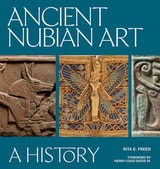
Ancient Nubian Art
A HistoryGates
J. Paul Getty Trust, The, 0
Lushly illustrated with stunning artifacts, this volume is the first comprehensive and accessible publication to explore the art, architecture, and material culture of ancient Nubia.
Kings and queens of Nubia reigned over one of the largest empires in the ancient world and had contacts extending north to Greece and Rome, south to sub-Saharan Africa, east to the Red Sea, and west across much of the Sahel. Even a quick look at Nubia’s artifacts reveals the incredible creativity of its artists, architects, craftspeople, and thinkers. Despite their significance, the achievements of ancient Nubia are little known to the public and are often viewed as a subculture, a derivative offshoot of Egypt, Nubia’s northern neighbor. Nothing could be further from the truth. During its over eight-thousand-year lifespan (beginning around 8000 BCE), Nubia indelibly shaped the art and architecture of the ancient world, an influence still felt today.
Ancient Nubian Art is the first comprehensive and accessible treatment of Nubian artistic culture and showcases its vast range—from ceramics, sculptures, and jewelry to tombs, temples, and palaces. Rita E. Freed, curator emerita at the Museum of Fine Arts, Boston, which has the largest collection of Nubian artifacts outside the Nile Valley, contextualizes the development of Nubian art against a vivid backdrop of kingship, power, worship, identity, gender, technology, and internationalism. Her text is accompanied by a foreword by Henry Louis Gates Jr. and sidebars by expert voices from the field.
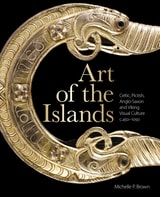
Art of the Islands
Celtic, Pictish, Anglo-Saxon and Viking Visual Culture, c. 450-1050Michelle P. Brown
Bodleian Library Publishing, 2015
Michelle P. Brown remedies this oversight, presenting an extensively illustrated art historical overview of this formative period in the region’s history. Describing the interactions between the region’s inhabitants, she also explores the formation of national and regional identities. Brown ranges across works as diverse as the Book of Kells, the Tara Brooch, the Aberlemno Stone, the Lindisfarne Gospels, the Alfred Jewel, and the Benedictional of St. Ethelwold, showing how their complex imagery can be best interpreted. She also considers the impact of the art of this period upon the history of art in general, exploring how it has influenced many movements since, from the Carolingian Renaissance and the Romanesque style to the nineteenth-century Arts and Crafts movement.
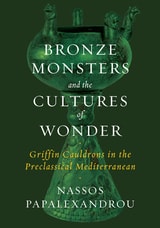
Bronze Monsters and the Cultures of Wonder
Griffin Cauldrons in the Preclassical MediterraneanNassos Papalexandrou
University of Texas Press, 2021
The eighth and seventh centuries BCE were a time of flourishing exchange between the Mediterranean and the Near East. One of the period’s key imports to the Hellenic and Italic worlds was the image of the griffin, a mythical monster that usually possesses the body of a lion and the head of an eagle. In particular, bronze cauldrons bore griffin protomes—figurative attachments showing the neck and head of the beast. Crafted in fine detail, the protomes were made to appear full of vigor, transfixing viewers.
Bronze Monsters and the Cultures of Wonder takes griffin cauldrons as case studies in the shifting material and visual universes of preclassical antiquity, arguing that they were perceived as lifelike monsters that introduced the illusion of verisimilitude to Mediterranean arts. The objects were placed in the tombs of the wealthy (Italy, Cyprus) and in sanctuaries (Greece), creating fantastical environments akin to later cabinets of curiosities. Yet griffin cauldrons were accessible only to elites, ensuring that the new experience of visuality they fostered was itself a symbol of status. Focusing on the sensory encounter of this new visuality, Nassos Papalexandrou shows how spaces made wondrous fostered novel subjectivities and social distinctions.
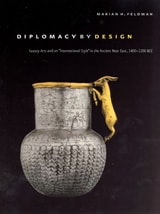
Diplomacy by Design
Luxury Arts and an "International Style" in the Ancient Near East, 1400-1200 BCEMarian H. Feldman
University of Chicago Press, 2006
Marian Feldman's Diplomacy by Design examines the profound connection between art produced during this period and its social context, revealing inanimate objects as catalysts—or even participants—in human dynamics. Feldman's fascinating study shows the ways in which the exchange of these works of art actively mediated and strengthened political relations, intercultural interactions, and economic negotiations. Previous studies of this international style have focused almost exclusively on stylistic attribution at the expense of social contextualization. Written by a specialist in ancient Near Eastern art and archaeology who has excavated and traveled extensively in this area of the world, Diplomacy by Design provides a much broader consideration of the symbolic power of material culture and its centrality in the construction of human relations.
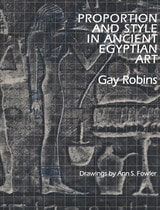
Proportion and Style in Ancient Egyptian Art
By Gay Robins
University of Texas Press, 1993
The painted and relief-cut walls of ancient Egyptian tombs and temples record an amazing continuity of customs and beliefs over nearly 3,000 years. Even the artistic style of the scenes seems unchanging, but this appearance is deceptive. In this work, Gay Robins offers convincing evidence, based on a study of Egyptian usage of grid systems and proportions, that innovation and stylistic variation played a significant role in ancient Egyptian art.
Robins thoroughly explores the squared grid systems used by the ancient artists to proportion standing, sitting, and kneeling human figures. This investigation yields the first chronological account of proportional variations in male and female figures from the Early Dynastic to the Ptolemaic periods. Robins discusses in detail the proportional changes underlying the revolutionary style instituted during the Amarna Period. She also considers how the grid system influenced the composition of scenes as a whole. Numerous line drawings with superimposed grids illustrate the text.
The Public in the Picture
Involving the Beholder in Antique, Islamic, Byzantine, Western Medieval and Renaissance ArtEdited by Beate Fricke and Urte Krass
Diaphanes, 2015
With The Public in the Picture, contributors describe this shift, with each essay focusing on a specific group of works created at a different moment in history. Together, the contributions explore the political, religious, and social contexts of the publics depicted and relate this shift to the rise of perspectival representation. Contributors to The Public in the Picture include Andrew Griebler, Annette Haug, Henrike Haug, Christiane Hille, Christopher Lakey, Andrea Lermer, Cornelia Logemann, Anja Rathmann-Lutz, Alberto Saviello, and Daniela Wagner.
When Writing Met Art
From Symbol to StoryBy Denise Schmandt-Besserat
University of Texas Press, 2007
Denise Schmandt-Besserat opened a major new chapter in the history of literacy when she demonstrated that the cuneiform script invented in the ancient Near East in the late fourth millennium BC—the world's oldest known system of writing—derived from an archaic counting device. Her discovery, which she published in Before Writing: From Counting to Cuneiform and How Writing Came About, was widely reported in professional journals and the popular press. In 1999, American Scientist chose How Writing Came About as one of the "100 or so Books that shaped a Century of Science."
In When Writing Met Art, Schmandt-Besserat expands her history of writing into the visual realm of communication. Using examples of ancient Near Eastern writing and masterpieces of art, she shows that between 3500 and 3000 BC the conventions of writing—everything from its linear organization to its semantic use of the form, size, order, and placement of signs—spread to the making of art, resulting in artworks that presented complex visual narratives in place of the repetitive motifs found on preliterate art objects. Schmandt-Besserat then demonstrates art's reciprocal impact on the development of writing. She shows how, beginning in 2700-2600 BC, the inclusion of inscriptions on funerary and votive art objects emancipated writing from its original accounting function. To fulfill its new role, writing evolved to replicate speech; this in turn made it possible to compile, organize, and synthesize unlimited amounts of information; and to preserve and disseminate information across time and space.
Schmandt-Besserat's pioneering investigation of the interface between writing and art documents a key turning point in human history, when two of our most fundamental information media reciprocally multiplied their capacities to communicate. When writing met art, literate civilization was born.