Results by title
10 books match the query 'Art, European'
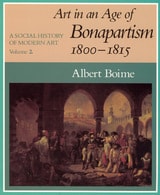
A Social History of Modern Art, Volume 2
Art in an Age of Bonapartism, 1800-1815Albert Boime
University of Chicago Press, 1990
Heavily illustrated, this volume is an invaluable social history of modern art during the Napoleonic era.
Stimulating and informative, this volume will become a valuable resource for faculty and undergraduates.—R. W. Liscombe, Choice

Art and the Academy in the Nineteenth Century
Rafael Cardoso Denis
Rutgers University Press, 2000
"Intellectually broad and carefully grounded in fundamental issues affecting the time, role, and place of the academy in society, this collection explores the ways in which art and tradition are either maintained or rearticulated late in the Victorian Era. Art and the Academy forges a distinctive new way to look at the broad range of academic creativity against a complex network of changing social patterns." -Gabriel P. Weisberg, department of art history, University of Minnesota
Throughout the nineteenth century, academies functioned as the main venues for the teaching, promotion, and display of art. Contemporary scholars have, for the most part, denigrated academic art, calling it formulaic, unoriginal, and repetitious. The contributors to Art and the Academy in the Nineteenth Century challenge this entrenched notion and consider how academies worldwide have represented an important system of artistic preservation and transmission. Their essays eschew easy binaries that have reigned in academia for over half a century and that simply oppose the avant-garde to academism.
The essayists uncover the institutional structures and artistic practices of academies in England, France, Germany, and Brazil. Investigating artistic protocols across national and cultural boundaries, the scholars examine the relationship between artistic training and cultural identity. Their essays provide new insights into the ways in which institutions of art helped shape the nineteenth century's view of itself as an age of civilization amidst the turmoil of rapid social and cultural change. With an engaging mix of works by leading scholars, Art and the Academy will be essential reading for anyone interested in the artistic, cultural, and social history of the nineteenth century.
Rafael Cardoso Denis is adjunct professor (visiting) at the Escola Superior de Desenho Industrial (Universidade do Estado do Rio de Janeiro). Colin Trodd is senior lecturer in art history at the University of Sunderland.
.
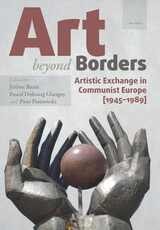
Art beyond Borders
Artistic Exchange in Communist Europe (1945-1989)Jérôme Bazin
Central European University Press, 2016
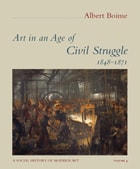
Art in an Age of Civil Struggle, 1848-1871
Albert Boime
University of Chicago Press, 2008
Tracing the various movements of realism through the major metropolitan centers of Europe and America, Boime strikingly evokes the milieus that shaped the lives and works of Gustave Courbet, Edouard Manet, Émile Zola, Honoré Daumier, Walt Whitman, Abraham Lincoln, and the earliest photographers, among countless others. In doing so, he spearheads a powerful new way of reassessing how art emerges from the welter of cultural and political events and the artist’s struggle to interpret his surroundings. Boime supports this multifaceted approach with a wealth of illustrations and written sources that demonstrate the intimate links between visual culture and social change. Culminating at the transition to impressionism, Art in an Age of Civil Struggle makes historical sense of a movement that paved the way for avant-garde aesthetics and, more broadly, of how a particular style emerges at a particular moment.
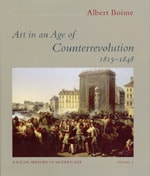
Art in an Age of Counterrevolution, 1815-1848
Albert Boime
University of Chicago Press, 2004
This volume focuses on the astonishing range of art forms currently understood to fall within the broad category of Romanticism. Drawing on visual media and popular imagery of the time, this generously illustrated work examines the art of Romanticism as a reaction to the social and political events surrounding it. Boime reinterprets canonical works by such politicized artists as Goya, Delacroix, Géricault, Friedrich, and Turner, framing their work not by personality but by its sociohistorical context. Boime's capacious approach and scope allows him to incorporate a wide range of perspectives into his analysis of Romantic art, including Marxism, social history, gender identity, ecology, structuralism, and psychoanalytic theory, a reach that parallels the work of contemporary cultural historians and theorists such as Edward Said, Pierre Bourdieu, Eric Hobsbawm, Frederic Jameson, and T. J. Clark.
Boime ultimately establishes that art serves the interests and aspirations of the cultural bourgeoisie. In grounding his arguments on their work and its scope and influence, he elucidates how all artists are inextricably linked to history. This book will be used widely in art history courses and exert enormous influence on cultural studies as well.
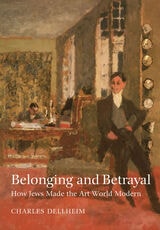
Belonging and Betrayal
How Jews Made the Art World ModernCharles Dellheim
Brandeis University Press, 2021
The story of dealers of Old Masters, champions of modern art, and victims of Nazi plunder.
Since the late 1990s, the fate of Nazi-stolen art has become a cause célèbre. In Belonging and Betrayal, Charles Dellheim turns this story on its head by revealing how certain Jewish outsiders came to acquire so many old and modern masterpieces in the first place—and what this reveals about Jews, art, and modernity. This book tells the epic story of the fortunes and misfortunes of a small number of eminent art dealers and collectors who, against the odds, played a pivotal role in the migration of works of art from Europe to the United States and in the triumph of modern art.
Beautifully written and compellingly told, this story spans both sides of the Atlantic from the late nineteenth century to the present. It is set against the backdrop of critical transformations, among them the gradual opening of European high culture, the ambiguities of Jewish acculturation, the massive sell-off of aristocratic family art collections, the emergence of different schools of modern art, the cultural impact of World War I, and the Nazi war against the Jews.

Largesse
Jean Starobinski
University of Chicago Press, 1997
Jean Starobinski, noted literary critic and intellectual historian from the University of Geneva, was selected as the third curator in the program. In his exhibition and accompanying essay, Starobinski explores the theme of largesse in its broadest sense. Arguing that gift giving and receiving are fundamental human gestures, he examines graphic and textual representations from the offering of the apple to Eve to Salome's gift of the head of John the Baptist, from the giving of laws to the gift of death. Charity, the poetic gift, and the benefits of Fortune all play a role in Starobinski's extended meditation on the act of donation. Lavishly illustrated and
dazzling in its scope and imagination, Largesse is an exemplar of the rich intellectual work that can result from crossing disciplinary boundaries and considering history as a dense network of themes and allusions.

The Green Bloc
Neo-avant-garde Art and Ecology under SocialismMaja Fowkes
Central European University Press, 2015
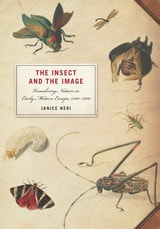
The Insect and the Image
Visualizing Nature in Early Modern Europe, 1500-1700Janice Neri
University of Minnesota Press, 2011
Once considered marginal members of the animal world (at best) or vile and offensive creatures (at worst), insects saw a remarkable uptick in their status during the early Renaissance. This quickened interest was primarily manifested in visual images—in illuminated manuscripts, still life paintings, the decorative arts, embroidery, textile design, and cabinets of curiosity. In The Insect and the Image, Janice Neri explores the ways in which such imagery defined the insect as a proper subject of study for Europeans of the early modern period.
It was not until the sixteenth century that insects began to appear as the sole focus of paintings and drawings—as isolated objects, or specimens, against a blank background. The artists and other image makers Neri discusses deployed this “specimen logic” and so associated themselves with a mode of picturing in which the ability to create a highly detailed image was a sign of artistic talent and a keenly observant eye. The Insect and the Image shows how specimen logic both reflected and advanced a particular understanding of the natural world—an understanding that, in turn, supported the commodification of nature that was central to global trade and commerce during the early modern era.
Revealing how sixteenth- and seventeenth-century artists and image makers shaped ideas of the natural world, Neri’s work enhances our knowledge of the convergence of art, science, and commerce today.
Vision in Motion
Streams of Sensation and Configurations of TimeEdited by Michael F. Zimmermann
Diaphanes, 2015
Bringing together a renowned international group of contributors, Vision in Motion explores one of the most vexing problems in the study of vision and cognition: To make sense of the sensations we experience when we see something, we must configure many moments into a synchronous image. This volume offers a critical reexamination of seeing that restores a concept of “vision in motion” that avoids reducing the sensations we experience to narrative chronological sequencing. The contributors draw on Hume, Bergson, and Deleuze, among others, to establish a nuanced idea of how we perceive.