Results by title
6 books match the query 'Art, German'
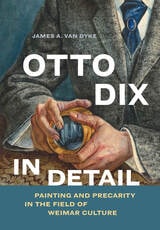
Otto Dix in Detail
Painting and Precarity in the Field of Weimar CultureJames A. van Dyke
University of Chicago Press, 2026
Offering a fresh look at German art during a period of extraordinary transition and precarity, James A. van Dyke focuses on overlooked but critically significant details in works completed by Otto Dix between 1919 and 1936. A small lump of paint, a monogram, an almost invisible self-portrait, the verso of a drawing, a patch of discoloration, and a web of fine cracks—van Dyke reveals such details, hidden in plain sight, as coded dialogue through which Dix addressed audiences and art-world insiders amid the combative world of cultural production in Weimar Germany. Sly, cutting, and provocative, these are the material traces of social relationships between the painter and those who represented threats to his professional ambition: an avant-garde mentor and rival, an increasingly skeptical critic, a prominent bourgeois photographer, and a local Nazi authority.
Proving that small things offer insight into the big picture, this book highlights Dix’s satirical, transgressive work as nuanced and polyvocal, reflecting the complex fields of power and economics in which the field of art is located.
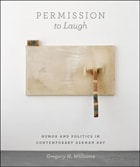
Permission to Laugh
Humor and Politics in Contemporary German ArtGregory H. Williams
University of Chicago Press, 2012
Permission to Laugh explores the work of three generations of German artists who, beginning in the 1960s, turned to jokes and wit in an effort to confront complex questions regarding German politics and history. Gregory H. Williams highlights six of them—Martin Kippenberger, Isa Genzken, Rosemarie Trockel, Albert Oehlen, Georg Herold, and Werner Büttner—who came of age in the mid-1970s in the art scenes of West Berlin, Cologne, and Hamburg. Williams argues that each employed a distinctive brand of humor that responded to the period of political apathy that followed a decade of intense political ferment in West Germany.

The Dada Cyborg
Visions of the New Human in Weimar BerlinMatthew Biro
University of Minnesota Press, 2009
Finding the cyborg in early twentieth-century German art
In an era when technology, biology, and culture are becoming ever more closely connected, The Dada Cyborg explains how the cyborg as we know it today actually developed between 1918 and 1933 when German artists gave visual form to their utopian hopes and fantasies in a fearful response to World War I.
In what could be termed a prehistory of the posthuman, Matthew Biro shows the ways in which new forms of human existence were imagined in Germany between the two world wars through depictions of cyborgs. Examining the work of Hannah Höch, Raoul Hausmann, George Grosz, John Heartfield, Otto Dix, and Rudolf Schlichter, he reveals an innovative interpretation of the cyborg as a representative of hybrid identity, as well as a locus of new modes of awareness created by the impact of technology on human perception. Tracing the prevalence of cyborgs in German avant-garde art, Biro demonstrates how vision, hearing, touch, and embodiment were beginning to be reconceived during the Weimar Republic. Biro’s unique and interdisciplinary analysis offers a substantially new account of the Berlin Dada movement, one that integrates the group’s poetic, theoretical, and performative practices with its famous visual strategies of photomontage, assemblage, and mixed-media painting to reveal radical images of a “new human.”
The Forces of Form in German Modernism
Malika Maskarinec
Northwestern University Press, 2018
Considering canonical artists such as Rodin and Klee, seminal authors such as Kafka and Döblin, and largely neglected thinkers in aesthetics and art history such as those associated with Empathy Aesthetics, Maskarinec unpacks the manifold anthropological and aesthetic concerns and historical lineage embedded in the idea of form as the precarious achievement of uprightness.
The Forces of Form in German Modernism makes a decisive contribution to our understanding of modernism and to contemporary discussions about form, empathy, materiality, and human embodiment.
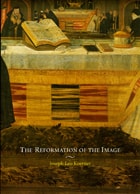
The Reformation of the Image
Joseph Leo Koerner
University of Chicago Press, 2004
But if words—not iconic images—showed the way to salvation, why didn't religious imagery during the Reformation disappear along with indulgences? The answer, according to Joseph Leo Koerner, lies in the paradoxical nature of Protestant religious imagery itself, which is at once both iconic and iconoclastic. Koerner masterfully demonstrates this point not only with a multitude of Lutheran images, many never before published, but also with a close reading of a single pivotal work—Lucas Cranach the Elder's altarpiece for the City Church in Wittenberg (Luther's parish). As Koerner shows, Cranach, breaking all the conventions of traditional Catholic iconography, created an entirely new aesthetic for the new Protestant ethos.
In the Crucifixion scene of the altarpiece, for instance, Christ is alone and stripped of all his usual attendants—no Virgin Mary, no John the Baptist, no Mary Magdalene—with nothing separating him from Luther (preaching the Word) and his parishioners. And while the Holy Spirit is nowhere to be seen—representation of the divine being impossible—it is nonetheless dramatically present as the force animating Christ's drapery. According to Koerner, it is this "iconoclash" that animates the best Reformation art.
Insightful and breathtakingly original, The Reformation of the Image compellingly shows how visual art became indispensable to a religious movement built on words.
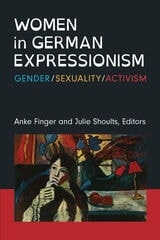
Women in German Expressionism
Gender, Sexuality, ActivismAnke Finger and Julie Shoults, Editors
University of Michigan Press, 2023