Results by title
5 books match the query 'Art, Greek'
Capturing Troy
The Narrative Functions of Landscape in Archaic and Early Classical Greek ArtGuy Hedreen
University of Michigan Press, 2002
Guy Michael Hedreen is Professor of Art, Williams College.
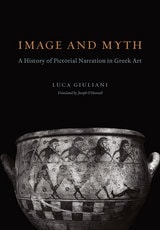
Image and Myth
A History of Pictorial Narration in Greek ArtLuca Giuliani
University of Chicago Press, 2013
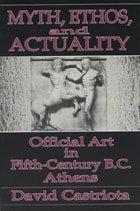
Myth, Ethos, and Actuality
Official Art in Fifth Century B.C. AthensDavid Castriota
University of Wisconsin Press, 1992
Using material remains, as well as the evidence of contemporary Greek history, rhetoric, and poetry, David Castriota interprets the Athenian monuments as vehicles of an official ideology intended to celebrate and justify the present in terms of the past.
Castriota focuses on the strategy of ethical antithesis that asserted Greek moral superiority over the “barbaric” Persians, whose invasion had been repelled a generation earlier. He examines how, in major public programs of painting and sculpture, the leading artists of the period recast the Persians in the guise of wild and impious mythic antagonists to associate them with the ethical flaws or weaknesses commonly ascribed to women, animals, and foreigners. The Athenians, in contrast, were compared to mythic protagonists representing the excellence and triumph of Hellenic culture.
Castriota’s study is innovative in emphasizing the ethical implication of mythic precedents, which required substantial alterations to render them more effective as archetypes for the defense of Greek culture against a foreign, morally inferior enemy. The book looks in new ways at how the patrons and planners sought to manipulate viewer response through the selective presentation or repackaging of mythic traditions.
The Dionysian Vision of the World
Friedrich Nietzsche
University of Minnesota Press, 2012
Before the world knew of the thinker who “philosophizes with a hammer,” there was a young, passionate thinker who was captivated by the two forces found within Greek art: Dionysus and Apollo. In this essay, which was the forerunner to his groundbreaking book The Birth of Tragedy, The Dionysian Vision of the World provides an unparalleled look into the philosophical mind of one of Europe’s greatest and provocative intellects at the beginning of his philosophical interrogation on the subject of art. “While dreaming is the game man plays with reality as an individual, the visual artist (in the larger sense) plays a game with dreaming.” This is the Dionysian vision of the world.
The Emergence of the Classical Style in Greek Sculpture
Richard Neer
University of Chicago Press, 2010