Results by title
9 books match the query 'Art, Medieval'
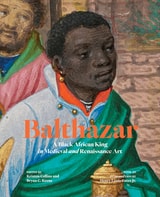
Balthazar
A Black African King in Medieval and Renaissance ArtKristen Collins
J. Paul Getty Trust, The, 0
According to the Gospel of Matthew, magi from the East, following a star, traveled to Jerusalem bearing precious gifts for the infant Jesus. The magi were revered as wise men and later as kings. Over time, one of the three came to be known as Balthazar and to be depicted as a Black man.
Balthazar was familiar to medieval Europeans, appearing in paintings, manuscript illuminations, mosaics, carved ivories, and jewelry. But the origin story of this fascinating character uncovers intricate ties between Europe and Africa, including trade and diplomacy as well as colonization and enslavement.
In this book, experts in the fields of Ethiopian, West African, Nubian, and Western European art explore the representation of Balthazar as a Black African king. They examine exceptional art that portrays the European fantasy of the Black magus while offering clues about the very real Africans who may have inspired these images. Along the way, the authors chronicle the Black presence in premodern Europe, where free and enslaved Black people moved through public spaces and courtly circles. The volume’s lavish illustrations include selected works by contemporary artists who creatively challenge traditional depictions of Black history.
Lumen
The Art and Science of Light, 800–1600Kristen Collins
J. Paul Getty Trust, The, 2024
Through the manipulation of materials, such as gold, crystal, and glass, medieval artists created dazzling light-filled environments, evoking, in the everyday world, the layered realms of the divine. While contemporary society separates science and spirituality, the medieval world harnessed the science of light to better perceive and understand the sacred. From 800 to 1600, the study of astronomy, geometry, and optics emerged as a framework that was utilized by theologians and artists to comprehend both the sacred realm and the natural world.
Through essays written by contributors from the fields of art history, the history of science, and neuroscience, and with more than two hundred illustrations, including glimmering golden reliquaries, illuminated manuscripts, rock crystal vessels, astronomical instruments, and more, Lumen cuts across religious, political, and geographic boundaries to reveal the ways medieval Christian, Jewish, and Islamic artists, theologians, and thinkers studied light. To convey the sense of wonder created by moving light on precious materials, a number of contemporary artworks are placed in dialogue with historic objects.
This volume is published to accompany an exhibition on view at the J. Paul Getty Museum at the Getty Center from September 10 to December 8, 2024.
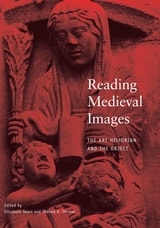
Reading Medieval Images
The Art Historian and the ObjectElizabeth Sears and Thelma K. Thomas, Editors
University of Michigan Press, 2002
What kind of language do they use to descibe what they see? How do they construct arguments using visual evidence? What sorts of arguments do they make? In this unusual anthology, eighteen prominent art historians specializing in the medieval field (European, Byzantine, and Islamic) provide answers to these fundamental questions, not directly but by way of example. Each author, responding to invitation, has chosen for study a single image or object and has submitted it to sustained analysis. The collection of essays, accompanied by statements on methodology by the editors, offers an accessible introduction to current art-historical practice.
Thelma K. Thomas is Associate Professor of the History of Art and Associate Curator of the Kelsey Museum, University of Michigan.
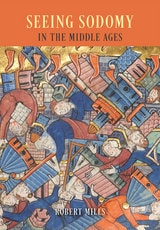
Seeing Sodomy in the Middle Ages
Robert Mills
University of Chicago Press, 2015
In Seeing Sodomy in the Middle Ages, Robert Mills explores the relationship between sodomy and motifs of vision and visibility in medieval culture, on the one hand, and those categories we today call gender and sexuality, on the other. Challenging the view that ideas about sexual and gender dissidence were too confused to congeal into a coherent form in the Middle Ages, Mills demonstrates that sodomy had a rich, multimedia presence in the period—and that a flexible approach to questions of terminology sheds new light on the many forms this presence took. Among the topics that Mills covers are depictions of the practices of sodomites in illuminated Bibles; motifs of gender transformation and sex change as envisioned by medieval artists and commentators on Ovid; sexual relations in religious houses and other enclosed spaces; and the applicability of modern categories such as “transgender,” “butch” and “femme,” or “sexual orientation” to medieval culture.
Taking in a multitude of images, texts, and methodologies, this book will be of interest to all scholars, regardless of discipline, who engage with gender and sexuality in their work.
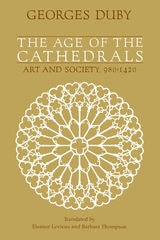
The Age of the Cathedrals
Art and Society, 980-1420Georges Duby
University of Chicago Press, 1981
"If Age of the Cathedrals has a fault, it is that Professor Duby knows too much, has too many new ideas and takes such a delight in setting them out. . . insights whiz to and fro like meteorites."—John Russell, New York Times Book Review

The Brummer Collection of Medieval Art
Duke University Museum of ArtCaroline Bruzelius and with Jill Meredith
Duke University Press, 1991
Five studies by leading art scholars focus on key works in the collection and contribute to a new understanding of the origins of many of the pieces. Two introductory essays comment on the character of the collection as a whole, its acquisition by Duke University, and its conservation. Finally, the catalog section discusses the more important pieces in the collection and is followed by a checklist of entries and smaller photographs of all other objects.
Contributors. Ilene H. Forsyth, Jean M. French, Dorothy F. Glass, Dieter Kimpel, Jill Meredith, Linda S. Roundhill
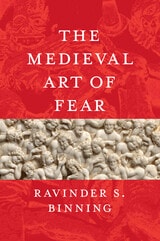
The Medieval Art of Fear
Ravinder S. Binning
University of Chicago Press, 2026
In the medieval world, experiences of fear attained a mystical significance: monks, urban publics, and even emperors pursued horror and grief to explore the limits of fantasy, sensation, and catharsis. In this book, Ravinder S. Binning examines an expansive archive ranging from poetry and scientific treatises to artistic works in ivory and crystal to recover an aesthetic tradition centered on optical tension, spatial suspense, and tactile experience.
Moving between early monastic spaces in Egypt and major urban centers like Constantinople from the fourth through the thirteenth centuries, The Medieval Art of Fear shows how the psychosomatic experience of fear became the deliberate object of mystical practices, meditation, and other embodied techniques across the medieval world. The result is a powerful exploration of the aesthetic effects behind some of the medieval world’s most ambitious works, whose influence extends well beyond the Middle Ages.
The Public in the Picture
Involving the Beholder in Antique, Islamic, Byzantine, Western Medieval and Renaissance ArtEdited by Beate Fricke and Urte Krass
Diaphanes, 2015
With The Public in the Picture, contributors describe this shift, with each essay focusing on a specific group of works created at a different moment in history. Together, the contributions explore the political, religious, and social contexts of the publics depicted and relate this shift to the rise of perspectival representation. Contributors to The Public in the Picture include Andrew Griebler, Annette Haug, Henrike Haug, Christiane Hille, Christopher Lakey, Andrea Lermer, Cornelia Logemann, Anja Rathmann-Lutz, Alberto Saviello, and Daniela Wagner.

The Thief, the Cross, and the Wheel
Pain and the Spectacle of Punishment in Medieval and Renaissance EuropeMitchell B. Merback
University of Chicago Press, 1999
Merback compares the images of Christ's Crucifixion with those of the two thieves who met their fate beside Jesus. In paintings by well-known Northern European masters and provincial painters alike, Merback finds the two thieves subjected to incredible cruelty, cruelty that artists could not depict in their scenes of Christ's Crucifixion because of theological requirements. Through these representations Merback explores the ways audiences in early modern Europe understood images of physical suffering and execution. The frequently shocking works also provide a perspective from which Merback examines the live spectacle of public torture and execution and how audiences were encouraged by the Church and the State to react to the experience. Throughout, Merback traces the intricate and extraordinary connections among religious art, devotional practice, bodily pain, punishment, and judicial spectatorship.
Keenly aware of the difficulties involved in discussing images of atrocious violence but determined to make them historically comprehensible, Merback has written an informed and provocative study that reveals the rituals of medieval criminal justice and the visual experiences they engendered.