Results by title
99 books match the query 'Art, Modern' and 18 start with a
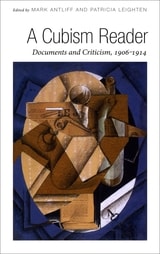
A Cubism Reader
Documents and Criticism, 1906-1914Mark Antliff and Patricia Leighten
University of Chicago Press, 2008
This definitive anthology covers the historical genesis of cubism from 1906 to 1914, with documents that range from manifestos and poetry to exhibition prefaces and reviews to articles that address the cultural, political, and philosophical issues related to the movement. Most of the texts Mark Antliff and Patricia Leighten have selected are from French sources, but their inclusion of carefully culled German, English, Czech, Italian, and Spanish documents speaks to the international reach of cubist art and ideas. Equally wide-ranging are the writers represented—a group that includes Guillaume Apollinaire, Gertrude Stein, Jean Metzinger, Albert Gleizes, Fernand Léger, Francis Picabia, André Salmon, Raymond Duchamp-Villon, Henri Le Fauconnier, and many others.
These diverse selections—unabridged and freshly translated—represent a departure from the traditional view of cubism as shaped almost exclusively by Picasso and Braque. Augmented by Antliff and Leighten’s insightful commentary on each entry, as well as many of the articles’ original illustrations, A Cubism Reader ultimately broadens the established history of the movement by examining its monumental contributions from a variety of contemporary perspectives.
A Mythology of Forms
Selected Writings on ArtCarl Einstein
University of Chicago Press, 2019
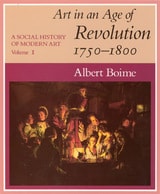
A Social History of Modern Art, Volume 1
Art in an Age of Revolution, 1750-1800Albert Boime
University of Chicago Press, 1990
This inaugural volume explores the artistic repercussions of the major political and economic events of the latter half of the eighteenth century: the Seven Years' War, the French Revolution, and the English industrial revolution. Boime examines the prerevolutionary popularity of the rococo style and the emergence of the cult of antiquity that followed the Seven Years' War. He shows how the continual experiments of Jacques-Louis David and others with neoclassical symbols and themes in the latter part of the century actively contributed to the transformation of French and English politics. Boime's analyses reveal the complex relationship of art with a wide range of contemporary attitudes and conditions—technological innovation, social and political tensions, commercial expansion, and the growth of capitalism.
"Provocative and endlessly revealing."—Christopher Knight, Los Angeles Herald Examiner
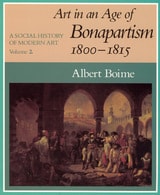
A Social History of Modern Art, Volume 2
Art in an Age of Bonapartism, 1800-1815Albert Boime
University of Chicago Press, 1990
Heavily illustrated, this volume is an invaluable social history of modern art during the Napoleonic era.
Stimulating and informative, this volume will become a valuable resource for faculty and undergraduates.—R. W. Liscombe, Choice

A Visitable Past
Views of Venice by American Artists, 1860-1915Margaretta M. Lovell
University of Chicago Press, 1988

Abstract Expressionism
The International ContextMarter, Joan
Rutgers University Press, 2007
Bringing together fifteen original and path-breaking essays by world-class authorities on Abstract Expressionism as well as by younger scholars, this anthology looks beyond the canonical painters to explore the broader connections among abstract artists of the post–World War II era. Moving from the margins to the center, the essays recognize the contributions of artists working far beyond New York City. Topics include Jackson Pollock’s contact with Mexican muralists and the legacy of Abstract Expressionism for leftist artists in Latin America, the relevance of Jean-Paul Sartre and Samuel Beckett as sources of philosophical thought, the significance of northern European CoBrA painters such as Asger Jorn, the impact of Japanese Gutai artists, and connections with the revolutionary art of Italy, Belgium, and France. Abstract Expressionism is also described as a model for contemporaneous developments in the former Soviet Union.
As the first book to consider the movement in relation to post–World War II abstraction on four continents, this book brings a fresh perspective to this widely studied school of painting. Scholars and students alike will find this anthology essential reading in creating a more complete and nuanced understanding of Abstract Expressionism.
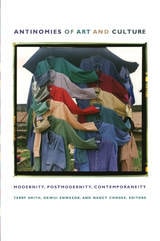
Antinomies of Art and Culture
Modernity, Postmodernity, ContemporaneityTerry Smith, Okwui Enwezor, and Nancy Condee, eds.
Duke University Press, 2008
In the volume’s introduction the theorist Terry Smith argues that predictions that postmodernity would emerge as a global successor to modernity have not materialized as anticipated. Smith suggests that the various situations of decolonized Africa, post-Soviet Europe, contemporary China, the conflicted Middle East, and an uncertain United States might be better characterized in terms of their “contemporaneity,” a concept which captures the frictions of the present while denying the inevitability of all currently competing universalisms. Essays range from Antonio Negri’s analysis of contemporaneity in light of the concept of multitude to Okwui Enwezor’s argument that the entire world is now in a postcolonial constellation, and from Rosalind Krauss’s defense of artistic modernism to Jonathan Hay’s characterization of contemporary developments in terms of doubled and even para-modernities. The volume’s centerpiece is a sequence of photographs from Zoe Leonard’s Analogue project. Depicting used clothing, both as it is bundled for shipment in Brooklyn and as it is displayed for sale on the streets of Uganda, the sequence is part of a striking visual record of new cultural forms and economies emerging as others are left behind.
Contributors: Monica Amor, Nancy Condee, Okwui Enwezor, Boris Groys, Jonathan Hay, Wu Hung, Geeta Kapur, Rosalind Krauss, Bruno Latour, Zoe Leonard, Lev Manovich, James Meyer, Gao Minglu, Helen Molesworth, Antonio Negri, Sylvester Okwunodu Ogbechie, Nikos Papastergiadis, Colin Richards, Suely Rolnik, Terry Smith, McKenzie Wark
Art History after Modernism
Hans Belting
University of Chicago Press, 2003
So begins Hans Belting's brilliant, iconoclastic reconsideration of art and art history at the end of the millennium, which builds upon his earlier and highly successful volume, The End of the History of Art?. "Known for his striking and original theories about the nature of art," according to the Economist, Belting here examines how art is made, viewed, and interpreted today. Arguing that contemporary art has burst out of the frame that art history had built for it, Belting calls for an entirely new approach to thinking and writing about art. He moves effortlessly between contemporary issues—the rise of global and minority art and its consequences for Western art history, installation and video art, and the troubled institution of the art museum—and questions central to art history's definition of itself, such as the distinction between high and low culture, art criticism versus art history, and the invention of modernism in art history. Forty-eight black and white images illustrate the text, perfectly reflecting the state of contemporary art.
With Art History after Modernism, Belting retains his place as one of the most original thinkers working in the visual arts today.
Art and Contemporaneity
Edited by Frank Ruda and Jan Voelker
Diaphanes, 2015
Art and Contemporaneity features contributions from leading scholars, including Alain Badiou and Alexander García Düttmann, who bring theories of aesthetic philosophy to bear on one of the most crucial questions about contemporary art: how do works of art come to exist within and in relation to time? A specific temporality of an artwork emerges from the material and political conditions of its production. But works of art also forge new relationships to time in their reception, which are continually superimposed upon layers of history. With a broad range of perspectives, Art and Contemporaneity offers a sustained reflection on the relationship between art and time, and it will appeal to those interested in both the theory and practice of contemporary art.
Art and Objecthood
Essays and ReviewsMichael Fried
University of Chicago Press, 1998
Ranging from brief reviews to extended essays, and including major critiques of Jackson Pollock, Morris Louis, Kenneth Noland, Jules Olitski, Frank Stella, and Anthony Caro, these writings establish a set of basic terms for understanding key issues in high modernism: the viability of Clement Greenberg’s account of the infralogic of modernism, the status of figuration after Pollock, the centrality of the problem of shape, the nature of pictorial and sculptural abstraction, and the relationship between work and beholder. In a number of essays Fried contrasts the modernist enterprise with minimalist or literalist art, and, taking a position that remains provocative to this day, he argues that minimalism is essentially a genre of theater, hence artistically self-defeating.
For this volume Fried has also provided an extensive introductory essay in which he discusses how he became an art critic, clarifies his intentions in his art criticism, and draws crucial distinctions between his art criticism and the art history he went on to write. The result is a book that is simply indispensable for anyone concerned with modernist painting and sculpture and the task of art criticism in our time.
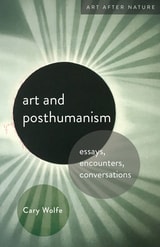
Art and Posthumanism
Essays, Encounters, ConversationsCary Wolfe
University of Minnesota Press, 2021
A sustained engagement between contemporary art and philosophy relating to our place in, and responsibility to, the nonhuman world
How do contemporary art and theory contemplate the problem of the “bio” of biopolitics and bioart? How do they understand the question of “life” that binds human and nonhuman worlds in their shared travail? In Art and Posthumanism, Cary Wolfe argues for the reconceptualization of nature in art and theory to turn the idea of the relationship between the human and the planet upside down.
Wolfe explores a wide range of contemporary artworks—from Sue Coe’s illustrations of animals in factory farms and Eduardo Kac’s bioart to the famous performance pieces of Joseph Bueys and the video installations of Eija-Liisa Ahtila, among others—examining how posthumanist theory can illuminate, and be illuminated by, artists’ engagement with the more-than-human world. Looking at biological and social systems, the question of the animal, and biopolitics, Art and Posthumanism explores how contemporary art rivets our attention on the empirically thick, emotionally charged questions of “life” and the “living” amid ecological catastrophe.
One of the foremost theorists of posthumanism, Wolfe pushes that philosophy out of the realm of the purely theoretical to show how a posthumanist engagement with particular works and their conceptual underpinnings help to develop more potent ethical and political commitments.
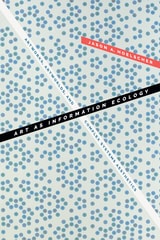
Art as Information Ecology
Artworks, Artworlds, and Complex Systems AestheticsJason Hoelscher
Duke University Press, 2021
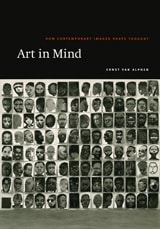
Art in Mind
How Contemporary Images Shape ThoughtErnst van Alphen
University of Chicago Press, 2005
Examining a broad range of works, van Alphen—a renowned art historian and cultural theorist—demonstrates how art serves a socially constructive function by actually experimenting with the parameters of thought. Employing work from artists as diverse as Picasso, Watteau, Francis Bacon, Marlene Dumas, and Matthew Barney, he shows how art confronts its viewers with the "pain points" of cultural experience-genocide, sexuality, diaspora, and transcultural identity-and thereby transforms the ways in which human existence is conceived. Van Alphen analyzes how art visually "thinks" about these difficult cultural issues, tapping into an understudied interpretation of art as the realm where ideas and values are actively created, given form, and mobilized. In this way, van Alphen's book is a work of art in itself as it educates us in a new mode of thought that will forge equally new approaches and responses to the world.
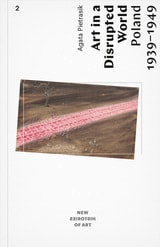
Art in a Disrupted World
Poland 1939–1949Agata Pietrasik
Museum of Modern Art in Warsaw, 2020
Employing an accessible, essayistic style, Pietrasik offers a new look at life in the ten years following the outbreak of World War II and features artists—including Marian Bogusz, Jadwiga Simon-Pietkiewicz, and Józef Szajna—whose work has not yet found substantial audiences in the English-speaking world. Her reading of the art and artists of this period strives to capture their autonomous artistic language and poses critical questions about the ability of traditional art history writing to properly accommodate artworks created in direct response to traumatic experiences.
Art to Come
Histories of Contemporary ArtTerry Smith
Duke University Press, 2019
Artificial Darkness
An Obscure History of Modern Art and MediaNoam M. Elcott
University of Chicago Press, 2016
In exploring how artificial darkness shaped modern art, film, and media, Noam M. Elcott addresses seminal and obscure works alongside their sites of production—such as photography darkrooms, film studios, and laboratories—and their sites of reception, including theaters, cinemas, and exhibitions. He argues that artists, scientists, and entertainers like Étienne-Jules Marey, Richard Wagner, Georges Méliès, and Oskar Schlemmer revolutionized not only images but also everything surrounding them: the screen, the darkness, and the experience of bodies and space. At the heart of the book is “the black screen,” a technology of darkness that spawned today’s blue and green screens and has undergirded numerous advanced art and film practices to this day.
Turning familiar art and film narratives on their heads, Artificial Darkness is a revolutionary treatment of an elusive, yet fundamental, aspect of art and media history.
Artists, Intellectuals, and World War II
The Pontigny Encounters at Mount Holyoke College, 1942-1944Christopher E. G. Benfey
University of Massachusetts Press, 2006
Sixty years ago, at the height of World War II, an extraordinary series of gatherings took place at Mount Holyoke College in western Massachusetts. During the summers of 1942–1944, leading European figures in the arts and sciences met at the college with their American counterparts for urgent conversations about the future of human civilization in a precarious world.
Two Sorbonne professors, the distinguished medievalist Gustave Cohen and the existentialist philosopher Jean Wahl, organized these “Pontigny” sessions, named after an abbey in Burgundy where similar symposia had been held in the decades before the war. Among the participants—many of whom were Jewish or had Jewish backgrounds—were the philosophers Hannah Arendt and Rachel Bespaloff, the poets Marianne Moore and Wallace Stevens, the anthropologist Claude Lévi-Strauss and the linguist Roman Jakobson, and the painters Marc Chagall and Robert Motherwell.
In this collection of original essays, Stanley Cavell and Jacques Derrida lead an international group of scholars—including Jed Perl, Mary Ann Caws, Jeffrey Mehlman, and Elisabeth Young-Bruehl—in assessing the lasting impact and contemporary significance of Pontigny-en- Amérique. Rachel Bespaloff, a tragic figure who wrote a major work on the Iliad, is restored to her rightful place beside Arendt and Simone Weil. Anyone interested in the “intellectual resistance” of Francophone intellectuals and artists, and the inspiring support from such American figures as Stevens and Moore, will want to read this pioneering work of scholarship and historical re-creation.
Autonomy
The Social Ontology of Art under CapitalismNicholas Brown
Duke University Press, 2019