Results by title
5 books match the query 'Art, Prehistoric'
Archaeologies of Modernity
Avant-Garde BildungRainer Rumold
Northwestern University Press, 2015
Archaeologies of Modernity explores the shift from the powerful tradition of literary forms of Bildung—the education of the individual as the self—to the visual forms of “Bildung” (from Bild) that characterize German modernism and the European avant-garde. Interrelated chapters examine the work of Franz Kafka, Jean/Hans Arp, Walter Benjamin, and Carl Einstein, and of artists such as Oskar Kokoschka or Kurt Schwitters, in the light of the surge of an autoformation (Bildung) of verbal and visual images at the core of expressionist and surrealist aesthetics and the art that followed. In this first scholarly focus on modernist avant-garde Bildung in its entwinement of conceptual modernity with forms of the archaic, Rumold resituates the significance of the poet and art theorist Einstein and his work on the language of primitivism and the visual imagination. Archaeologies of Modernity is a major reconsideration of the conception of the modernist project and will be of interest to scholars across the disciplines.
Primitive Art in Civilized Places
Second EditionSally Price
University of Chicago Press, 2002
"[Price] presents a literary collage of the Western attitude to other cultures, and in particular to the visual art of the Third and Fourth Worlds. . . . Her book is not about works of 'primitive art' as such, but about the Western construction 'Primitive Art.' It is a critique of Western ignorance and arrogance: ignorance about other cultures and arrogance towards them."—Jeremy Coote, Times Literary Supplement
"The book is infuriating, entertaining, and inspirational, leaving one feeling less able than before to pass judgment on 'known' genres of art, but feeling more confident for that."—Joel Smith, San Francisco Review of Books
"[A] witty, but scholarly, indictment of the whole primitive-art business, from cargo to curator. And because she employs sarcasm as well as pedagogy, Price's book will probably forever deprive the reader of the warm fuzzies he usually gets standing before the display cases at the local ethnographic museum."—Newsweek
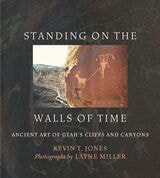
Standing on the Walls of Time
Ancient Art of Utah's Cliffs and CanyonsKevin T. Jones and Layne Miller
University of Utah Press, 2019
Miller’s photographs include many rare and relatively unknown panels and represent a lifetime of work by someone intimately familiar with the Colorado Plateau. The photos highlight the astonishing variety of rock art as well as the variability within traditions and time periods. Jones’s essays furnish general information about previous Colorado Plateau cultures and shine a light on rock art as art. The book emphasizes the exquisite artistry of these ancient works and their capacity to reach through the ages to envelop and inspire viewers.
The Nature of Paleolithic Art
R. Dale Guthrie
University of Chicago Press, 2005
With a natural historian's keen eye for observation, and as one who has spent a lifetime using bones and other excavated materials to piece together past human behavior and environments, Guthrie demonstrates that Paleolithic art is a mode of expression we can comprehend to a remarkable degree and that the perspective of natural history is integral to that comprehension. He employs a mix of ethology, evolutionary biology, and human universals to access these distant cultures and their art and artifacts. Guthrie uses innovative forensic techniques to reveal new information; estimating, for example, the ages and sexes of some of the artists, he establishes that Paleolithic art was not just the creation of male shamans.
With more than 3,000 images, The Nature of Paleolithic Art offers the most comprehensive representation of Paleolithic art ever published and a radical (and controversial) new way of interpreting it. The variety and content of these images—most of which have never been available or easily accessible to nonspecialists or even researchers—will astonish you. This wonderfully written work of natural history, of observation and evidence, tells the great story of our deepest past.
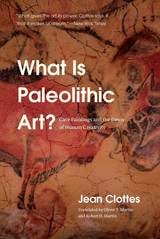
What Is Paleolithic Art?
Cave Paintings and the Dawn of Human CreativityJean Clottes
University of Chicago Press, 2016
In this book, Jean Clottes, one of the most renowned figures in the study of cave paintings, pursues an answer to this “why” of Paleolithic art. While other books focus on particular sites and surveys, Clottes’s work is a contemplative journey across the world, a personal reflection on how we have viewed these paintings in the past, what we learn from looking at them across geographies, and what these paintings may have meant—what function they may have served—for their artists. Steeped in Clottes’s shamanistic theories of cave painting, What Is Paleolithic Art? travels from well-known Ice Age sites like Chauvet, Altamira, and Lascaux to visits with contemporary aboriginal artists, evoking a continuum between the cave paintings of our prehistoric past and the living rock art of today. Clottes’s work lifts us from the darkness of our Paleolithic origins to reveal, by firelight, how we think, why we create, why we believe, and who we are.