Results by title
4 books match the query 'Art, Russian'
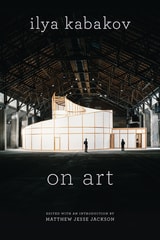
On Art
Ilya Kabakov
University of Chicago Press, 2018
Devoted to themes that range from the “cosmism” of pre-Revolutionary Russian modernism to the philosophical implications of Moscow’s garbage, Kabakov’s handmade booklets were typed out on paper, then stapled or sewn together using rough butcher paper for their covers. Among these writings are faux Socialist Realist verses, theoretical explorations, art historical analyses, accompaniments to installation projects, and transcripts of dialogues between the artist and literary theorists, critics, journalists, and other artists.
This volume offers for the first time in English the most significant texts written by Kabakov. The writings have been expressly selected for this English-language volume and there exists no equivalent work in any language.
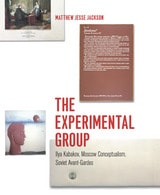
The Experimental Group
Ilya Kabakov, Moscow Conceptualism, Soviet Avant-GardesMatthew Jesse Jackson
University of Chicago Press, 2010
A compelling study of unofficial postwar Soviet art, The Experimental Group takes as its point of departure a subject of strange fascination: the life and work of renowned professional illustrator and conceptual artist Ilya Kabakov.
Kabakov’s art—iconoclastic installations, paintings, illustrations, and texts—delicately experiments with such issues as history, mortality, and disappearance, and here exemplifies a much larger narrative about the work of the artists who rose to prominence just as the Soviet Union began to disintegrate. By placing Kabakov and his conceptualist peers in line with our own contemporary perspective, Matthew Jesse Jackson suggests that the art that emerged in the wake of Stalin belongs neither entirely to its lost communist past nor to a future free from socialist nostalgia. Instead, these artists and their work produced a critical and controversial chapter in the as yet unwritten history of global contemporary art.
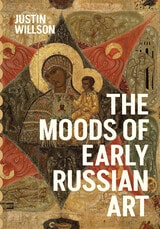
The Moods of Early Russian Art
Justin Willson
University of Chicago Press, 2026
The Moods of Early Russian Art describes an alternative early modernity at the easternmost border of the European cultural sphere, where the Renaissance marked a return not to secular humanism but to the religiosity and art of the Middle Ages. Charting a kind of “Renaissance in reverse,” art historian Justin Willson explores how the value placed on style and virtuosity faded in importance as the Church cultivated miracle-working images during the reigns of Ivan the Great and Ivan the Terrible. Arguing for a broader unity of interests among artistic workshops across the Muscovite landscape—a system of interconnected values that he explains using the language of “moods”—Willson examines icons, illuminated manuscripts, enamelwork, and murals, tracing how the interpretive framework of the age shifted from the “aesthetic” and “literal” moods to the “intoxicated” and “romantic” over the fifteenth and sixteenth centuries.
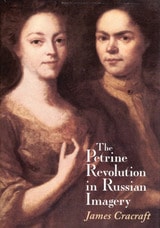
The Petrine Revolution in Russian Imagery
James Cracraft
University of Chicago Press, 1997
In this second volume of the series, Cracraft considers the impact of Peter's intensive program of Europeanization on the visual arts, and shows how modern forms of imagery came into being in Russia along with allied techniques of image-making.
Drawing on a wealth of primary sources as well as numerous secondary works in Russian and other languages, Cracraft discusses the advent in Russia of painting in the Renaissance tradition, bronze and stone sculpture, and the modern graphic arts. He also discusses the decline of manuscript illumination, the rise of modern coinage, the production of new-style flags and altar cloths, and the arrival in Russia of the new cartography and the new heraldry. Cracraft draws special attention to the early history of the St. Petersburg Academy of Fine Arts, and to the impact of Peter's program on popular imagery and on the cult art of the Russian Orthodox Church. He argues in sum that the imagery of the Russian Empire can tell us as much or more about its dominant ethos and ideology as can the written texts normally studied by historians.
Like its predecessor, The Petrine Revolution in Russian Architecture, this second volume presents a highly original argument supported by numerous illustrations, many of them not previously published. It will appeal to art historians as well as to those more generally interested in European or modern history.