Results by title
2 books match the query 'Art, Soviet'
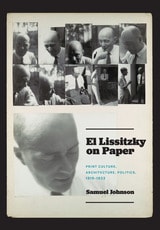
El Lissitzky on Paper
Print Culture, Architecture, Politics, 1919–1933Samuel Johnson
University of Chicago Press, 2024
An examination of the importance of paper in the work of Soviet artist, designer, and architect El Lissitzky.
Russian artist El Lissitzky’s work spans painting, photography, theatrical and exhibition design, architecture, graphic design, typography, and literature. He was active in the Jewish cultural renaissance, formed an artists’ collective with Kazimir Malevich, was a key figure in the dissemination of early Soviet art in Western Europe, and designed propaganda for the Stalin regime. With such a varied history and body of work, scholars have often struggled to identify the core principles that tied his diverse oeuvre together.
In El Lissitzky on Paper, Samuel Johnson argues that Lissitzky’s commitment to creating works on paper is a constant that unites his endeavors. Paper played a key role in the utopian projects that informed Lissitzky’s work, and the artist held a commitment to print as the premier medium of immediate public exchange. Johnson analyzes and contextualizes this idea against the USSR’s strict management of this essential resource and the growth of new media communications, including the telephone, telegraph, and film.
With this book, Johnson presents a significant contribution to scholarship on this major artist, revealing new connections between Lissitzky’s work in architecture and visual art and bringing to light sources from largely unstudied Russian archives.
[more]
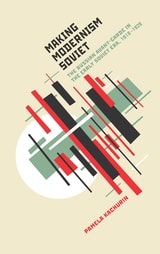
Making Modernism Soviet
The Russian Avant-Garde in the Early Soviet Era, 1918-1928Pamela Kachurin
Northwestern University Press, 2013
Making Modernism Soviet provides a new understanding of the ideological engagement of Russian modern artists such as Kazimir Malevich, Alexander Rodchenko, and Vera Ermolaeva with the political and social agenda of the Bolsheviks in the chaotic years immediately following the Russian Revolution. Focusing on the relationship between power brokers and cultural institutions under conditions of state patronage, Pamela Kachurin lays to rest the myth of the imposition of control from above upon a victimized artistic community. Drawing on extensive archival research, she shows that Russian modernists used their positions within the expanding Soviet arts bureaucracy to build up networks of like-minded colleagues. Their commitment to one another and to the task of creating a socially transformative visual language for the new Soviet context allowed them to produce some of their most famous works of art. But it also contributed to the "Sovietization" of the art world that eventually sealed their fate.
[more]