Results by title
6 books match the query 'Art appreciation'
AESTHETICS & EDUCATION
Michael J. Parsons and H. Gene Blocker
University of Illinois Press, 1993
What is the appropriate content of aesthetics for students of art at different age levels? How can it best be taught? How should it be combined with studio work and other art disciplines?
Michael J. Parsons and H. gene Blocker answer these and other questions in a volume designed to help art educators, potential educators, and curriculum developers integrate aesthetics into the study of art in the school curriculum. The two introduce some of the philosophical problems and questions in art, encouraging teachers and others to form a personal outlook on these issues.
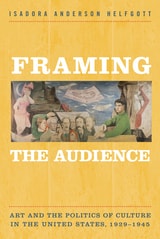
Framing the Audience
Art and the Politics of Culture in the United States, 1929-1945Isadora Helfgott
Temple University Press, 2015
Framing the Audience explores the cultural politics of the Great Depression and World War II through the prism of art appreciation. Isadora Helfgott interrogates the ideological and political motivations for breaking down barriers between fine art and popular culture. She charts the impact that changes in art appreciation had on the broader political, social, cultural, and artistic landscape.
Framing the Audience argues that efforts to expand the social basis of art became intertwined with—and helped shape—broader debates about national identity and the future of American political economy. Helfgott chronicles artists’ efforts toinfluence the conditions of artistic production and display. She highlights the influence of the Federal Art Project, the impact of the Museum of Modern Art as an institutional home for modernism in America and as an organizer of traveling exhibitions, and the efforts by LIFE and Fortune magazines to integrate art education into their visual record of modern life. In doing so, Helfgott makes critical observations about the changing relationship between art and the American public.
How Art Can Be Thought
A Handbook for ChangeAl-An deSouza
Duke University Press, 2018
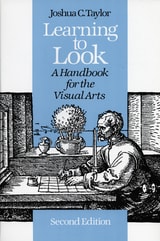
Learning to Look
A Handbook for the Visual ArtsJoshua C. Taylor
University of Chicago Press, 1981
This handy guide to the visual arts is designed to provide a comprehensive view of art, moving from the analytic study of specific works to a consideration of broad principles and technical matters. Forty-four carefully selected illustrations afford an excellent sampling of the wide range of experience awaiting the explorer.
The second edition of Learning to Look includes a new chapter on twentieth-century art. Taylor's thoughtful discussion of pure forms and our responses to them gives the reader a few useful starting points for looking at art that does not reproduce nature and for understanding the distance between contemporary figurative art and reality.
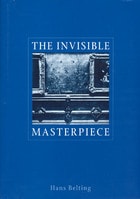
The Invisible Masterpiece
Hans Belting
University of Chicago Press, 2001
Belting explores and explains how twentieth-century artists, following Duchamp, struggled with their personal dreams of absolute art. It was not until the 1960s that artists, such as Warhol, finally began to reject the idea of the individual, totemic work of art and its permanent exhibition, as well as the related concept of the "masterpiece" and the outmoded art market that fed off it.
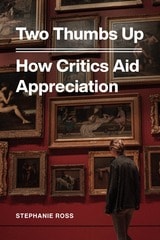
Two Thumbs Up
How Critics Aid AppreciationStephanie Ross
University of Chicago Press, 2020
In Two Thumbs Up, philosopher Stephanie Ross tackles these questions, revealing the ways that critics influence our decisions, and why that’s a good thing. Starting from David Hume’s conception of ideal critics, Ross refines his position and makes the case that review-based journalistic or consumer reporting criticism proves the best model for helping us find and appreciate quality. She addresses and critiques several other positions and, in the process, she demonstrates how aesthetic and philosophical concerns permeate our lives, choices, and culture. Ultimately, whether we’re searching for the right wine or the best concert, Ross encourages us all to find and follow critics whose taste we share.