Results by title
7 books match the query 'Artifice'
Artifact and Artifice
Classical Archaeology and the Ancient HistorianJonathan M. Hall
University of Chicago Press, 2013

Artifice and Illusion
The Art and Writing of Samuel van HoogstratenCeleste Brusati
University of Chicago Press, 1995
Analyzing van Hoogstraten's painting treatise, illusionistic pictures, ingenious perspective boxes, and witty trompe-l'oeil images, Brusati reveals the crucial role these endeavors played in the forging of van Hoogstraten's professional and social identity. Brusati looks at the historical circumstances of van Hoogstraten's career, which he fashioned from a convergence of Dutch cultural practices, family genealogy, and his considerable entrepreneurial acumen. She shows how Van Hoogstraten exploited the court patronage system to secure the worth of his work in the newer market culture of the Dutch Republic.
Brusati explores Van Hoogstraten's use of illusionistic artifice in his art and writing to shed new light on the much-disputed nature of Dutch "realism", and she discusses how a notion of "experimental artistry", which linked representational craft to the production of knowledge, informed Van Hoogstraten's many projects and framed the terms within which he and his colleagues understood artistic achievement during this period.
Artifice and Indeterminacy
An Anthology of New PoeticsChristopher Beach
University of Alabama Press, 2007
Artifice and Indeterminacy gathers the strongest and most representative writings of the past two decades and shows more clearly than ever before the depth and breadth of contemporary American poetics. Collectively, these essays break with conventional interpretive frameworks and traditional generic boundaries of poetry to give fresh voice to the poetics of our time.
Neither dismissive of the aesthetic value(s) of poetry, nor reluctant to articulate the ways in which aesthetic evaluation is complicated by the mediating influences of history, culture, class, gender, race, and academic status, the writers presented in this anthology celebrate the artifice of the poetic text while also accepting as a given the indeterminacy of its inception and reception.
Individual pieces range in style and approach from theoretical writings to discussions of individual poets such as Emily Dickinson, Louis Zukofsky, and Bob Kaufman. The authors consider such critical issues as gender and the possibilities of a feminist poetics, the textual politics of race and class, and the broader implications of an avant-garde practice.
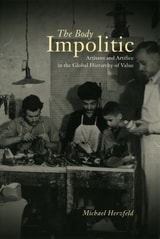
The Body Impolitic
Artisans and Artifice in the Global Hierarchy of ValueMichael Herzfeld
University of Chicago Press, 2003
Michael Herzfeld takes us inside a rich variety of small-town Cretan artisans' workshops to show how apprentices are systematically thwarted into learning by stealth and guile. This harsh training reinforces a stereotype of artisans as rude and uncultured. Moreover, the same stereotypes that marginalize artisans locally also operate to marginalize Cretans within the Greek nation and Greece itself within the international community. What Herzfeld identifies as "the global hierarchy of value" thus frames the nation's ancient monuments and traditional handicrafts as evidence of incurable "backwardness."
Herzfeld's sensitive observations offer an intimately grounded way of understanding the effects of globalization and of one of its most visible offshoots, the heritage industry, on the lives of ordinary people in many parts of the world today.
The Solaris Effect
Art and Artifice in Contemporary American FilmBy Steven Dillon
University of Texas Press, 2006
What do contemporary American movies and directors have to say about the relationship between nature and art? How do science fiction films like Steven Spielberg's A.I. and Darren Aronofsky's π represent the apparent oppositions between nature and culture, wild and tame?
Steven Dillon's intriguing new volume surveys American cinema from 1990 to 2002 with substantial descriptions of sixty films, emphasizing small-budget independent American film. Directors studied include Steven Soderbergh, Darren Aronofsky, Todd Haynes, Harmony Korine, and Gus Van Sant, as well as more canonical figures like Martin Scorcese, Robert Altman, David Lynch, and Steven Spielberg. The book takes its title and inspiration from Andrei Tarkovsky's 1972 film Solaris, a science fiction ghost story that relentlessly explores the relationship between the powers of nature and art. The author argues that American film has the best chance of aesthetic success when it acknowledges that a film is actually a film. The best American movies tell an endless ghost story, as they perform the agonizing nearness and distance of the cinematic image.
This groundbreaking commentary examines the rarely seen bridge between select American film directors and their typically more adventurous European counterparts. Filmmakers such as Lynch and Soderbergh are cross-cut together with Tarkovsky and the great French director, Jean-Luc Godard, in order to test the limits and possibilities of American film. Both enthusiastically cinephilic and fiercely critical, this book puts a decade of U.S. film in its global place, as part of an ongoing conversation on nature and art.
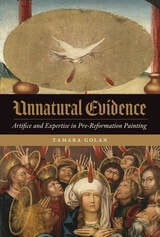
Unnatural Evidence
Artifice and Expertise in Pre-Reformation PaintingTamara Golan
University of Chicago Press, 2026
A novel account of the rise of pictorial naturalism on the eve of the Reformation.
In the summer of 1507, the town of Bern was abuzz with rumors about a sculpture at the Dominican church that had wept tears of blood. But astonishment soon gave way to doubt when a group of local artisans denounced the authenticity of the miracle, complaining that the tears were too poorly made to be the work of a skilled hand, let alone divine intervention. The resulting trial exposed an elaborate fraud staged by the church’s leaders and, with it, a tension that had been building across the region for nearly a century. In a world where claims of sanctity faced judicial scrutiny, the threshold between artistry and deception had become dangerously thin.
Tamara Golan examines how three generations of painters working in fifteenth- and sixteenth-century Switzerland navigated this fraught terrain. Golan traces how, amid intensifying skepticism over the authenticity of miracles and visions, these artists forged what she calls an “alternative naturalism,” a conspicuously unnatural mode of painting marked by distorted perspective, unusual modeling, and heavily tooled gold ground. Rather than striving for the faithful transcription of appearances, these artists drew on shared premises of artisanal expertise and juridical inquiry to advance bold claims about the capacity of their craft to represent not just the natural but the supernatural. The first study to identify this body of work as a coherent enterprise, Unnatural Evidence recovers an epistemological experiment at once ambitious and inherently unstable.
Winter of Artifice
Three NovelettesAnaïs Nin
Ohio University Press, 2016
Swallow Press first published Winter of Artifice in 1945, following two vastly different versions from other presses. The book opens with a film star, Stella, studying her own, but alien, image on the screen. It ends in the Manhattan office of a psychoanalyst—the Voice—who, as he counsels patients suffering from the maladies of modern life, reveals himself as equally susceptible to them. The middle, title story explores one of Nin’s most controversial themes, that of a woman’s sexual relationship with her father. Elliptical, fragmented prose; unconventional structure; surrealistic psychic landscapes—Nin forged these elements into a style that engaged with the artistic concerns of her time but still registers as strikingly contemporary.
This reissue, accompanied by a new introduction by Laura Frost and the original engravings by Nin’s husband Ian Hugo, presents an important opportunity to consider anew the work of an author who laid the groundwork for later writers. Swallow Press’s Winter of Artifice represents a literary artist coming into her own, with the formal experimentation, thematic daring, and psychological intrigue that became her hallmarks.