Results by title
6 books match the query 'Artistic collaboration'
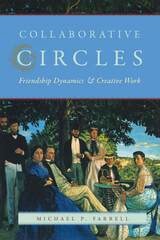
Collaborative Circles
Friendship Dynamics and Creative WorkMichael P. Farrell
University of Chicago Press, 2001
In a unique study that will become a rich source of ideas for professionals and anyone interested in fostering creative work in the arts and sciences, Michael P. Farrell looks at the group dynamics in six collaborative circles: the French Impressionists; Sigmund Freud and his friends; C. S. Lewis, J. R. R. Tolkien, and the Inklings; social reformers Elizabeth Cady Stanton and Susan B. Anthony; the Fugitive poets; and the writers Joseph Conrad and Ford Maddox Ford. He demonstrates how the unusual interactions in these collaborative circles drew out the creativity in each member. Farrell also presents vivid narrative accounts of the roles played by the members of each circle. He considers how working in such circles sustains the motivation of each member to do creative work; how collaborative circles shape the individual styles of the persons within them; how leadership roles and interpersonal relationships change as circles develop; and why some circles flourish while others flounder.
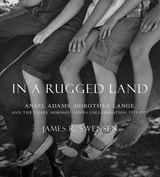
In a Rugged Land
Ansel Adams, Dorothea Lange, and the Three Mormon Towns Collaboration, 1953–1954James Swensen
University of Utah Press, 2018
In a Rugged Land examines the history and content of the two photographers’ forgotten collaboration Three Mormon Towns. Looking at Adams’s and Lange’s photographs, extant letters, and personal memories, the book provides a window into an important moment in their careers and seeks to understand why a project that once held such promise ended in disillusionment and is now little more than a footnote in their illustrative biographies. Swensen’s in-depth research and interpretation help make sense of what they did and place them alongside others who were also exploring the particular qualities of the Mormon village at that time.
Winner of the Joan Paterson Kerr Book Award for best illustrated book on the history of the American West from the Western History Association.
Winner of the Best Book Award from the Utah State Historical Society.
Winner of the 15 Bytes Book Award for Art Book.
Honorable mention for Best Book from the Mormon History Association.
Interview with Tom Williams at Access Utah

Kartoon Kings
The Graphic Work of Simon Grennan and Christopher SperandioPaul Krainak
West Virginia University Press, 2007
Kartoon Kings is the first monographic and comprehensive analysis of the graphic artwork of Simon Grennan and Christopher Sperandio. This work showcases a collection of full-color images excerpted from comic book projects, videos, billboards, and more of the artists’ collaborative public contributions created over the past fifteen years. To supplement the images an interview with the artists by Kristina Olson is included, along with essays by Joshua Decter and Paul Krainak. Grennan and Sperandio work together by conspiring about their creative ideas on the Internet. Their teamwork must be done this way because Grennan lives in England, while Sperandio lives in the United States.
More of Sperandio and Grennan’s work can be seen at www.kartoonkings.com.
Please RSVP
Questions on Collaborative Aesthetics, Trans-Subjectivity, and the Politics of LoveApril Durham
Dartmouth College Press, 2019
The One and the Many
Contemporary Collaborative Art in a Global ContextGrant H. Kester
Duke University Press, 2011
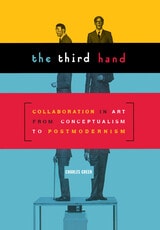
Third Hand
Collaboration in Art from Conceptualism to PostmodernismCharles Green
University of Minnesota Press, 2001
A major reevaluation of collaboration’s role in art since 1968.
The lone artist is a worn cliché of art history but one that still defines how we think about the production of art. Since the 1960s, however, a number of artists have challenged this image by embarking on long-term collaborations that dramatically altered the terms of artistic identity. In The Third Hand, Charles Green offers a sustained critical examination of collaboration in international contemporary art, tracing its origins from the evolution of conceptual art in the 1960s into such stylistic labels as Earth Art, Systems Art, Body Art, and Performance Art. During this critical period, artists around the world began testing the limits of what art could be, how it might be produced, and who the artist is. Collaboration emerged as a prime way to reframe these questions.
Green looks at three distinct types of collaboration: the highly bureaucratic identities created by Joseph Kosuth, Ian Burn, Mel Ramsden, and other members of Art & Language in the late 1960s; the close-knit relationships based on marriage or lifetime partnership as practiced by the Boyle Family, Anne and Patrick Poirier, Helen Mayer Harrison and Newton Harrison; and couples-like Christo and Jeanne-Claude, Gilbert & George, or Marina Abramovi´c and Ulay-who developed third identities, effacing the individual artists almost entirely. These collaborations, Green contends, resulted in new and, at times, extreme authorial models that continue to inform current thinking about artistic identity and to illuminate the origins of postmodern art, suggesting, in the process, a new genealogy for art in the twenty-first century.