Results by title

5 books match the query 'Arts, African'
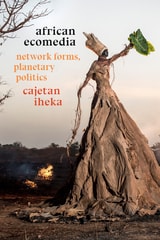
cover of African Ecomedia: Network Forms, Planetary Politics

African Ecomedia

Network Forms, Planetary Politics

Cajetan Iheka

Duke University Press, 2021
In African Ecomedia, Cajetan Iheka examines the ecological footprint of media in Africa alongside the representation of environmental issues in visual culture. Iheka shows how, through visual media such as film, photography, and sculpture, African artists deliver a unique perspective on the socioecological costs of media production, from mineral and oil extraction to the politics of animal conservation. Among other works, he examines Pieter Hugo's photography of electronic waste recycling in Ghana and Idrissou Mora-Kpai's documentary on the deleterious consequences of uranium mining in Niger. These works highlight not only the exploitation of African workers and the vast scope of environmental degradation but also the resourcefulness and creativity of African media makers. They point to the unsustainability of current practices while acknowledging our planet's finite natural resources. In foregrounding Africa's centrality to the production and disposal of media technology, Iheka shows the important place visual media has in raising awareness of and documenting ecological disaster even as it remains complicit in it.
[more]
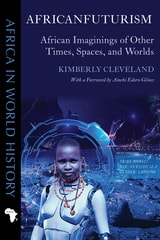
cover of Africanfuturism: African Imaginings of Other Times, Spaces, and Worlds

Africanfuturism

African Imaginings of Other Times, Spaces, and Worlds

Kimberly Cleveland

Ohio University Press, 2024
In the past few decades, Western studies of Afrofuturism have grown to encompass examples deriving from multiple sites across the diaspora, as well as from the African continent. However, an increasing number of Africans and Africanists have voiced their concerns about grouping African work under the larger umbrella of Afrofuturism without distinction and have emphasized the need to investigate the differences between African American and African production. This book offers an introduction to Africanfuturism—a body of African speculative works that is distinguishable from, albeit related to, US-based Afrofuturism. Kimberly Cleveland uses Africanfuturism as an intellectual lens to explore works that embody combinations of possibilities, challenges, and concerns related to what lies ahead for the continent and its peoples. This book highlights twenty-first-century film, video, painting, sculpture, photography, tapestry, novels, short stories, comic books, song lyrics, and architecture by African creatives of different nationalities, races, ethnicities, genders, and generations. Cleveland analyzes the ideas and opinions of African intellectuals and cultural producers, combining interviews with historical research. Each chapter features one of Africanfuturism’s most common themes: space and time exploration, creation of worlds, technology and the digital divide, Sankofa and remix, and mythmaking. This investigation of Africanfuturism is geared toward students, academics, and Afrofuturism enthusiasts, and its included discussion questions facilitate classroom use. The book illuminates Africa’s place in the worlds of science fiction and fantasy and how Africanfuturist work builds on the continent’s own traditions of speculative expression. Because these creative works disrupt the history of Western domination in Africa, Cleveland also connects Africanfuturism with the process of decolonization and addresses specific ways in which African creatives (re)center indigenous beliefs, strategies, and approaches in their production. Africanfuturism encourages both imaginative possibilities and potential real-world outcomes, highlighting the rich contributions of Africans to the vision of future worlds.
[more]
cover of Culture Game

Culture Game

Olu Oguibe

University of Minnesota Press, 2004

An acclaimed artist and cultural provocateur reveals the hidden biases of the contemporary art world

In self-congratulatory tones of tolerance and open-mindedness, the Western gatekeepers of the contemporary art world—gallery owners and museum curators, patrons and promoters—take great pains to demonstrate their inclusive vision of world culture. They highlight the Latin American show mounted “a few years ago” or the African works featured in a recent exhibition of non-Western artists. Non-Western artists soon discover that this veneer of liberalism masks an array of unwritten, unspoken, and unseemly codes and quotas dictating the acquisition and exhibition of their works and the success of their careers. In past decades, cultural institutions and the critical establishment in the West resisted difference; today, they are obsessed with exoticism. Both attitudes reflect firmly entrenched prejudices that prescribe the rules of what Nigerian-born artist, curator, and scholar Olu Oguibe terms the “culture game.”

In the celebrated, controversial essays gathered here, Oguibe exposes the disparities and inconsistencies of the reception and treatment afforded Western and non-Western artists; the obstacles that these contradictions create for non-Western and minority artists, especially those who live and practice in the Western metropolis; and the nature and peculiar concerns of contemporary non-Western art as it deals with the ramifications and residues of the colonial encounter as well as its own historical and cultural past. Ranging from the impact of the West’s appetite for difference on global cultural relations and the existence of a digital Third World to the African redefinition of modernity, Oguibe’s uncompromising and unapologetic criticism provides a uniquely global vision of contemporary art and culture.
[more]
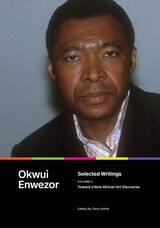
cover of Selected Writings, Volume 1: Toward a New African Art Discourse

Selected Writings, Volume 1

Toward a New African Art Discourse

Okwui Enwezor. Edited by Terry Smith.

Duke University Press, 2025
Okwui Enwezor is widely regarded as a leader among the brilliant curators who emerged in the 1990s to set agendas for understanding the global expansiveness of contemporary art. Among his pathfinding exhibitions were the second Johannesburg Biennale (1997), the paradigm-shifting Documenta11 (2002), Archive Fever (2008), and Postwar (2016). In addition to breaking ground as a curator, Enwezor was also a prolific critic, essayist, and theorist. Selected Writings—a landmark two-volume set—brings together Enwezor’s most influential and foundational works. Spanning a quarter-century, these selections reflect the depth and breadth of Enwezor’s writing and its role in his tireless efforts to decolonize the art world. Volume 1, Toward a New African Art Discourse, includes fifteen essays written between 1994 and 2006. Drawn from exhibition catalogs, art journals, interviews with artists, art reviews, curatorial statements, historical studies, and book chapters, these texts show him striving to fulfil the first main ambition that drove his career: to found and sustain what he called a “New African Art Discourse.” Demonstrating that his writing helped fulfill this goal, this collection reaffirms Enwezor’s status as a transformational figure in the global contemporary art world.
[more]
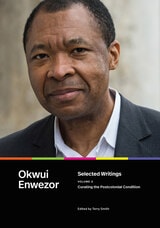
cover of Selected Writings, Volume 2: Curating the Postcolonial Condition, Volume 2

Selected Writings, Volume 2

Curating the Postcolonial Condition, Volume 2

Okwui Enwezor. Edited by Terry Smith.

Duke University Press, 2025

Okwui Enwezor is widely regarded as a leader among the brilliant curators who emerged in the 1990s to set agendas for understanding the global expansiveness of contemporary art. Among his pathfinding exhibitions were the second Johannesburg Biennale (1997), the paradigm-shifting Documenta 11 (2002), Archive Fever (2008), and Postwar (2016). In addition to breaking ground as a curator, Enwezor was also a prolific critic, essayist, and theorist. Selected Writings—a landmark two-volume set—brings together Enwezor’s most influential and foundational works. Spanning a quarter-century, these selections reflect the depth and breadth of Enwezor’s writing and its role in his tireless efforts to decolonize the art world. Volume 2, Curating the Postcolonial Condition, includes seventeen essays written between 2006 and 2019. Drawn from exhibition catalogs, art journals, interviews with artists, art reviews, curatorial statements, historical studies, and book chapters, these texts show him striving to fulfil the second main ambition that drove his career: enabling a critical, diasporic imagining of postcoloniality that would become pervasive within global art discourse. Demonstrating that his writing helped fulfill this goal, this collection reaffirms Enwezor’s status as a transformational figure in the global contemporary art world.
[more]