Results by title
3 books match the query 'Arts, Baroque'
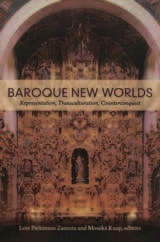
Baroque New Worlds
Representation, Transculturation, CounterconquestLois Parkinson Zamora and Monika Kaup, eds.
Duke University Press, 2010
Since Neobaroque reconstitutions necessarily reference the European Baroque, this volume begins with the reevaluation of the Baroque that evolved in Europe during the late nineteenth century and the early twentieth. Foundational essays by Friedrich Nietzsche, Heinrich Wölfflin, Walter Benjamin, Eugenio d’Ors, René Wellek, and Mario Praz recuperate and redefine the historical Baroque. Their essays lay the groundwork for the revisionist Latin American essays, many of which have not been translated into English until now. Authors including Alejo Carpentier, José Lezama Lima, Severo Sarduy, Édouard Glissant, Haroldo de Campos, and Carlos Fuentes understand the New World Baroque and Neobaroque as decolonizing strategies in Latin America and other postcolonial contexts. This collection moves between art history and literary criticism to provide a rich interdisciplinary discussion of the transcultural forms and functions of the Baroque.
Contributors. Dorothy Z. Baker, Walter Benjamin, Christine Buci-Glucksmann, José Pascual Buxó, Leo Cabranes-Grant, Haroldo de Campos, Alejo Carpentier, Irlemar Chiampi, William Childers, Gonzalo Celorio, Eugenio d’Ors, Jorge Ruedas de la Serna, Carlos Fuentes, Édouard Glissant, Roberto González Echevarría, Ángel Guido, Monika Kaup, José Lezama Lima, Friedrich Nietzsche, Mario Praz, Timothy J. Reiss, Alfonso Reyes, Severo Sarduy, Pedro Henríquez Ureña, Maarten van Delden, René Wellek, Christopher Winks, Heinrich Wölfflin, Lois Parkinson Zamora
Reflections on Baroque
Robert Harbison
University of Chicago Press, 2001
The Inordinate Eye
New World Baroque and Latin American FictionLois Parkinson Zamora
University of Chicago Press, 2006
The New World Baroque combines indigenous, African, and European forms of expression, and, in the early decades of the twentieth century, Latin American writers began to recuperate its visual structures to construct an alternative account of modernity, using its hybrid forms for the purpose of creating a discourse of “counterconquest”—a postcolonial self-definition aimed at disrupting entrenched power structures, perceptual categories, and literary forms.
Zamora engages this process, discussing a wide range of visual forms—Baroque façades and altarpieces, portraits of saints and martyrs (including the self-portraits of Frida Kahlo), murals from indigenous artisans to Diego Rivera—to elucidate works of fiction by Borges, Carpentier, Lezama Lima, Sarduy, Garro, García Márquez, and Galeano, and also to establish a critical perspective external to their work. Because visual media are “other” to the verbal economy of modern fiction, they serve these writers (and their readers) as oblique means by which to position their fiction culturally, politically, and aesthetically.
The first study of its kind in scope and ambition, The Inordinate Eye departs radically from most studies of literature by demonstrating how transcultural conceptions of the visual image have conditioned present ways of seeing and reading in Latin America.