Results by title
3 books match the query 'Arts, Caribbean'
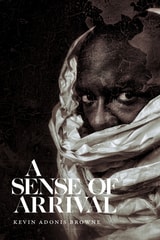
A Sense of Arrival
Kevin Adonis Browne
Duke University Press, 2024
In A Sense of Arrival, Kevin Adonis Browne blends literary, visual, and material forms to present a narrative of Caribbean blackness. Arguing that the story of Caribbeanness cannot be told through words alone, Browne interweaves essays, memoir, autotheory, and narrative verse with documentary photography, portraiture, Rorschach blots, and images of his own sculptures and art installations. Browne labels this multimodal approach and rhetorical form “Caribbean nonfiction,” and he uses it to conceptualize arrival as a theory of being. Arrival is practiced through forms of status, return, belonging, nomadism, self-exile, love, loss, presence, and haunting, each of which expresses the vast complexity and urgency of Caribbeanness. At the same time, arrival emphasizes and extends Caribbean ways of being, knowing, and doing. Throughout, Browne challenges readers to follow the archipelagic sensibilities of the Caribbean to look beyond black death and apprehend the inherent optimism and beauty of arrival. A singular meditation on the art and process of Caribbeanness, A Sense of Arrival is a statement on how the black Caribbean self comes to be.
[more]
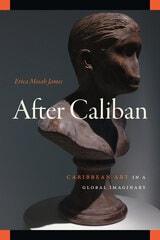
After Caliban
Caribbean Art in a Global ImaginaryErica Moiah James
Duke University Press, 2025
In After Caliban, Erica Moiah James examines the rise of global Caribbean artists in the 1990s and their production of a decolonized art history for the Caribbean. She draws on Aimé Césaire’s rewriting of Shakespeare’s The Tempest, in which Caliban becomes the sole author of his own story, dissolving his fixed position as colonized in relation to Prospero as colonizer. James shows how visual artists such as Marc Latamie, Janine Antoni, Belkis Ayón, Edouard Duval-Carrié, and Christopher Cozier followed Césaire’s model by employing a range of practices and methodologies that refused marginalization. Just as Césaire decolonized The Tempest, so too did these artists, who crafted a decolonial aesthetic that redefined their own cultural and historical narratives and positioned art as a key pathway toward a postcolonial future. By providing the foundation for a postcolonial, post-Caliban art world, these artists redefined the critical and popular notion of contemporary Caribbean art. At the same time, James argues, they fulfilled Césaire’s dream for a postcolonial Caribbean while creating a nonhegemonic art historical practice that exists beyond modern binaries and borders.
[more]
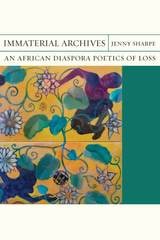
Immaterial Archives
An African Diaspora Poetics of LossJenny Sharpe
Northwestern University Press, 2020
In this innovative study, Jenny Sharpe moves beyond the idea of art and literature as an alternative archive to the historical records of slavery and its aftermath. Immaterial Archives explores instead the intangible phenomena of affects, spirits, and dreams that Caribbean artists and writers introduce into existing archives. Through the works of Frantz Zéphirin, Edouard Duval-Carrié, M. NourbeSe Philip, Erna Brodber, and Kamau Brathwaite, Immaterial Archives examines silences as black female spaces, Afro-Creole sacred worlds as diasporic cartographies, and the imaginative conjoining of spirits with industrial technologies as disruptions of enlightened modernity.
[more]