Results by title
2 books match the query 'Arts and morals'
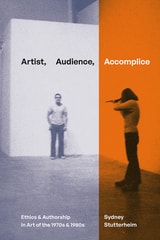
Artist, Audience, Accomplice
Ethics and Authorship in Art of the 1970s and 1980sSydney Stutterheim
Duke University Press, 2024
In Artist, Audience, Accomplice, Sydney Stutterheim introduces a new figure into the history of performance art and related practices of the 1970s and 1980s: the accomplice. Occupying roles including eyewitness, romantic partner, studio assistant, and documenter, this figure is situated between the conventional subject positions of the artist and the audience. The unseen and largely unacknowledged contributions of such accomplices exceed those performed by a typical audience because they share in the responsibility for producing artworks that entail potential ethical or legal transgressions. Stutterheim analyzes the art of Chris Burden, Hannah Wilke, Martin Kippenberger, and Lorraine O’Grady, showing how each cannily developed strategies of shared culpability that evoked questions about the accomplice’s various rights and roles. In this way, Stutterheim argues that the artist’s authority is not sovereign, total, or exclusive but, rather, fluid and relational. By examining the development of an alternative model of participatory art that relies on a network of accomplices, Stutterheim radically revises current understandings of artistic agency, aesthetic property, and acknowledged authorship.
[more]
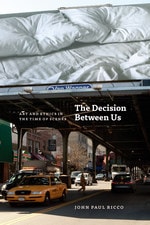
The Decision Between Us
Art and Ethics in the Time of ScenesJohn Paul Ricco
University of Chicago Press, 2014
The Decision Between Us combines an inventive reading of Jean-Luc Nancy with queer theoretical concerns to argue that while scenes of intimacy are spaces of sharing, they are also spaces of separation. John Paul Ricco shows that this tension informs our efforts to coexist ethically and politically, an experience of sharing and separation that informs any decision. Using this incongruous relation of intimate separation, Ricco goes on to propose that “decision” is as much an aesthetic as it is an ethical construct, and one that is always defined in terms of our relations to loss, absence, departure, and death.
Laying out this theory of “unbecoming community” in modern and contemporary art, literature, and philosophy, and calling our attention to such things as blank sheets of paper, images of unmade beds, and the spaces around bodies, The Decision Between Us opens in 1953, when Robert Rauschenberg famously erased a drawing by Willem de Kooning, and Roland Barthes published Writing Degree Zero, then moves to 1980 and the “neutral mourning” of Barthes’ Camera Lucida, and ends in the early 1990s with installations by Felix Gonzalez-Torres. Offering surprising new considerations of these and other seminal works of art and theory by Jean Genet, Marguerite Duras, and Catherine Breillat, The Decision Between Us is a highly original and unusually imaginative exploration of the spaces between us, arousing and evoking an infinite and profound sense of sharing in scenes of passionate, erotic pleasure as well as deep loss and mourning.
Laying out this theory of “unbecoming community” in modern and contemporary art, literature, and philosophy, and calling our attention to such things as blank sheets of paper, images of unmade beds, and the spaces around bodies, The Decision Between Us opens in 1953, when Robert Rauschenberg famously erased a drawing by Willem de Kooning, and Roland Barthes published Writing Degree Zero, then moves to 1980 and the “neutral mourning” of Barthes’ Camera Lucida, and ends in the early 1990s with installations by Felix Gonzalez-Torres. Offering surprising new considerations of these and other seminal works of art and theory by Jean Genet, Marguerite Duras, and Catherine Breillat, The Decision Between Us is a highly original and unusually imaginative exploration of the spaces between us, arousing and evoking an infinite and profound sense of sharing in scenes of passionate, erotic pleasure as well as deep loss and mourning.
[more]