82 books match the query 'Arts and society' and 10 start with a
cover of Aesthetics of the Commons

Aesthetics of the Commons

Edited by Cornelia Sollfrank, Felix Stalder, and Shusha Niederberger

Diaphanes, 2021

What do a feminist server, an art space located in a public park in North London, a so-called pirate library of high cultural value yet dubious legal status, and an art school that emphasizes collectivity have in common? They all demonstrate that art plays an important role in imagining and producing a real quite different from what is currently hegemonic, and that art has the possibility to not only envision or proclaim ideas in theory, but also to realize them materially.
 
Aesthetics of the Commons examines a series of artistic and cultural projects—drawn from what can loosely be called the (post)digital—that take up this challenge in different ways. What unites them, however, is that they all have a double character. They are art in the sense that they place themselves in relation to (Western) cultural and art systems, developing discursive and aesthetic positions, but, at the same time, they are operational in that they create recursive environments and freely available resources whose uses exceed these systems. The first aspect raises questions about the kind of aesthetics that are being embodied, the second creates a relation to the larger concept of the commons. In Aesthetics of the Commons, the commons are understood not as a fixed set of principles that need to be adhered to in order to fit a definition, but instead as a thinking tool—in other words, the book’s interest lies in what can be made visible by applying the framework of the commons as a heuristic device.
 
 
[more]
cover of African American Arts: Activism, Aesthetics, and Futurity

African American Arts

Activism, Aesthetics, and Futurity

weems, carrie mae

Bucknell University Press, 2020

Signaling such recent activist and aesthetic concepts in the work of Kara Walker, Childish Gambino, BLM, Janelle Monáe, and Kendrick Lamar, and marking the exit of the Obama Administration and the opening of the National Museum of African American History and Culture, this anthology explores the role of African American arts in shaping the future, and further informing new directions we might take in honoring and protecting the success of African Americans in the U.S. The essays in African American Arts: Activism, Aesthetics, and Futurity engage readers in critical conversations by activists, scholars, and artists reflecting on national and transnational legacies of African American activism as an element of artistic practice, particularly as they concern artistic expression and race relations, and the intersections of creative processes with economic, sociological, and psychological inequalities. Scholars from the fields of communication, theater, queer studies, media studies, performance studies, dance, visual arts, and fashion design, to name a few, collectively ask: What are the connections between African American arts, the work of social justice, and creative processes? If we conceive the arts as critical to the legacy of Black activism in the United States, how can we use that construct to inform our understanding of the complicated intersections of African American activism and aesthetics? How might we as scholars and creative thinkers further employ the arts to envision and shape a verdant society?

Contributors: Carrie Mae Weems, Carmen Gillespie, Rikki Byrd, Amber Lauren Johnson, Doria E. Charlson, Florencia V. Cornet, Daniel McNeil, Lucy Caplan, Genevieve Hyacinthe, Sammantha McCalla, Nettrice R. Gaskins, Abby Dobson, J. Michael Kinsey, Shondrika Moss-Bouldin, Julie B. Johnson, Sharrell D. Luckett, Jasmine Eileen Coles, Tawnya Pettiford-Wates, Rickerby Hinds.

Published by Bucknell University Press. Distributed worldwide by Rutgers University Press. 
[more]
cover of Ancient Muses: Archaeology and the Arts

Ancient Muses

Archaeology and the Arts

Edited by John H. Jameson Jr., John E. Ehrenhard, and Christine A. Finn

University of Alabama Press, 2003

Examines how information derived from archaeological investigations can be presented artistically to educate the general public
 
Known widely in Europe as “interpretive narrative archaeology,” the practice of using creative methods to interpret and present current knowledge of the past is gaining popularity in North America. This book is the first compilation of international case studies of the various artistic methods used in this new form of education—one that makes archaeology “come alive” for the nonprofessional. Plays, opera, visual art, stories, poetry, performance dance, music, sculpture, digital imagery—all can effectively communicate archaeological processes and cultural values to public audiences.

The contributors to this volume are a diverse group of archaeologists, educators, and artisans who have direct experience in schools, museums, and at archaeological sites. Citing specific examples, such as the film The English Patient, science fiction mysteries, and hypertext environments, they explain how creative imagination and the power of visual and audio media can personalize, contextualize, and demystify the research process. A 16-page color section illuminates their examples, and an accompanying CD includes relevant videos, music, web sites, and additional color images.
*
[more]
cover of Art and Social Movements: Cultural Politics in Mexico and Aztlán

Art and Social Movements

Cultural Politics in Mexico and Aztlán

Edward J. McCaughan

Duke University Press, 2012

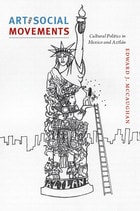
Art and Social Movements offers a comparative, cross-border analysis of the role of visual artists in three social movements from the late 1960s through the early 1990s: the 1968 student movement and related activist art collectives in Mexico City, a Zapotec indigenous struggle in Oaxaca, and the Chicano movement in California. Based on extensive archival research and interviews, Edward J. McCaughan explores how artists helped to shape the identities and visions of a generation of Mexican and Chicano activists by creating new visual discourses.

McCaughan argues that the social power of activist artists emanates from their ability to provoke people to see, think, and act in innovative ways. Artists, he claims, help to create visual languages and spaces through which activists can imagine and perform new collective identities and forms of meaningful citizenship. The artists' work that he discusses remains vital today—in movements demanding fuller democratic rights and social justice for working people, women, ethnic communities, immigrants, and sexual minorities throughout Mexico and the United States. Integrating insights from scholarship on the cultural politics of representation with structural analyses of specific historical contexts, McCaughan expands our understanding of social movements.
[more]
cover of Art as Sanctuary: Conjuring an Africana Aesthetic

Art as Sanctuary

Conjuring an Africana Aesthetic

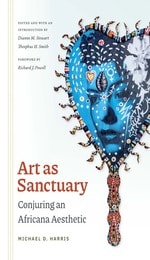
Michael D. Harris. Edited and with an introduction by Dianne M. Stewart and Theophus H. Smith. Foreword by Richard J. Powell.

Duke University Press, 2026
In Art as Sanctuary, Michael D. Harris considers literal and metaphorical uses of sanctuary in the black experience and African diaspora art, including locales of spiritual expression, self-renewal, and cultural celebration. Harris offers an alternative framework to the Duboisian philosophy of double consciousness, pushing the boundaries of Africana aesthetic analysis by exploring the cultural signifiers embedded consciously or unconsciously in African diaspora art. Within these works, he reveals how these cultural cues speak to the vibrancy of African American life. While acknowledging the presence of the white observer’s gaze, Harris wishes to relieve the black interior from the panoptic assumptions of that gaze and its disciplines. Art as Sanctuary provides innovative pathways to understand African American visual culture and music as autobiographies of cultural identity and experience.
[more]
cover of Art from Start to Finish: Jazz, Painting, Writing, and Other Improvisations

Art from Start to Finish

Jazz, Painting, Writing, and Other Improvisations

Edited by Howard S. Becker, Robert R. Faulkner, and Barbara Kirshenblatt-Gimblett

University of Chicago Press, 2006

When is an artistic work finished? When the copyeditor makes the final correction to a manuscript, when the composer writes the last note of a symphony, or when the painter puts the last brushstroke on the canvas? Perhaps it's even later, when someone reads the work, when an ensemble performs, or when the painting is hung on a gallery wall for viewing?

Art from Start to Finish gathers a unique group of contributors from the worlds of sociology, musicology, literature, and communications—many of them practicing artists in their own right—to discuss how artists from jazz musicians to painters work: how they coordinate their efforts, how they think, how they start, and, of course, how they finish their productions.

Specialists in the arts have much to say about the works themselves, which are often neglected by scholarsi n other fields. Art from Start to Finish takes a different tack by exploring the creative process itself and its social component. Any reader who makes art or has an interest in it will value this book.
[more]
cover of Art in the Lives of Immigrant Communities in the United States

Art in the Lives of Immigrant Communities in the United States

DiMaggio, Paul

Rutgers University Press, 2010
Art in the Lives of Immigrant Communities in the United States is the first book to provide a comprehensive and lively analysis of the contributions of artists from America's newest immigrant communities--Africa, the Middle East, China, India, Southeast Asia, Central America, and Mexico. Adding significantly to our understanding of both the arts and immigration, multidisciplinary scholars explore tensions that artists face in forging careers in a new world and navigating between their home communities and the larger society. They address the art forms that these modern settlers bring with them; show how poets, musicians, playwrights, and visual artists adapt traditional forms to new environments; and consider the ways in which the communities' young people integrate their own traditions and concerns into contemporary expression.
[more]
cover of Art, Culture, and Media Under the Third Reich

Art, Culture, and Media Under the Third Reich

Edited by Richard A. Etlin

University of Chicago Press, 2002

Art, Culture, and Media Under the Third Reich explores the ways in which the Nazis used art and media to portray their country as the champion of Kultur and civilization. Rather than focusing strictly on the role of the arts in state-supported propaganda, this volume contributes to Holocaust studies by revealing how multiple domains of cultural activity served to conceptually dehumanize Jews and other groups.

Contributors address nearly every facet of the arts and mass media under the Third Reich—efforts to define degenerate music and art; the promotion of race hatred through film and public assemblies; views of the racially ideal garden and landscape; race as portrayed in popular literature; the reception of art and culture abroad; the treatment of exiled artists; and issues of territory, conquest, and appeasement. Familiar subjects such as the Munich Accord, Nuremberg Party Rally Grounds, and Lebensraum (Living Space) are considered from a new perspective. Anyone studying the history of Nazi Germany or the role of the arts in nationalist projects will benefit from this book.

Contributors:
Ruth Ben-Ghiat
David Culbert
Albrecht Dümling
Richard A. Etlin
Karen A. Fiss
Keith Holz
Kathleen James-Chakraborty
Paul B. Jaskot
Karen Koehler
Mary-Elizabeth O'Brien
Jonathan Petropoulos
Robert Jan van Pelt
Joachim Wolschke-Bulmahn and Gert Gröning
[more]
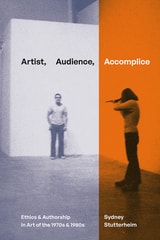
cover of Artist, Audience, Accomplice: Ethics and Authorship in Art of the 1970s and 1980s

Artist, Audience, Accomplice

Ethics and Authorship in Art of the 1970s and 1980s

Sydney Stutterheim

Duke University Press, 2024
In Artist, Audience, Accomplice, Sydney Stutterheim introduces a new figure into the history of performance art and related practices of the 1970s and 1980s: the accomplice. Occupying roles including eyewitness, romantic partner, studio assistant, and documenter, this figure is situated between the conventional subject positions of the artist and the audience. The unseen and largely unacknowledged contributions of such accomplices exceed those performed by a typical audience because they share in the responsibility for producing artworks that entail potential ethical or legal transgressions. Stutterheim analyzes the art of Chris Burden, Hannah Wilke, Martin Kippenberger, and Lorraine O’Grady, showing how each cannily developed strategies of shared culpability that evoked questions about the accomplice’s various rights and roles. In this way, Stutterheim argues that the artist’s authority is not sovereign, total, or exclusive but, rather, fluid and relational. By examining the development of an alternative model of participatory art that relies on a network of accomplices, Stutterheim radically revises current understandings of artistic agency, aesthetic property, and acknowledged authorship.
[more]
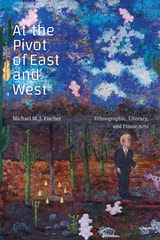
cover of At the Pivot of East and West: Ethnographic, Literary, and Filmic Arts

At the Pivot of East and West

Ethnographic, Literary, and Filmic Arts

Michael M. J. Fischer

Duke University Press, 2023

In At the Pivot of East and West, Michael M. J. Fischer examines documentary filmmaking and literature from Southeast Asia and Singapore for their para-ethnographic insights into politics, culture, and aesthetics. Women novelists—Lydia Kwa, Laksmi Pamuntjak, Sandi Tan, Jing Jing Lee, and Danielle Lim—renarrate Southeast Asian generational and political worlds as gendered psychodramas, while filmmakers Tan Pin Pin and Daniel Hui use film to probe into what can better be seen beyond textual worlds. Other writers like Daren Goh, Kevin Martens Wong, and Nuraliah Norasid reinvent the detective story for the age of artificial intelligence, use monsters to reimagine the Southeast Asian archipelago, and critique racism and the erasure of ethnic cultural histories. Continuing his project of applying anthropological thinking to the creative arts, Fischer exemplifies how art and fiction trace the ways in which taken-for-granted common sense changes over time, speak to the transnational present, and track signals of the future before they surface in public awareness.
[more]