Results by title
435 books match the query 'Asian American & Pacific Islander Studies' and 36 start with a
A Faith Of Our Own
Second-Generation Spirituality in Korean American ChurchesKim, Sharon
Rutgers University Press, 2010
A Faith of Our Own investigates the development and growth of these houses of worship, a recent and rapidly increasing phenomenon in major cities throughout the United States.
Immigration historians have depicted the second-generation as a transitional generation--on the steady march toward the inevitable decline of ethnic identity and allegiance. Sharon Kim suggests an alternative path. By harnessing religion and innovatively creating hybrid religious institutions, second-generation Korean Americans are assertively defining and shaping their own ethnic and religious futures. Rather than assimilating into mainstream American evangelical churches or inheriting the churches of their immigrant parents, second-generation pastors are creating their own hybrid third space--new autonomous churches that are shaped by multiple frames of reference.
Including data gathered over ten years at twenty-two churches, A Faith of Our Own is the most comprehensive study of this topic that addresses generational, identity, political, racial, and empowerment issues.
A Nation on the Line
Call Centers as Postcolonial Predicaments in the PhilippinesJan M. Padios
Duke University Press, 2018

A Part, Yet Apart
South Asians in Asian AmericaLavina Shankar
Temple University Press, 1998
This construction process parallels the gradual acceptance of the term "Asian American" by peoples primarily of East and Southeast Asian ancestry who found abundant reason to claim a shared identity in dealing with officialdom and an apparently intractable racism in this country. In time, "Asian American" has become a designation of collective pride for a wide range of peoples. In academic institutions and society generally, there are vexed questions about the term's inclusiveness and the dominance of established groups over more recent ones.
A Part, Yet Apart: South Asians in Asian America concerns itself with the extent to which South Asian American are and ought to be included within Asian America -- as that term is applied to academic programs and admission policies; grassroots community organizing and politics more broadly; and critical analyses of cultural products. Taken together these essays form a spirited dialogue on the dilemmas of identity politics, coalition building, and diasporics.
A Patchwork Shawl
Chronicles of South Asian Women in AmericaDas Dasgupta, Shamita
Rutgers University Press, 1998
A Patchwork Shawl sheds light on the lives of a segment of the U.S. immigrant population that has long been relegated to the margins. It focuses on women's lives that span different worlds: Bangladesh, India, Pakistan, and the United States. This collection of essays by and about South Asian women in America challenges stereotypes by allowing women to speak in their own words. Together they provide discerning insights into the reconstruction of immigrant patriarchy in a new world, and the development of women's resistance to that reconstruction. Shamita Das DasGupta's introduction also acquaints readers with the psychological topography of the South Asian community.
A Patchwork Shawl considers topics from re-negotiation of identity to sexuality, violence to intimacy, occupations to organizing within the community. The essays bear witness to women's negotiations for independent identities, their claim to their own bodies, and the right to choose relationships based on their own histories and truths. They bring new understanding to the intersection of gender, ethnicity, race, sexuality, and class.
A View from the Bottom
Asian American Masculinity and Sexual RepresentationNguyen Tan Hoang
Duke University Press, 2014
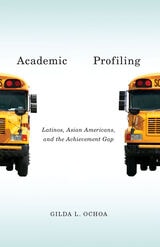
Academic Profiling
Latinos, Asian Americans, and the Achievement GapGilda L. Ochoa
University of Minnesota Press, 2013
Today the achievement gap is hotly debated among pundits, politicians, and educators. In particular this conversation often focuses on the two fastest-growing demographic groups in the United States: Asian Americans and Latinos. In Academic Profiling, Gilda L. Ochoa addresses this so-called gap by going directly to the source. At one California public high school where the controversy is lived every day, Ochoa turns to the students, teachers, and parents to learn about the very real disparities—in opportunity, status, treatment, and assumptions—that lead to more than just gaps in achievement.
In candid and at times heart-wrenching detail, the students tell stories of encouragement and neglect on their paths to graduation. Separated by unequal middle schools and curriculum tracking, they are divided by race, class, and gender. While those channeled into an International Baccalaureate Program boast about Socratic classes and stress-release sessions, students left out of such programs commonly describe uninspired teaching and inaccessible counseling. Students unequally labeled encounter differential policing and assumptions based on their abilities—disparities compounded by the growth in the private tutoring industry that favors the already economically privileged.
Despite the entrenched inequality in today’s schools, Academic Profiling finds hope in the many ways students and teachers are affirming identities, creating alternative spaces, and fostering critical consciousness. When Ochoa shares the results of her research with the high school, we see the new possibilities—and limits—of change.
Across The Pacific
Asian Americans and GlobalizationEvelyn Hu-Dehart, E
Temple University Press, 2000
Members of the Asian American community have always been trans-Pacific, but are now more than ever, since the 1965 change in U.S. immigration law. Entering the U.S. at the culmination of the Civil Rights movement, Asians becoming Asian Americans have joined a self-consciously multicultural society. Asian economies roared onto the world stage, creating new markets while circulating capital and labor at an unprecedented scale and intensity, thereby helping drive the forces of modern globalization. These essays by well-known scholars in the field of Asian American studies consider such topics as the impact of new migrations on Asian American subjectivity and politics, Asian American activism and U.S. foreign policy, and the role of Asian Americans in Pacific Rim economies.
Considering issues of diaspora, transmigrancy, assimilation, institutionalized racism, and community, Across the Pacific covers such cutting-edge subjects as the cultural expressions of dislocation among contemporary Asian American writers, as well as the impact of the new migrations on Asian American subjectivity and politics.
Adoption Fantasies
The Fetishization of Asian Adoptees from Girlhood to WomanhoodKimberly D. McKee
The Ohio State University Press, 2023
Advertising Diversity
Ad Agencies and the Creation of Asian American ConsumersShalini Shankar
Duke University Press, 2015
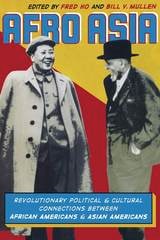
Afro Asia
Revolutionary Political and Cultural Connections between African Americans and Asian AmericansFred Ho and Bill V. Mullen, eds.
Duke University Press, 2008
Afro Asia opens with analyses of historical connections between people of African and of Asian descent. An account of nineteenth-century Chinese laborers who fought against slavery and colonialism in Cuba appears alongside an exploration of African Americans’ reactions to and experiences of the Korean “conflict.” Contributors examine the fertile period of Afro-Asian exchange that began around the time of the 1955 Bandung Conference, the first meeting of leaders from Asian and African nations in the postcolonial era. One assesses the relationship of two important 1960s Asian American activists to Malcolm X and the Black Panthers. Mao Ze Dong’s 1963 and 1968 statements in support of black liberation are juxtaposed with an overview of the influence of Maoism on African American leftists.
Turning to the arts, Ishmael Reed provides a brief account of how he met and helped several Asian American writers. A Vietnamese American spoken-word artist describes the impact of black hip-hop culture on working-class urban Asian American youth. Fred Ho interviews Bill Cole, an African American jazz musician who plays Asian double-reed instruments. This pioneering collection closes with an array of creative writing, including poetry, memoir, and a dialogue about identity and friendship that two writers, one Japanese American and the other African American, have performed around the United States.
Contributors: Betsy Esch, Diane C. Fujino, royal hartigan, Kim Hewitt, Cheryl Higashida, Fred Ho,
Everett Hoagland, Robin D. G. Kelley, Bill V. Mullen, David Mura, Ishle Park, Alexs Pate, Thien-bao Thuc Phi, Ishmael Reed, Kalamu Ya Salaam, Maya Almachar Santos, JoYin C. Shih, Ron Wheeler, Daniel Widener, Lisa Yun
Airborne Dreams
"Nisei" Stewardesses and Pan American World AirwaysChristine R. Yano
Duke University Press, 2011
Alien Capital
Asian Racialization and the Logic of Settler Colonial CapitalismIyko Day
Duke University Press, 2016
Alien Encounters
Popular Culture in Asian AmericaMimi Thi Nguyen and Thuy Linh Nguyen Tu, eds.
Duke University Press, 2007
This interdisciplinary collection brings together contributors working in Asian American studies, English, anthropology, sociology, and art history. They consider issues of cultural authenticity raised by Asian American participation in hip hop and jazz, the emergence of an orientalist “Indo-chic” in U.S. youth culture, and the circulation of Vietnamese music variety shows. They examine the relationship between Chinese restaurants and American culture, issues of sexuality and race brought to the fore in the video performance art of a Bruce Lee–channeling drag king, and immigrant television viewers’ dismayed reactions to a Chinese American chef who is “not Chinese enough.” The essays in Alien Encounters demonstrate the importance of scholarly engagement with popular culture. Taking popular culture seriously reveals how people imagine and express their affective relationships to history, identity, and belonging.
Contributors. Wendy Hui Kyong Chun, Kevin Fellezs, Vernadette Vicuña Gonzalez, Joan Kee, Nhi T. Lieu, Sunaina Maira, Martin F. Manalansan IV, Mimi Thi Nguyen, Robyn Magalit Rodriguez, Sukhdev Sandhu, Christopher A. Shinn, Indigo Som, Thuy Linh Nguyen Tu, Oliver Wang
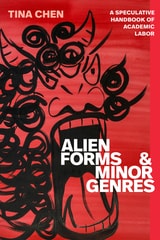
Alien Forms and Minor Genres
A Speculative Handbook of Academic LaborTina Chen
Duke University Press, 2026
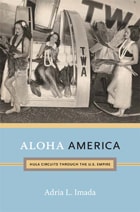
Aloha America
Hula Circuits through the U.S. EmpireAdria L. Imada
Duke University Press, 2012
At vaudeville theaters, international expositions, commercial nightclubs, and military bases, Hawaiian women acted as ambassadors of aloha, enabling Americans to imagine Hawai'i as feminine and benign, and the relation between colonizer and colonized as mutually desired. By the 1930s, Hawaiian culture, particularly its music and hula, had enormous promotional value. In the 1940s, thousands of U.S. soldiers and military personnel in Hawai'i were entertained by hula performances, many of which were filmed by military photographers. Yet, as Adria L. Imada shows, Hawaiians also used hula as a means of cultural survival and countercolonial political praxis. In Aloha America, Imada focuses on the years between the 1890s and the 1960s, examining little-known performances and films before turning to the present-day reappropriation of hula by the Hawaiian self-determination movement.
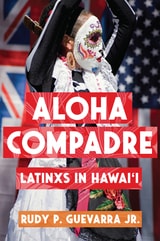
Aloha Compadre
Latinxs in Hawai'iRudy P. Guevarra
Rutgers University Press, 2023
Aloha Compadre: Latinxs in Hawaiʻi is the first book to examine the collective history and contemporary experiences of the Latinx population of Hawaiʻi. This study reveals that contrary to popular discourse, Latinx migration to Hawaiʻi is not a recent event. In the national memory of the United States, for example, the Latinx population of Hawaiʻi is often portrayed as recent arrivals and not as long-term historical communities with a presence that precedes the formation of statehood itself. Historically speaking, Latinxs have been voyaging to the Hawaiian Islands for over one hundred and ninety years. From the early 1830s to the present, they continue to help shape Hawaiʻi’s history, yet their contributions are often overlooked. Latinxs have been a part of the cultural landscape of Hawaiʻi prior to annexation, territorial status, and statehood in 1959. Aloha Compadre also explores the expanding boundaries of Latinx migration beyond the western hemisphere and into Oceania.
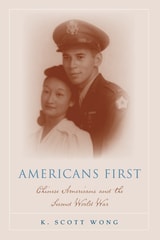
Americans First
Chinese Americans and the Second World WarK. Scott Wong
Temple University Press, 2008
In Americans First, K. Scott Wong uses archival research and oral histories to provide the first detailed account of Chinese Americans in the American military. Wong traces the history of the 14th Air Service Group, a segregated outfit of Chinese Americans sent to China in support of the American Army Air Corps and the Chinese Air Force. His ethnic history of inclusion shows how this new generation of Chinese Americans was more socially accepted, moving from the margins of society into the American mainstream during a time of pervasive racism.
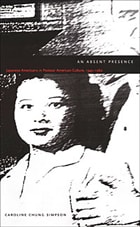
An Absent Presence
Japanese Americans in Postwar American Culture, 1945-1960Caroline Chung Simpson
Duke University Press, 2001
Simpson argues that when popular journals or social theorists engaged the topic of Japanese American history or identity in the Cold War era they did so in a manner that tended to efface or diminish the complexity of their political and historical experience. As a result, the shadowy figuration of Japanese American identity often took on the semblance of an “absent presence.” Individual chapters feature such topics as the case of the alleged Tokyo Rose, the Hiroshima Maidens Project, and Japanese war brides. Drawing on issues of race, gender, and nation, Simpson connects the internment episode to broader themes of postwar American culture, including the atomic bomb, McCarthyism, the crises of racial integration, and the anxiety over middle-class gender roles.
By recapturing and reexamining these vital flashpoints in the projection of Japanese American identity, Simpson fills a critical and historical void in a number of fields including Asian American studies, American studies, and Cold War history.
An Asian American Theology of Liberation
Tian An Wong
Lever Press, 2023
Providing an intersectional frame that considers the breadth and diversity of Asian American experiences alongside those of Black, Indigenous, and Latinx thinkers in the United States and across the globe, An Asian American Theology of Liberation puts Asian American theology in dialogue with theories from psychoanalysis, Afro-pessimism, Black Marxism, postcolonial studies, and queer theology. In this groundbreaking work, Wong Tian An combines archival research uncovering a much overlooked theology of liberation — born in the 1970s out of Asian Americans’ struggles for political recognition and civil rights in the United States — with powerful analyses drawing from the theological, intellectual, and political developments of the last half century.
This wide-ranging study connects urgent themes such as protest movements in Hong Kong, anti-Asian violence in the United States, and Indigenous struggles everywhere, while building on Asian theologies such as Dalit theology in India, theology of struggle in the Philippines, and Minjung theology in Korea. Drawing deeply and broadly across disciplines, the book altogether revives and renews an Asian American theology of liberation for a new generation.

Animacies
Biopolitics, Racial Mattering, and Queer AffectMel Y. Chen
Duke University Press, 2012
Chen's book is the first to bring the concept of animacy together with queer of color scholarship, critical animal studies, and disability theory. Through analyses of dehumanizing insults, the meanings of queerness, animal protagonists in recent Asian/American art and film, the lead in toys panic in 2007, and the social lives of environmental illness, Animacies illuminates a hierarchical politics infused by race, sexuality, and ability. In this groundbreaking book, Chen rethinks the criteria governing agency and receptivity, health and toxicity, productivity and stillness—and demonstrates how attention to the affective charge of matter challenges commonsense orderings of the world.
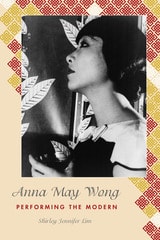
Anna May Wong
Performing the ModernShirley Jennifer Lim
Temple University Press, 2019
Finalist for the 2020 Organization of American Historians Mary Nickliss Prize
Pioneering Chinese American actress Anna May Wong made more than sixty films, headlined theater and vaudeville productions, and even starred in her own television show. Her work helped shape racial modernity as she embodied the dominant image of Chinese and, more generally, “Oriental” women between 1925 and 1940.
In Anna May Wong, Shirley Jennifer Lim re-evaluates Wong’s life and work as a consummate artist by mining an historical archive of her efforts outside of Hollywood cinema. From her pan-European films and her self-made My China Film to her encounters with artists such as Josephine Baker, Carl Van Vechten, and Walter Benjamin, Lim scrutinizes Wong’s cultural production and self-fashioning. Byconsidering the salient moments of Wong’s career and cultural output, Lim’s analysis explores the deeper meanings, and positions the actress as an historical and cultural entrepreneur who rewrote categories of representation.
Anna May Wong provides a new understanding of the actress’s career as an ingenious creative artist.
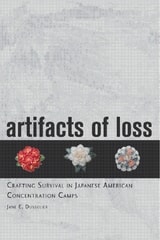
Artifacts of Loss
Crafting Survival in Japanese American Concentration CampsDusselier, Jane E
Rutgers University Press, 2008
In Artifacts of Loss, Jane E. Dusselier looks at the lives of these internees through the lens of their art. These camp-made creations included flowers made with tissue paper and shells, wood carvings of pets left behind, furniture made from discarded apple crates, gardens grown next to their housingùanything to help alleviate the visual deprivation and isolation caused by their circumstances. Their crafts were also central in sustaining, re-forming, and inspiring new relationships. Creating, exhibiting, consuming, living with, and thinking about art became embedded in the everyday patterns of camp life and helped provide internees with sustenance for mental, emotional, and psychic survival.
Dusselier urges her readers to consider these often overlooked folk crafts as meaningful political statements which are significant as material forms of protest and as representations of loss. She concludes briefly with a discussion of other displaced people around the globe today and the ways in which personal and group identity is reflected in similar creative ways.
Asian America
Forming New Communities, Expanding BoundariesLing, Huping
Rutgers University Press, 2009
Asian America is the first comprehensive look at post-1960s Asian American communities in the United States and Canada. From Chinese Americans in Chicagoland to Vietnamese Americans in Orange County, this multi-disciplinary collection spans a wide comparative and panoramic scope. Contributors from an array of academic fields focus on global views of Asian American communities as well as on territorial and cultural boundaries.
Presenting groundbreaking perspectives, Asian America revises worn assumptions and examines current challenges Asian American communities face in the twenty-first century.
Asian American Connective Action in the Age of Social Media
Civic Engagement, Contested Issues, and Emerging IdentitiesJames S. Lai
Temple University Press, 2022
Social media provides ethno-racial immigrant groups—especially those who cannot vote due to factors such as lack of citizenship and limited English proficiency—the ability to mobilize and connect around collective issues. Online spaces and discussion forums have encouraged many Asian Americans to participate in public policy debates and take action on social justice issues. This form of digital group activism serves as an adaptive political empowerment strategy for the fastest-growing and largest foreign-born population in America. Asian American Connective Action in the Age of Social Media illuminates how associating online can facilitate and amplify traditional forms of political action.
James Lai provides diverse case studies on contentious topics ranging from affirmative action debates to textbook controversies to emphasize the complexities, limitations, and challenges of connective action that is relevant to all racial groups. Using a detailed multi-methods approach that includes national survey data and Twitter hashtag analysis, he shows how traditional immigrants, older participants, and younger generations create online consensus and mobilize offline to foment political change. In doing so, Lai provides a nuanced glimpse into the multiple ways connective action takes shape within the Asian American community.
Asian American History
Huping Ling
Rutgers University Press, 2023
Asian American History provides a comprehensive historical dive into Asian immigration to the United States, exploring it in international and domestic contexts and alongside the significant elements that define Asian America: imperialism and global capitalist expansion; labor and capital; race and ethnicity; immigration and exclusion; family and work; community and gender roles; assimilation and multiculturalism; panethnicity and identity; transnationalism and globalization; and new challenges and opportunities. Huping Ling traces the roots of Asian immigration from the late 1700s through intervening centuries of racial prejudice, wartime experiences, legal restrictions, and social mobility into the 2010s. It is an up-to-date and easily accessible resource for high school and college students as well as anyone who is interested in Asian American history.
Asian American Panethnicity
Bridging Institutions and IdentitiesYen Espiritu
Temple University Press, 1993
Yen Le Espiritu explores the construction of large-scale affiliations, in which previously unrelated groups submerge their differences and assume a common identity. Making use of extensive interviews and statistical data, she examines how Asian panethnicity protects the rights and interests of all Asian American groups, including those, like the Vietnamese and Cambodians, which are less powerful and prominent than the Chinese and Japanese. By citing specific examples—educational discrimination, legal redress, anti-Asian violence, the development of Asian American Studies programs, social services, and affirmative action—the author demonstrates how Asian Americans came to understand that only by cooperating with each other would they succeed in fighting the racism they all faced.
Asian American Political Participation
Emerging Constituents and Their Political IdentitiesJanelle S. Wong
Russell Sage Foundation, 2012
Asian American Studies Now
A Critical ReaderWu, Jean Yu-Wen Shen
Rutgers University Press, 2010
Jean Yu-wen Shen Wu and Thomas C. Chen have selected essays for the significance of their contribution to the field and their clarity, brevity, and accessibility to readers with little to no prior knowledge of Asian American studies. Featuring both reprints of seminal articles and groundbreaking texts, as well as bold new scholarship, Asian American Studies Now addresses the new circumstances, new communities, and new concerns that are reconstituting Asian America.

Asian American Studies
A ReaderEdited by Jean Yu-Wen Shen Wu and Min Song
Rutgers University Press, 2000
The reader is organized into two parts: "The Documented Past" and "Social Issues and Literature." Within these broad divisions, the subjects covered include Chinatown stories, nativist reactions, exclusionism, citizenship, immigration, community growth, Asia American ethnicities, racial discourse and the Civil Rights movement, transnationalism, gender, refugees, anti-Asian American violence, legal battles, class polarization, and many more.
Among the contributors are such noted scholars as Gary Okihiro, Michael Omi, Yen Le Espiritu, Lisa Lowe, and Ronald Takaki; writers such as Sui Sin Far, Bienvenido Santos, Sigrid Nunez, and R. Zamora Linmark, as well as younger, emerging scholars in the field.
Asian American X
An Intersection of Twenty-First Century Asian American VoicesArar Han and John Y. Hsu, Editors
University of Michigan Press, 2004
-Eric Liu, author of The Accidental Asian
"There's fury, dignity, and self-awareness in these essays. I found the voices to be energetic and the ideas exciting."
-Diana Son, playwright (Stop Kiss) and co-producer (Law & Order: Criminal Intent)
This refreshing and timely collection of coming-of-age essays, edited and written by young Asian Americans, powerfully captures the joys and struggles of their evolving identities as one of the fastest-growing groups in the nation and poignantly depicts the many oft-conflicting ties they feel to both American and Asian cultures. The essays also highlight the vast cultural diversity within the category of Asian American, yet ultimately reveal how these young people are truly American in their ideals and dreams.
Asian American X is more than a book on identity; it is required reading both for young Asian Americans who seek to understand themselves and their social group, and for all who are interested in keeping abreast of the changing American social terrain.
Asian Americans in Dixie
Race and Migration in the SouthEdited by Jigna Desai and Khyati Y. Joshi
University of Illinois Press, 2013
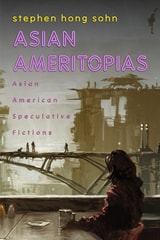
Asian Ameritopias
Asian American Speculative FictionsStephen Hong Sohn
Temple University Press, 2026
Asian American writers have long produced literary works of speculative fiction, the supergenre that employs science fictional, fantastical, or supernatural elements. Stephen Hong Sohn’s Asian Ameritopias is the first book-length study to consider how these aesthetically complex and wildly imaginative representations offer writers a way to explore themes of race and identity, as well as alternate futures and other planets.
Sohn examines how various novels and stories enable Asian American writers to engage with and reimagine issues of social justice, revisualize the bounds of social collectives, and create new pathways for precarious subjects. Asian Ameritopias assesses speculative fictions that spotlight supernatural horror and fantasy, such as ghosts and magical objects, to excavate racialized histories of oppression. Moving to science fiction, Sohn shows how Asian American cyborgs employ their technological powers to offer protection for socially marginalized groups, including sex workers, the undocumented, the poor, and the injured. He ends by analyzing three novels featuring extraterrestrials who look like Asian Americans in order to address issues of xenophobia and ostracization.
The speculative fictions Sohn unpacks in Asian Ameritopias provide a ripe opportunity to reflect on and confront our current, turbulent reality.
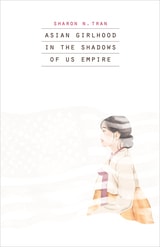
Asian Girlhood in the Shadows of US Empire
Sharon N. Tran
University of Minnesota Press, 2026
How the “Asian girl” is central to the story of US imperialism and the formation of Asian America
Representations of the “Asian girl” as lucky objects of humanitarian rescue and rehabilitation have been used to advance America’s imperial ambitions from World War II to the wars in Korean and Viet Nam. In this compelling work, Sharon N. Tran traces the production and instrumentalization of this figure through an examination of state documents, military newspapers, documentary photographs, and other archival materials. Theorizing “Asian girlhood” as a technology of imperial power, Tran exposes how the Asian girl is invoked as a shield that protects the innocence of US empire while she is excluded from innocence herself—relegated instead to a precarious position between child and adult, human and nonhuman, plaything and laborer.
Offering fresh insight into how imperial power operates, Tran analyzes figures such as the Japanese American school-girl in the context of World War II incarceration, the elusive “camptown girl,” and the objectified image of the “Napalm Girl.” Her innovative feminist approach interrogates the tendency to reclaim innocence for the Asian girl or to reframe her as an empowered woman. She engages the work of writers and artists such as Kiku Hughes, Nora Okja Keller, Aimee Phan, and lê thi diem thúy to demonstrate how Asian American literature offers rich theoretical interventions for critiquing the child–adult dichotomy that underpins key structures of imperial domination, illuminating more capacious conceptions of girlhood.
Restoring the dignity and agency of a figure too often denied both, Asian Girlhood in the Shadows of US Empire is a groundbreaking intersectional contribution to studies of gender, race, childhood, and state power.
Retail e-book files for this title are screen-reader friendly with images accompanied by short alt text and/or extended descriptions.
Asianfail
Narratives of Disenchantment and the Model MinorityEleanor Ty
University of Illinois Press, 2017
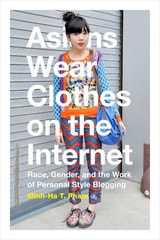
Asians Wear Clothes on the Internet
Race, Gender, and the Work of Personal Style BloggingMinh-ha T. Pham
Duke University Press, 2015
Assimilating Asians
Gendered Strategies of Authorship in Asian AmericaPatricia P. Chu
Duke University Press, 2000
Chu further demonstrates that Asian American male and female writers engage different strategies in the struggle to adapt, reflecting their particular, gender-based relationships to immigration, work, and cultural representation. While offering fresh perspectives on the well-known writings—both fiction and memoir—of Maxine Hong Kingston, Amy Tan, Bharati Mukherjee, Frank Chin, and David Mura, Assimilating Asians also provides new insight into the work of less recognized but nevertheless important writers like Carlos Bulosan, Edith Eaton, Younghill Kang, Milton Murayama, and John Okada. As she explores this expansive range of texts—published over the course of the last century by authors of Chinese, Japanese, Korean, Filipino, and Indian origin or descent—Chu is able to illuminate her argument by linking it to key historical and cultural events.
Assimilating Asians makes an important contribution to the fields of Asian American, American, and women’s studies. Scholars of Asian American literature and culture, as well as of ethnicity and assimilation, will find particular interest and value in this book.