Results by title

4 books match the query 'Asian American art'
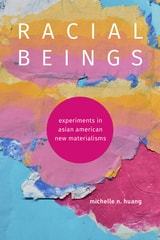
cover of Racial Beings: Experiments in Asian American New Materialisms

Racial Beings

Experiments in Asian American New Materialisms

Michelle N. Huang

Duke University Press, 2026
In Racial Beings, Michelle N. Huang brings a feminist new materialist lens to bear on contemporary Asian American literature’s innovative play with discourses of science and technology. She argues that emerging from these works is a “molecular aesthetics”—formal experimentation that diminishes the boundaries of the human—which challenge the perception of racial identity as a trait of an individual human. Instead, molecular aesthetics reveals how race permeates the matter of the world. Reading works by authors such as Ruth Ozeki, Larissa Lai, Mei-mei Berssenbrugge, and Julie Otsuka through the language of scientific discourses like quantum physics, genetic engineering, and elemental chemistry, Huang develops a synthetic reading practice which shows both that the nexus of race and science is not reducible to scientific racism and that science can provide an unlikely creative reservoir for Asian American writers and artists which allows us to imagine alternative ways of understanding racial being beyond the limits of the human individual.
[more]
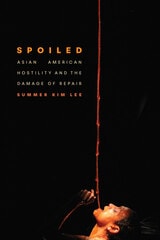
cover of Spoiled: Asian American Hostility and the Damage of Repair

Spoiled

Asian American Hostility and the Damage of Repair

Summer Kim Lee

Duke University Press, 2025
In Spoiled, Summer Kim Lee examines how contemporary Asian American artists challenge expectations that their work should repair the wounds of racial trauma. Kim Lee turns to the “spoiled”—the racialized, gendered body and all that it consumes, wrecks, and inflicts in its desire and excess—in visual culture, performance, music, and literature. Reading works by Cato Ouyang, Patty Chang, Wu Tsang, TJ Shin, Jes Fan, and others, Kim Lee highlights moments of hostility and deformation that spoil idealizations of Asian Americanness and incite modes of feeling and relating that relinquish fantasies of wholeness, power, and control. She observes the latent aggressive behaviors and negative affects in Asian American aesthetic practice: the embarrassment of asociality, the imposition of speaking as someone else, and the indulgence of ravenous appetites. In so doing, Kim Lee questions the political desires for repair expressed in “feeling Asian” and stays with the damage that spoilage creates as integral to the kinds of repair that Asian Americans seek.
[more]
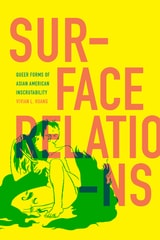
cover of Surface Relations: Queer Forms of Asian American Inscrutability

Surface Relations

Queer Forms of Asian American Inscrutability

Vivian L. Huang

Duke University Press, 2022
In Surface Relations Vivian L. Huang traces how Asian and Asian American artists have strategically reworked the pernicious stereotype of inscrutability as a dynamic antiracist, feminist, and queer form of resistance. Following inscrutability in literature, visual culture, and performance art since 1965, Huang articulates how Asian American artists take up the aesthetics of Asian inscrutability—such as invisibility, silence, unreliability, flatness, and withholding—to express Asian American life. Through analyses of diverse works by performance artists (Tehching Hsieh, Baseera Khan, Emma Sulkowicz, Tseng Kwong Chi), writers (Kim Fu, Kai Cheng Thom, Monique Truong), and video, multimedia, and conceptual artists (Laurel Nakadate, Yoko Ono, Mika Tajima), Huang challenges neoliberal narratives of assimilation that erase Asianness. By using sound, touch, and affect, these artists and writers create new frameworks for affirming Asianness as a source of political and social critique and innovative forms of life and creativity.
[more]
cover of Unsettled Visions: Contemporary Asian American Artists and the Social Imaginary

Unsettled Visions

Contemporary Asian American Artists and the Social Imaginary

Margo Machida

Duke University Press, 2008

In Unsettled Visions, the activist, curator, and scholar Margo Machida presents a pioneering, in-depth exploration of contemporary Asian American visual art. Machida focuses on works produced during the watershed 1990s, when surging Asian immigration had significantly altered the demographic, cultural, and political contours of Asian America, and a renaissance in Asian American art and visual culture was well underway. Machida conducted extensive interviews with ten artists working during this transformative period: women and men of Chinese, Filipino, Indian, Vietnamese, Korean, and Japanese descent, most of whom migrated to the United States. In dialogue with the artists, Machida illuminates and contextualizes the origins of and intent behind bodies of their work. Unsettled Visions is an engrossing look at a vital art scene and a subtle account of the multiple, shifting meanings of “Asianness” in Asian American art.

Analyses of the work of individual artists are grouped around three major themes that Asian American artists engaged with during the 1990s: representations of the Other; social memory and trauma; and migration, diaspora, and sense of place. Machida considers the work of the photographers Pipo Nguyen-duy and Hanh Thi Pham, the printmaker and sculptor Zarina Hashmi, and installations by the artists Tomie Arai, Ming Fay, and Yong Soon Min. She examines the work of Marlon Fuentes, whose films and photographs play with the stereotyping conventions of visual anthropology, and prints in which Allan deSouza addresses the persistence of Orientalism in American popular culture. Machida reflects on Kristine Aono’s museum installations embodying the multigenerational effects of the internment of Japanese Americans during World War II and on Y. David Chung’s representations of urban spaces transformed by migration in works ranging from large-scale charcoal drawings to multimedia installations and an “electronic rap opera.”

[more]