Results by title
2 books match the query 'Asian Racialization'
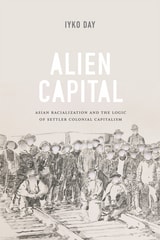
Alien Capital
Asian Racialization and the Logic of Settler Colonial CapitalismIyko Day
Duke University Press, 2016
In Alien Capital Iyko Day retheorizes the history and logic of settler colonialism by examining its intersection with capitalism and the racialization of Asian immigrants to Canada and the United States. Day explores how the historical alignment of Asian bodies and labor with capital's abstract and negative dimensions became one of settler colonialism's foundational and defining features. This alignment allowed white settlers to gloss over and expunge their complicity with capitalist exploitation from their collective memory. Day reveals this process through an analysis of a diverse body of Asian North American literature and visual culture, including depictions of Chinese railroad labor in the 1880s, filmic and literary responses to Japanese internment in the 1940s, and more recent examinations of the relations between free trade, national borders, and migrant labor. In highlighting these artists' reworking and exposing of the economic modalities of Asian racialized labor, Day pushes beyond existing approaches to settler colonialism as a Native/settler binary to formulate it as a dynamic triangulation of Native, settler, and alien populations and positionalities.
[more]

Sensational Futures
On Asian Racialization and Speculative AestheticsFrances Tran
Duke University Press, 2027
The racialization of Asian peoples, as both “model minorities” and “the yellow peril,” has been instrumental to envisioning futures that reproduce racial capitalism as well as social and material inequities. In Sensational Futures, Frances Tran takes up this problem of Asian futurity to explore other possible modes of conceptualizing the future. Engaging an eclectic archive of transnational Asian and multiethnic literature, film, and public art, she demonstrates how the speculative multisensory worlds these texts animate recreate futures that have been discarded and delegitimized because they do not conform to liberal humanist and racial capitalist scripts of progress. She reaches beyond the spectacular visualization of Asian futurity captured in contemporary discourses of rising Asia and the Asian Century for practices that can sense futures otherwise. By bringing this temporal and sensory awareness to bear on debates over the future as problems of research, education, sustainability, and mourning, Tran attends to how a sensory, embodied aesthetics can attune us to alternative ways of conceiving and orienting ourselves toward the future.
[more]