Results by title
24 books match the query 'Asians'
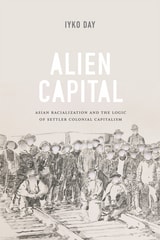
Alien Capital
Asian Racialization and the Logic of Settler Colonial CapitalismIyko Day
Duke University Press, 2016

Ashore
Laurel Nakanishi
Tupelo Press, 2021
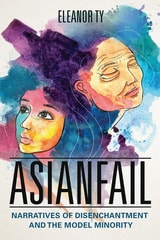
Asianfail
Narratives of Disenchantment and the Model MinorityEleanor Ty
University of Illinois Press, 2017
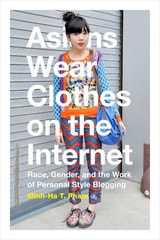
Asians Wear Clothes on the Internet
Race, Gender, and the Work of Personal Style BloggingMinh-ha T. Pham
Duke University Press, 2015
Asians and Pacific Islanders in the United States
Herbert Barringer
Russell Sage Foundation, 1993

Asians in Britain
400 Years of HistoryRozina Visram
Pluto Press, 2002
Rozina Visram examines the nature and pattern of Asian migration; official attitudes to Asian settlement; the reactions and perceptions of the British people; the responses of the Asians themselves and their social, cultural and political lives in Britain.
This imaginative and detailed investigation asks what it would have been like for Asians to live in Britain, in the heart of an imperial metropolis, and documents the anti-colonial struggle by Asians and their allies in the UK. It is an invaluable contribution to our understanding of the origins of the many different communities that make up contemporary Britain.
Asians on Demand
Mediating Race in Video Art and ActivismFeng-Mei Heberer
University of Minnesota Press, 2023
Does media representation advance racial justice?
While the past decade has witnessed a push for increased diversity in visual media, Asians on Demand grapples with the pressing question of whether representation is enough to advance racial justice. Surveying a contemporary, cutting-edge archive of video works from the Asian diaspora in North America, Europe, and East Asia, this book uncovers the ways that diasporic artists challenge the narrow—and damaging—conceptions of Asian identity pervading mainstream media.
Through an engagement with grassroots activist documentaries, experimental video diaries by undocumented and migrant workers, and works by high-profile media artists such as Hito Steyerl and Ming Wong, Feng-Mei Heberer showcases contemporary video productions that trouble the mainstream culture industry’s insistence on portraying ethnic Asians as congenial to dominant neoliberal values. Undermining the demands placed on Asian subjects to exemplify institutional diversity and individual exceptionalism, this book provides a critical and nuanced set of alternatives to the easily digestible forms generated by online streaming culture and multicultural lip service more broadly.
Employing feminist, racial, and queer critiques of the contemporary media landscape, Asians on Demand highlights how the dynamics of Asian representation play out differently in Germany, the United States, Taiwan, and Spain. Rather than accepting the notion that inclusion requires an uncomplicated set of appearances, the works explored in this volume spotlight a staunch resistance to formulating racial identity as an instantly accessible consumer product.
Black Star
Britain's Asian Youth MovementsAnandi Ramamurthy
Pluto Press, 2013
Black Star documents the vibrant Asian Youth Movements in 1970s and 80s Britain who struggled against the racism of the street and the state. Anandi Ramamurthy shows how they drew inspiration from Black Power movements as well as anti-imperialist and workers' struggles across the globe.
Drawing on her intimate knowledge and extensive research, Ramamurthy shows how the struggle to make Britain 'home' led to a broad-based identity where 'black' was a political colour inspiring unity amongst all those struggling against racism.
Ramamurthy documents how by the late 1980s this broad based black identity disintegrated as Islamophobia became a new form of racism. In the process the legacy of the Asian Youth Movements has been largely hidden. Black Star retrieves this history and demonstrates its importance for political struggles today.
Contemporary Directions in Asian American Dance
Edited by Yutian Wong
University of Wisconsin Press, 2018
The contributors to this volume address such topics as the role of the 1960s Asian American Movement in creating Japanese American taiko groups, and the experience of internment during World War II influencing butoh dance in Canada. Essays about artists such as Jay Hirabayashi, Alvin Tolentino, Shen Wei, Kun-Yang Lin, Yasuko Yokoshi, Eiko & Koma, Sam Kim, Roko Kawai, and Denise Uyehara look closely at the politics of how Asian aesthetics are set into motion and marketed. The volume includes first-person narratives, interviews, ethnography, cultural studies, performance studies, and comparative ethnic studies.
Displacements and Diasporas
Asians in the AmericasAnderson, Wanni W.
Rutgers University Press, 2005
With an emphasis on anthropological and historical contexts, the essays show how the experiences of Asians across the Americas have been shaped by the social dynamics and politics of settlement locations as much as by transnational connections and the economic forces of globalization. Contributors bring new insights to the unique situations of Asian communities previously overlooked by scholars, such as Vietnamese Canadians and the Lao living in Rhode Island. Other topics include Chinese laborers and merchants in Latin America and the Caribbean, Japanese immigrants and their descendants in Brazil, Afro-Amerasians in America, and the politics of second-generation Indian American youth culture.
Together the essays provide a valuable comparative portrait of Asians across the Americas. Engaging issues of diaspora, transnational social practice and community building, gender, identity, institutionalized racism, and deterritoriality, this volume presents fresh perspectives on displacement, opening the topic up to a wider, more interdisciplinary terrain of inquiry and teaching.
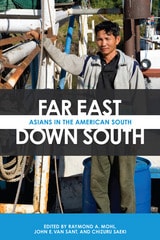
Far East, Down South
Asians in the American SouthEdited by Raymond A. Mohl, John E. Van Sant, and Chizuru Saeki
University of Alabama Press, 2016
Uncovering the overlooked histories of Asians in the American South.
In sharp contrast to the “melting pot” reputation of the United States, the American South—with its history of slavery, Jim Crow, and the civil rights movement—has been perceived in stark and simplistic demographic terms. In Far East, Down South, editors Raymond A. Mohl, John E. Van Sant, and Chizuru Saeki provide a collection of essential essays that restores and explores an overlooked part of the South’s story—that of Asian immigration to the region.
These essays form a comprehensive overview of key episodes and issues in the history of Asian immigrants to the South. During Reconstruction, southern entrepreneurs experimented with the replacement of slave labor with Chinese workers. As in the West, Chinese laborers played a role in the development of railroads. Japanese farmers also played a more widespread role than is usually believed. Filipino sailors recruited by the US Navy in the early decades of the twentieth century often settled with their families in the vicinity of naval ports such as Corpus Christi, Biloxi, and Pensacola. Internment camps brought Japanese Americans to Arkansas. Marriages between American servicemen and Japanese, Korean, Filipina, Vietnamese, and nationals in other theaters of war created many thousands of blended families in the South. In recent decades, the South is the destination of internal immigration as Asian Americans spread out from immigrant enclaves in West Coast and Northeast urban areas.
Taken together, the book’s essays document numerous fascinating themes: the historic presence of Asians in the South dating back to the mid-nineteenth century; the sources of numerous waves of contemporary Asian immigration to the South; and the steady spread of Asians out from the coastal port cities. Far East, Down South adds a vital new dimension to popular understanding of southern history.
Imagining Asia in the Americas
Zelideth María Rivas and Debbie Lee-DiStefano
Rutgers University Press, 2016

Masters of Their Own Destiny
Asians in the First World WarEdited by Claire Thi Liên Tran
National University of Singapore Press, 2026
An intervention in World War I historiography that foregrounds personal accounts of the conflict from its non-European participants and witnesses.
Accounts of World War I tend to focus on Europe, the epicenter of this conflict, and find in its battlefields the later death of empires, spreading revolution, and eventual decolonization. However, the war was also global, drawing in people from all over the world while rapidly circulating ideas and innovations far beyond Europe.
Almost two million non-Europeans participated in the war as soldiers, workers, and professionals, including Asians in particular. They could be found in the battlefields of France, behind the lines in munitions factories and military hospitals, in the frozen construction sites of the Murmansk Railway, and in Mesopotamia’s burning deserts. The voices of these volunteers and conscripts are rarely heard; the war’s narratives are mainly European. And yet, here and there, lone voices pierce the silence.
In a compelling intervention in World War I historiography, Masters of Their Own Destiny offers a history from below, demonstrating how rare personal accounts may illuminate broader historical forces. Alongside the story of Nguyen Xuan Mai, a Vietnamese military doctor whose pursuit of professional recognition ended in disillusionment with colonial promises, this study draws on a wealth of material like Indian soldiers’ letters, Vietnamese workers’ censored correspondence, and records of Chinese laborers who witnessed revolution in Russia. It gives voice to hitherto ignored wartime experiences that later transformed the expectations of millions of colonial subjects and seeded the anticolonial movements that followed.

Musicians from a Different Shore
Asians and Asian Americans in Classical MusicMari Yoshihara
Temple University Press, 2008
Musicians of Asian descent enjoy unprecedented prominence in concert halls, conservatories, and classical music performance competitions. In the first book on the subject, Mari Yoshihara looks into the reasons for this phenomenon, starting with her own experience of learning to play piano in Japan at the age of three. Yoshihara shows how a confluence of culture, politics and commerce after the war made classical music a staple in middle-class households, established Yamaha as the world's largest producer of pianos and gave the Suzuki method of music training an international clientele. Soon, talented musicians from Japan, China and South Korea were flocking to the United States to study and establish careers, and Asian American families were enrolling toddlers in music classes.
Against this historical backdrop, Yoshihara interviews Asian and Asian American musicians, such as Cho-Liang Lin, Margaret Leng Tan, Kent Nagano, who have taken various routes into classical music careers. They offer their views about the connections of race and culture and discuss whether the music is really as universal as many claim it to be. Their personal histories and Yoshihara's observations present a snapshot of today's dynamic and revived classical music scene.
Negotiating National Identity
Immigrants, Minorities, and the Struggle for Ethnicity in BrazilJeffrey Lesser
Duke University Press, 1999
Employing a cross-cultural approach, Lesser examines a variety of acculturating responses by minority groups, from insisting on their own whiteness to becoming ultra-nationalists and even entering secret societies that insisted Japan had won World War II. He discusses how various minority groups engaged in similar, and successful, strategies of integration even as they faced immense discrimination and prejudice. Some believed that their ethnic heritage was too high a price to pay for the “privilege” of being white and created alternative categories for themselves, such as Syrian-Lebanese, Japanese-Brazilian, and so on. By giving voice to the role ethnic minorities have played in weaving a broader definition of national identity, this book challenges the notion that elite discourse is hegemonic and provides the first comprehensive look at Brazilian worlds often ignored by scholars.
Based on extensive research, Negotiating National Identity will be valuable to scholars and students in Brazilian and Latin American studies, as well as those in the fields of immigrant history, ethnic studies, and race relations.
Nuevo South
Latinas/os, Asians, and the Remaking of PlaceBy Perla M. Guerrero
University of Texas Press, 2017
Latinas/os and Asians are rewriting the meaning and history of race in the American South by complicating the black/white binary that has frequently defined the region since before the Civil War. Arriving in southern communities as migrants or refugees, Latinas/os and Asians have experienced both begrudging acceptance and prejudice as their presence confronts and troubles local understandings of race and difference—understandings that have deep roots in each community’s particular racial history, as well as in national fears and anxieties about race.
Nuevo South offers the first comparative study showing how Latinas/os and Asians are transforming race and place in the contemporary South. Integrating political, economic, and social analysis, Perla M. Guerrero examines the reception of Vietnamese, Cubans, and Mexicans in northwestern Arkansas communities that were almost completely white until the mid-1970s. She shows how reactions to these refugees and immigrants ranged from reluctant acceptance of Vietnamese as former US allies to rejection of Cubans as communists, criminals, and homosexuals and Mexicans as “illegal aliens” who were perceived as invaders when they began to establish roots and became more visible in public spaces. Guerrero’s research clarifies how social relations are constituted in the labor sphere, particularly the poultry industry, and reveals the legacies of regional history, especially anti-Black violence and racial cleansing. Nuevo South thus helps us to better understand what constitutes the so-called Nuevo South and how historical legacies shape the reception of new people in the region.
Postcolonial Grief
The Afterlives of the Pacific Wars in the AmericasJinah Kim
Duke University Press, 2019
Racial Melancholia, Racial Dissociation
On the Social and Psychic Lives of Asian AmericansDavid L. Eng and Shinhee Han
Duke University Press, 2018
Reimaging Britain
500 Years of Black and Asian HistoryRon Ramdin
Pluto Press, 1999
Blacks and Asians have a long history in the British Isles. Ramdin illustrates this by covering a 500-year period, from 1500 to the present day. He recounts the major historical episodes and covers all the major figures, including Ottobah Cugoano, William Cuffay, William Davidson, George Padmore, Mary Seacole, C.L.R. James, V.S. Naipaul, Sam Selvon, Walter Tull, Shirley Bassey, Bill Morris, Salman Rushdie, Hanif Kureshi and Bernie Grant.
In bringing the largely hidden histories of these immigrant communities to the fore, Ron Ramdin’s wide-ranging study challenges conventional histories of the British Isles. Reimaging Britain will lead to a reappraisal of how ‘British’ history is written in the future.
Saving Face
The Emotional Costs of the Asian Immigrant Family MythAngie Y. Chung
Rutgers University Press, 2016
The Minor Intimacies of Race
Asian Publics in North AmericaChristine Kim
University of Illinois Press, 2016
The New Asian Immigration in Los Angeles and Global Restructuring
Paul Ong
Temple University Press, 1994
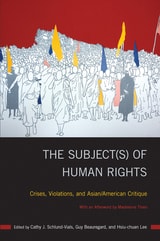
The Subject(s) of Human Rights
Crises, Violations, and Asian/American CritiqueCathy J. Schlund-Vials
Temple University Press, 2020
Human rights violations have always been part of Asian American studies. From Chinese immigration restrictions, the incarceration of Japanese Americans, yellow peril characterizations, and recent acts of deportation and Islamophobia, Asian Americans have consistently functioned as subordinated “subjects” of human rights violations. The Subject(s) of Human Rights brings together scholars from North America and Asia to recalibrate these human rights concerns from both sides of the Pacific.
The essays in this collection provide a sharper understanding of how Asian/Americans have been subjected to human rights violations, how they act as subjects of history and agents of change, and how they produce knowledge around such subjects. The editors of and contributors to The Subject(s) of Human Rights examine refugee narratives, human trafficking, and citizenship issues in twentieth- and twenty-first century literature. These themes further refract issues of American war-making, settler colonialism, military occupation, collateral damage, and displacement that relocate the imagined geographies of Asian America from the periphery to the center of human rights critique.

Unfastened
Globality and Asian North American NarrativesEleanor Ty
University of Minnesota Press, 2010