Results by title
4 books match the query 'Aspiration'
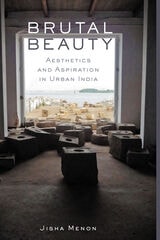
Brutal Beauty
Aesthetics and Aspiration in Urban IndiaJisha Menon
Northwestern University Press, 2022
Brutal Beauty: Aesthetics and Aspiration in Urban India follows a postcolonial city as it transforms into a bustling global metropolis after the liberalization of the Indian economy. Taking the once idyllic “garden city” of Bangalore in southern India as its point of departure, the book explores how artists across India and beyond foreground neoliberalism as a “structure of feeling” permeating aesthetics, selfhood, and everyday life.
Jisha Menon conveys the affective life of the city through multiple aesthetic projects that express a range of urban feelings, including aspiration, panic, and obsolescence. As developers and policymakers remodel the city through tumultuous construction projects, urban beautification, privatization, and other templated features of “world‑class cities,” urban citizens are also changing—transformed by nostalgia, narcissism, shame, and the spaces where they dwell and work. Sketching out scenes of urban aspiration and its dark underbelly, Menon delineates the creative and destructive potential of India’s lurch into contemporary capitalism, uncovering the interconnectedness of local and global power structures as well as art’s capacity to absorb and critique liberalization’s discontents. She argues that neoliberalism isn’t just an economic, social, and political phenomenon; neoliberalism is also a profoundly aesthetic project.
Jisha Menon conveys the affective life of the city through multiple aesthetic projects that express a range of urban feelings, including aspiration, panic, and obsolescence. As developers and policymakers remodel the city through tumultuous construction projects, urban beautification, privatization, and other templated features of “world‑class cities,” urban citizens are also changing—transformed by nostalgia, narcissism, shame, and the spaces where they dwell and work. Sketching out scenes of urban aspiration and its dark underbelly, Menon delineates the creative and destructive potential of India’s lurch into contemporary capitalism, uncovering the interconnectedness of local and global power structures as well as art’s capacity to absorb and critique liberalization’s discontents. She argues that neoliberalism isn’t just an economic, social, and political phenomenon; neoliberalism is also a profoundly aesthetic project.
[more]
Muslim Becoming
Aspiration and Skepticism in PakistanNaveeda Khan
Duke University Press, 2012
In Muslim Becoming, Naveeda Khan challenges the claim that Pakistan's relation to Islam is fragmented and problematic. Offering a radically different interpretation, Khan contends that Pakistan inherited an aspirational, always-becoming Islam, one with an open future and a tendency toward experimentation. For the individual, this aspirational tendency manifests in a continual striving to be a better Muslim. It is grounded in the thought of Muhammad Iqbal (1877–1938), the poet, philosopher, and politician considered the spiritual founder of Pakistan. Khan finds that Iqbal provided the philosophical basis for recasting Islam as an open religion with possible futures as yet unrealized, which he did in part through his engagement with the French philosopher Henri Bergson. Drawing on ethnographic research in the neighborhoods and mosques of Lahore and on readings of theological polemics, legal history, and Urdu literature, Khan points to striving throughout Pakistani society: in prayers and theological debates and in the building of mosques, readings of the Qur'an, and the undertaking of religious pilgrimages. At the same time, she emphasizes the streak of skepticism toward the practices of others that accompanies aspiration. She asks us to consider what is involved in affirming aspiration while acknowledging its capacity for violence.
[more]
We Were Adivasis
Aspiration in an Indian Scheduled TribeMegan Moodie
University of Chicago Press, 2015
In We Were Adivasis, anthropologist Megan Moodie examines the Indian state’s relationship to “Scheduled Tribes,” or adivasis—historically oppressed groups that are now entitled to affirmative action quotas in educational and political institutions. Through a deep ethnography of the Dhanka in Jaipur, Moodie brings readers inside the creative imaginative work of these long-marginalized tribal communities. She shows how they must simultaneously affirm and refute their tribal status on a range of levels, from domestic interactions to historical representation, by relegating their status to the past: we were adivasis.
Moodie takes readers to a diversity of settings, including households, tribal council meetings, and wedding festivals, to reveal the aspirations that are expressed in each. Crucially, she demonstrates how such aspiration and identity-building are strongly gendered, requiring different dispositions required of men and women in the pursuit of collective social uplift. The Dhanka strategy for occupying the role of adivasi in urban India comes at a cost: young women must relinquish dreams of education and employment in favor of community-sanctioned marriage and domestic life. Ultimately, We Were Adivasis explores how such groups negotiate their pasts to articulate different visions of a yet uncertain future in the increasingly liberalized world.
Moodie takes readers to a diversity of settings, including households, tribal council meetings, and wedding festivals, to reveal the aspirations that are expressed in each. Crucially, she demonstrates how such aspiration and identity-building are strongly gendered, requiring different dispositions required of men and women in the pursuit of collective social uplift. The Dhanka strategy for occupying the role of adivasi in urban India comes at a cost: young women must relinquish dreams of education and employment in favor of community-sanctioned marriage and domestic life. Ultimately, We Were Adivasis explores how such groups negotiate their pasts to articulate different visions of a yet uncertain future in the increasingly liberalized world.
[more]
Working Women in Jordan
Education, Migration, and AspirationFida J. Adely
University of Chicago Press, 2024
A surprising look at the meaningful social changes in Jordan as lived and navigated by educated women.
Jordan has witnessed tremendous societal transformation in its relatively short history. Today it has one of the most highly educated populations in the region, and women have outnumbered and outperformed their male counterparts for more than a decade. Yet, despite their education and professional status, many women still struggle to build a secure future and a life befitting of their aspirations.
In Working Women in Jordan anthropologist Fida J. Adely turns to college-educated women in Jordan who migrate from rural provinces to Amman for employment opportunities. Building on twelve years of ethnographic research and extensive interviews with dozens of women, as well as some of their family members, Adely analyzes the effects of developments such as expanded educational opportunities, urbanization, privatization, and the restructuring of the labor market on women’s life trajectories, gender roles, the institution of marriage, and kinship relations. Through these rich narrative accounts and the analysis of broader socio-economic shifts, Adely explains how educational structures can act as both facilitators and obstacles to workforce entry—along with cascading consequences for family and social life. Deeply thorough and compelling, Working Women in Jordan asks readers to think more critically about what counts as development, and for whom.
[more]