Results by title
4 books match the query 'Assam'
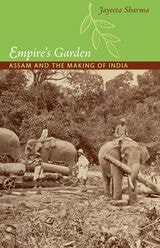
Empire's Garden
Assam and the Making of IndiaJayeeta Sharma
Duke University Press, 2011
In the mid-nineteenth century the British created a landscape of tea plantations in the northeastern Indian region of Assam. The tea industry filled imperial coffers and gave the colonial state a chance to transform a jungle-laden frontier into a cultivated system of plantations. Claiming that local peasants were indolent, the British soon began importing indentured labor from central India. In the twentieth century these migrants were joined by others who came voluntarily to seek their livelihoods. In Empire’s Garden, Jayeeta Sharma explains how the settlement of more than one million migrants in Assam irrevocably changed the region’s social landscape. She argues that the racialized construction of the tea laborer catalyzed a process by which Assam’s gentry sought to insert their homeland into an imagined Indo-Aryan community and a modern Indian political space. Various linguistic and racial claims allowed these elites to defend their own modernity while pushing the burden of primitiveness onto “non-Aryan” indigenous tribals and migrant laborers. As vernacular print arenas emerged in Assam, so did competing claims to history, nationalism, and progress that continue to reverberate in the present.
[more]
Plantation Worlds
Maan Barua
Duke University Press, 2024
In Plantation Worlds, Maan Barua interrogates debates on planetary transformations through the histories and ecologies of plantations. Drawing on long-term research spanning fifteen years, Barua presents a unique ethnography attentive to the lives of both people and elephants amid tea plantations in the Indian state of Assam. In the nineteenth and early twentieth centuries, nearly three million people were brought in to Assam’s plantations to work under conditions of indenture. Plantations dramatically altered the region’s landscape, plundered resources, and created fraught worlds for elephants and people. Their extractive logics and colonial legacies prevail as durations, forging the ambit of infrastructures, labor, habitability, and conservation in the present. And yet, as the perspectives of the Adivasi plantation worker community and lifeworlds of elephants show, possibilities for enacting a decolonial imaginary of landscape remain present amid immiseration. From the margins of the Global South, Barua offers an alternative grammar for articulating environmental change. In so doing, he prompts a rethinking of multispecies ecologies and how they are structured by colonialism and race.
[more]
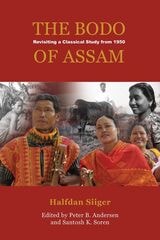
The Bodo of Assam
Revisiting a Classical Study from 1951Halfdan Siiger
National University of Singapore Press, 2015
The Bodo (or Boros) are one of the indigenous tribal peoples of Assam. During colonial times they resisted Christianization and in recent decades they have been involved both in interethnic violence and separatist insurgencies. Much research has gone into understanding the Boros and their aspirations but an issue has been that earlier accounts of this once-animist people are meagre and date from the colonial period. The rediscovery and publication of the ethnographic material based on fieldwork carried out by Halfdan Siiger among the Boros in 1949–50 is thus hugely important. Siiger’s manuscript is unique, offering detailed descriptions of the social and ritual life of the Boros and new insights into the traditions and myths as they were told in the village he studied before the transformation of religious life in recent decades. Thanks to Siiger’s diligent translation and interpretation, the manuscript also preserves a number of ritual formulas and songs in the Boro language. Siiger’s manuscript is given even greater relevance by the inclusion of more recent material contributed by the editors and other contemporary scholars. In addition, his original photos are augmented by new photos from the village and by rare images from the collections of the National Museum of Denmark.
[more]
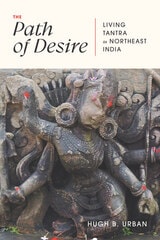
The Path of Desire
Living Tantra in Northeast IndiaHugh B. Urban
University of Chicago Press, 2024
A provocative study of contemporary Tantra as a dynamic living tradition.
Tantra, one of the most important religious currents in South Asia, is often misrepresented as little more than ritualized sex. Through a mixture of ethnography and history, Hugh B. Urban reveals a dynamic living tradition behind the sensationalist stories. Urban shows that Tantric desire goes beyond the erotic, encompassing such quotidian experiences as childbearing and healing. He traces these holistic desires through a series of unique practices: institutional Tantra centered on gurus and esoteric rituals; public Tantra marked by performance and festival; folk Tantra focused on magic and personal well-being; and popular Tantra imagined in fiction, film, and digital media. The result is a provocative new description of Hindu Tantra that challenges us to approach religion as something always entwined with politics and culture, thoroughly entangled with ordinary needs and desires.
Tantra, one of the most important religious currents in South Asia, is often misrepresented as little more than ritualized sex. Through a mixture of ethnography and history, Hugh B. Urban reveals a dynamic living tradition behind the sensationalist stories. Urban shows that Tantric desire goes beyond the erotic, encompassing such quotidian experiences as childbearing and healing. He traces these holistic desires through a series of unique practices: institutional Tantra centered on gurus and esoteric rituals; public Tantra marked by performance and festival; folk Tantra focused on magic and personal well-being; and popular Tantra imagined in fiction, film, and digital media. The result is a provocative new description of Hindu Tantra that challenges us to approach religion as something always entwined with politics and culture, thoroughly entangled with ordinary needs and desires.
[more]