Results by title

3 books match the query 'Assessing'
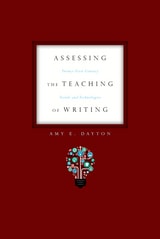
cover of Assessing the Teaching of Writing: Twenty-First Century Trends and Technologies

Assessing the Teaching of Writing

Twenty-First Century Trends and Technologies

Amy E. Dayton

Utah State University Press, 2015

Although fraught with politics and other perils, teacher evaluation can contribute in important, positive ways to faculty development at both the individual and the departmental levels. Yet the logistics of creating a valid assessment are complicated. Inconsistent methods, rater bias, and overreliance on student evaluation forms have proven problematic. The essays in Assessing the Teaching of Writing demonstrate constructive ways of evaluating teacher performance, taking into consideration the immense number of variables involved.

Contributors to the volume examine a range of fundamental issues, including the political context of declining state funds in education; growing public critique of the professoriate and demands for accountability resulting from federal policy initiatives like No Child Left Behind; the increasing sophistication of assessment methods and technologies; and the continuing interest in the scholarship of teaching. The first section addresses concerns and advances in assessment methodologies, and the second takes a closer look at unique individual sites and models of assessment. Chapters collectively argue for viewing teacher assessment as a rhetorical practice.

Fostering new ways of thinking about teacher evaluation, Assessing the Teaching of Writing will be of great interest not only to writing program administrators but also to those concerned with faculty development and teacher assessment outside the writing program. 
[more]
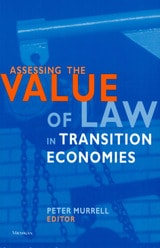
cover of Assessing the Value of Law in Transition Economies

Assessing the Value of Law in Transition Economies

Peter Murrell, Editor

University of Michigan Press, 2001
Does law play a role in the economies that are moving from Soviet-style socialism to market capitalism? The essays in this book examine that question, providing a vivid picture of how the new institutions of capitalism affect the lives of business people, legal practitioners, investors, and bureaucrats. They analyze the determinants of successful institutional reform, suggesting that law can influence economic behavior even in inhospitable environments. Contributors--including economists, political scientists, and legal and business scholars--examine the pathways through which legal and institutional reforms affect behavior and identify the circumstances under which such reforms add value. They ask: What are the microeconomic mechanisms by which law contributes to the activities of economic agents? How do the characteristics of economic agents affect their ability to use the law? Which spheres of the economy are most affected by institutional reforms and where does law fail? What are the preconditions for effective legal and institutional reforms? Which types of political processes produce a workable system of economic legislation? The focus throughout is on the analysis of the individual economic agent who is subject to the new institutions, and thus the decisions of the individual actor, the shopkeeper, the lawyer, the court, the legislator-politician, the enterprise, the bureaucrat, the regulatory authority, and the outside investor. There are lessons on research methodology, on the economic role of institutions, and on the practice of institutional development. The focus is on the transition economies, but the conclusions and methodologies are pertinent when understanding the role of law in any context. The book will be important reading for scholars and practitioners with a wide range of interests and in a wide range of disciplines and of interest to all those concerned with economic, legal, and institutional development, economists, political scientists, lawyers, and development specialists alike.
[more]
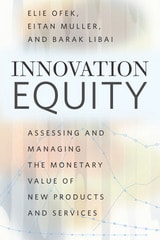
cover of Innovation Equity: Assessing and Managing the Monetary Value of New Products and Services

Innovation Equity

Assessing and Managing the Monetary Value of New Products and Services

Elie Ofek, Eitan Muller, and Barak Libai

University of Chicago Press, 2016

From drones to wearable technology to Hyperloop pods that can potentially travel more than seven hundred miles per hour, we’re fascinated with new products and technologies that seem to come straight out of science fiction. But, innovations are not only fascinating, they’re polarizing, as, all too quickly, skepticism regarding their commercial viability starts to creep in. And while fortunes depend on people’s ability to properly assess their prospects for success, no one can really agree on how to do it, especially for truly radical new products and services.

In Innovation Equity, Elie Ofek, Eitan Muller, and Barak Libai analyze how a vast array of past innovations performed in the marketplace—from their launch to the moment they became everyday products to the phase where consumers moved on to the “next big thing.” They identify key patterns in how consumers adopt innovations and integrate these with marketing scholarship on how companies manage their customer base by attracting new customers, keeping current customers satisfied, and preventing customers from switching to competitors’ products and services. In doing so, the authors produce concrete models that powerfully predict how the marketplace will respond to innovations, providing a much more authoritative way to estimate their potential monetary value, as well as a framework for making it possible to achieve that value.
 
[more]