Results by title
6 books match the query 'Assimilation'
Alternatives to Assimilation
The Response of Reform Judaism to American Culture, 1840–1930Alan Silverstein
Brandeis University Press, 1995
Explores the influence of American culture and history on the development of Reform Jewish institutions. Brandeis Series in American Jewish History, Culture, and Life.
[more]
Generations of Exclusion
Mexican-Americans, Assimilation, and RaceEdward E. Telles
Russell Sage Foundation, 2008
Foreword by Joan W. Moore When boxes of original files from a 1965 survey of Mexican Americans were discovered behind a dusty bookshelf at UCLA, sociologists Edward Telles and Vilma Ortiz recognized a unique opportunity to examine how the Mexican American experience has evolved over the past four decades. Telles and Ortiz located and re-interviewed most of the original respondents and many of their children. Then, they combined the findings of both studies to construct a thirty-five year analysis of Mexican American integration into American society. Generations of Exclusion is the result of this extraordinary project. Generations of Exclusion measures Mexican American integration across a wide number of dimensions: education, English and Spanish language use, socioeconomic status, intermarriage, residential segregation, ethnic identity, and political participation. The study contains some encouraging findings, but many more that are troubling. Linguistically, Mexican Americans assimilate into mainstream America quite well—by the second generation, nearly all Mexican Americans achieve English proficiency. In many domains, however, the Mexican American story doesn't fit with traditional models of assimilation. The majority of fourth generation Mexican Americans continue to live in Hispanic neighborhoods, marry other Hispanics, and think of themselves as Mexican. And while Mexican Americans make financial strides from the first to the second generation, economic progress halts at the second generation, and poverty rates remain high for later generations. Similarly, educational attainment peaks among second generation children of immigrants, but declines for the third and fourth generations. Telles and Ortiz identify institutional barriers as a major source of Mexican American disadvantage. Chronic under-funding in school systems predominately serving Mexican Americans severely restrains progress. Persistent discrimination, punitive immigration policies, and reliance on cheap Mexican labor in the southwestern states all make integration more difficult. The authors call for providing Mexican American children with the educational opportunities that European immigrants in previous generations enjoyed. The Mexican American trajectory is distinct—but so is the extent to which this group has been excluded from the American mainstream. Most immigration literature today focuses either on the immediate impact of immigration or what is happening to the children of newcomers to this country. Generations of Exclusion shows what has happened to Mexican Americans over four decades. In opening this window onto the past and linking it to recent outcomes, Telles and Ortiz provide a troubling glimpse of what other new immigrant groups may experience in the future.
[more]
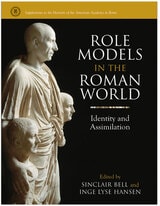
Role Models in the Roman World
Identity and AssimilationSinclair Bell and Inge Lyse Hansen, Editors
University of Michigan Press, 2008
The tendency of ancient Romans to look to mythical and historical figures for role models is everywhere evident in their surviving literary and material culture. This book broadens the horizon of the long-standing scholarly interest in role models in several ways, looking beyond the more familiar famous heroes---such as Achilles and Alexander the Great---and the paternal figures, both mythological and historical, that gave inspiration to later leaders and authors. From the adoption of specific aspects of a favored role model, to the creation of new visual languages for different social groups, to the deliberate counter of common models, this collection demonstrates the importance of exemplary figures in inspiring imitation and assimilation in the creation of new identities. Featuring world-renowned scholars and essays from a broad range of fields, including literature, art, and historiography, Role Models in the Roman World is a groundbreaking collection at the cusp of the newest scholarship of the classical world. "Role Models in the Roman World is an exciting collection, striking for the interdisciplinary range of its contributors and for their vigorous debates---indeed, strong disagreements---about ideas that are currently of fundamental importance in Roman studies: identity construction, exemplarity, memory, monumentality. In framing these crucial issues, and in displaying the range and diversity of current approaches to them, this collection will be useful to every student of the Roman world." ---Matthew Roller, Professor of Classics, Johns Hopkins University "This collection covers a full range of topics, from how the Romans interpreted their origins from the ashes of Troy on through themes in Roman literature, historiography, declamation, and art, ending with how Christians may have defined their self-presentation in part through reference to earlier, non-Christian models. The editors have shown themselves wonderfully adept at their task, and the result is a uniformly fine volume that will be widely consulted." ---Anthony Corbeill, Professor and Graduate Advisor, Department of Classics, University of Kansas "Significant essays by leading archaeologists, philologists, and art historians on a theme of central importance in the Roman world." ---Barbara Kellum, Professor and Chair, Department of Art, Smith College Jacket illustration: Side view of statue of Togato Barberini © Araldo de Luca/CORBIS
[more]
The Angel and Beehive
THE MORMON STRUGGLE WITH ASSIMILATIONArmand L. Mauss
University of Illinois Press, 1994
"The past few decades have witnessed an increasing reaction of the Mormons against their own successful assimilation," Armand Mauss writes in The Angel and the Beehive, "as though trying to recover some of the cultural tension and special identity associated with their earlier 'sect-like' history."
This retrenchment among Mormons is the main theme of Mauss's book, which analyzes the last forty years of Mormon history from a sociological perspective. At the official ecclesiastical level, Mauss finds, the retrenchment can be seen in the greatly increased centralization of bureaucratic control and in renewed emphases on obedience to modern prophets, on genealogy and vicarious temple work, and on traditional family life; retrenchment is also apparent in extensive formal religious indoctrination by full-time professionals and in increased sophistication and intensity of proselytizing.
This retrenchment among Mormons is the main theme of Mauss's book, which analyzes the last forty years of Mormon history from a sociological perspective. At the official ecclesiastical level, Mauss finds, the retrenchment can be seen in the greatly increased centralization of bureaucratic control and in renewed emphases on obedience to modern prophets, on genealogy and vicarious temple work, and on traditional family life; retrenchment is also apparent in extensive formal religious indoctrination by full-time professionals and in increased sophistication and intensity of proselytizing.
[more]
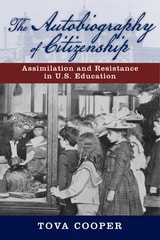
The Autobiography of Citizenship
Assimilation and Resistance in U.S. EducationCooper, Tova
Rutgers University Press, 0
At the turn of the twentieth century, the United States was faced with a new and radically mixed population, one that included freed African Americans, former reservation Indians, and a burgeoning immigrant population. In The Autobiography of Citizenship, Tova Cooper looks at how educators tried to impose unity on this divergent population, and how the new citizens in turn often resisted these efforts, reshaping mainstream U.S. culture and embracing their own view of what it means to be an American.
The Autobiography of Citizenship traces how citizenship education programs began popping up all over the country, influenced by the progressive approach to hands-on learning popularized by John Dewey and his followers. Cooper offers an insightful account of these programs, enlivened with compelling readings of archival materials such as photos of students in the process of learning; autobiographical writing by both teachers and new citizens; and memoirs, photos, poems, and novels by authors such as W.E.B. Du Bois, Jane Addams, Charles Reznikoff, and Emma Goldman. Indeed, Cooper provides the first comparative, inside look at these citizenship programs, revealing that they varied wildly: at one end, assimilationist boarding schools required American Indian children to transform their dress, language, and beliefs, while at the other end the libertarian Modern School encouraged immigrant children to frolic naked in the countryside and learn about the world by walking, hiking, and following their whims.
Here then is an engaging portrait of what it was like to be, and become, a U.S. citizen one hundred years ago, showing that what it means to be “American” is never static.
[more]

The Sephardic Jews of Bordeaux
Assimilation and Emancipation in Revolutionary and Napoleonic FranceFrances Malino
University of Alabama Press, 1978
Sephardim of Bordeaux—the first in Europe to be recognized as a Jewish community
This book focuses on a small community of French Jews, the first in Europe to encounter the requirements of an emerging nation-state and to be recognized by that state as full and equal citizens. The Sephardim of Bordeaux were typical of neither the majority of the Jews of France nor those of Western Europe. They had entered France as Catholics; only after more than a century of public adherence to Catholicism was their community officially recognized as Jewish. Nevertheless, their assimilation and conformity to the standards of French society as well as their commitment to a Judaism fashioned as much by contemporary political and economic concerns as by tradition reveal a legacy bequeathed to French Jewry and an important model for the development of the modern Jew.
Describing the tensions that existed between the Sephardic community of Bordeaux and the Ashkenazic Jews of France, the author also depicts their role in the relation of the Jews with Napoleon and the forming of the Grand Sanhedrin.
[more]