Results by title
3 books match the query 'Assisted suicide'
Law at the End of Life
The Supreme Court and Assisted SuicideCarl E. Schneider, Editor
University of Michigan Press, 2000
Understanding Assisted Suicide
Nine Issues to ConsiderJohn B. Mitchell
University of Michigan Press, 2007
Assisted suicide remains one of the most emotionally charged and controversial topics—and the issue isn’t going away any time soon. As the baby boomer generation ages, many of us will watch as our parents—and ourselves—grow older, and wonder at the decisions that lie ahead.
Understanding Assisted Suicide provides both a fresh take on this important topic and the framework for intelligent participation in the discussion. Uniquely, the author frames the issue using his own experience watching both his parents die, which led him to ask fundamental questions about death, dying, religion, and the role of medicine and technology in alleviating human suffering.
In concerns about assisted suicide, each person’s “big picture” has largely been created out of picking and choosing from nine separate snapshot albums.
Understanding this offers a perspective for quickly determining the sources of another’s opinion on assisted suicide, as well as the issues they are not considering. Most importantly, Understanding Assisted Suicide offers a clear, easy-to-traverse landscape over which those who are sincerely looking for their own answers can navigate. The “nine-issue structure” allows both careful exploration of separate issues and a view of the full spectrum of ideas involved.
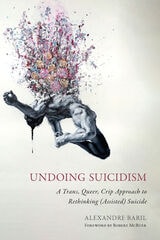
Undoing Suicidism
A Trans, Queer, Crip Approach to Rethinking (Assisted) SuicideAlexandre Baril
Temple University Press, 2023
Undoing Suicidism questions the belief that the best way to help suicidal people is through the logic of prevention. Alexandre Baril presents the thought-provoking argument that supporting assisted suicide for suicidal people could better prevent unnecessary deaths. Offering a new queercrip model of (assisted) suicide, he invites us to imagine what could happen if we started thinking about (assisted) suicide from an anti-suicidist and intersectional framework.
Baril provides a radical reconceptualization of (assisted) suicide and invaluable reflections for academics, activists, practitioners, and policymakers.