Results by title
6 books match the query 'Asteroids'
Asteroids
Tom Gehrels
University of Arizona Press, 1979
Originally published in 1979, this was a comprehensive source and textbook on asteroids by 70 authors covering exploration, composition, evolution, and the interrelations with other small solar system bodies. Also includes an extensive file of all known asteroid parameters including magnitudes, colors, proper elements and compositional types.
[more]
Asteroids II
Richard P. Binzel
University of Arizona Press, 1989
This sourcebook brought together our knowledge about asteroids, based on a gather during the week of March 8-11, 1988 with move than 160 scientists from 14 countries who gathered in Tucson for the Asteroids II conference.
Asteroids II is not a sequel, per se, to the 1979 book Asteroids. It offered a fresh treatment intended to stand on its own as a complete description of the current understanding of the field. It was published in December 1989. The work showcased a large international collaboration, a sign of an active and growing discipline.
Asteroids II is not a sequel, per se, to the 1979 book Asteroids. It offered a fresh treatment intended to stand on its own as a complete description of the current understanding of the field. It was published in December 1989. The work showcased a large international collaboration, a sign of an active and growing discipline.
[more]
Asteroids III
Edited by W. F. Bottke Jr., A. Cellino, P. Paolicchi, and R. P. Binzel
University of Arizona Press, 2002
Two hundred years after the first asteroid was discovered, asteroids can no longer be considered mere points of light in the sky. Spacecraft missions, advanced Earth-based observation techniques, and state-of-the-art numerical models are continually revealing the detailed shapes, structures, geological properties, and orbital characteristics of these smaller denizens of our solar system. This volume brings together the latest information obtained by spacecraft combined with astronomical observations and theoretical modeling, to present our best current understanding of asteroids and the clues they reveal for the origin an,d evolution of the solar system.
This collective knowledge, prepared by a team of more than one hundred international authorities on asteroids, includes new insights into asteroid-meteorite connections, possible relationships with comets, and the hazards posed by asteroids colliding with Earth. The book's contents include reports on surveys based on remote observation and summaries of physical properties; results of in situ exploration; studies of dynamical, collisional, cosmochemical, and weathering evolutionary processes; and discussions of asteroid families and the relationships between asteroids and other solar system bodies. Two previous Space Science Series volumes have established standards for research into asteroids. Asteroids III carries that tradition forward in a book that will stand as the definitive source on its subject for the next decade.
This collective knowledge, prepared by a team of more than one hundred international authorities on asteroids, includes new insights into asteroid-meteorite connections, possible relationships with comets, and the hazards posed by asteroids colliding with Earth. The book's contents include reports on surveys based on remote observation and summaries of physical properties; results of in situ exploration; studies of dynamical, collisional, cosmochemical, and weathering evolutionary processes; and discussions of asteroid families and the relationships between asteroids and other solar system bodies. Two previous Space Science Series volumes have established standards for research into asteroids. Asteroids III carries that tradition forward in a book that will stand as the definitive source on its subject for the next decade.
[more]
Asteroids IV
Edited by Patrick Michel, Francesca E. DeMeo, and William F. Bottke
University of Arizona Press, 2015
Over the past decade, asteroids have come to the forefront of planetary science. Scientists across broad disciplines are increasingly recognizing that understanding asteroids is essential to discerning the basic processes of planetary formation, including how their current distribution bespeaks our solar system’s cataclysmic past. For explorers, the nearest asteroids beckon as the most accessible milestones in interplanetary space, offering spaceflight destinations easier to reach than the lunar surface. For futurists, the prospects of asteroids as commercial resources tantalize as a twenty-first-century gold rush, albeit with far greater challenges than faced by nineteenth-century pioneers. For humanity, it is the realization that asteroids matter. It is not a question of if—but when—the next major impact will occur. While the disaster probabilities are thankfully small, fully cataloging and characterizing the potentially hazardous asteroid population remains unfinished business.
Asteroids IV sets the latest scientific foundation upon which all these topics and more will be built upon for the future. Nearly 150 international authorities through more than 40 chapters convey the definitive state of the field by detailing our current astronomical, compositional, geological, and geophysical knowledge of asteroids, as well as their unique physical processes and interrelationships with comets and meteorites. Most importantly, this volume outlines the outstanding questions that will focus and drive researchers and students of all ages toward new advances in the coming decade and beyond.
Asteroids IV sets the latest scientific foundation upon which all these topics and more will be built upon for the future. Nearly 150 international authorities through more than 40 chapters convey the definitive state of the field by detailing our current astronomical, compositional, geological, and geophysical knowledge of asteroids, as well as their unique physical processes and interrelationships with comets and meteorites. Most importantly, this volume outlines the outstanding questions that will focus and drive researchers and students of all ages toward new advances in the coming decade and beyond.
[more]
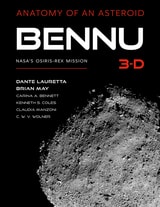
Bennu 3-D
Anatomy of an AsteroidDante Lauretta, Brian May, Carina A. Bennett, Kenneth S. Coles, Claudia Manzoni, and C. W. V. Wolner
University of Arizona Press, 2023
Bennu, named for the ancient Egyptian phoenix, was the chosen destination of OSIRIS-REx, NASA’s premier mission of asteroid exploration, launched in 2016. Study of the asteroid is important in safeguarding the future of planet Earth, but Bennu is also a time capsule from the dawn of our Solar System, holding secrets over four-and-a-half billion years old about the origin of life and Earth as a habitable planet.
In 2020 the OSIRIS-REx spacecraft successfully landed on the surface of Bennu and collected pristine asteroid material for delivery to Earth in September 2023. Scientific studies of the samples, along with data collected during the rendezvous, promise to help find answers to some of humanity’s deepest questions: Where did we come from? What is our destiny in space?
This book, the world’s first complete (and stereoscopic) atlas of an asteroid, is the result of a unique collaboration between OSIRIS-REx mission leader Dante Lauretta and Brian May’s London Stereoscopic Company. Lauretta’s colleagues include Carina Bennett, Kenneth Coles, and Cat Wolner, as well as Brian May and Claudia Manzoni, who became part of the ultimately successful effort to find a safe landing site for sampling. The text details the data collected by the mission so far, and the stereo images have been meticulously created by Manzoni and May from original images collected by the OSIRIS-REx cameras.
[more]
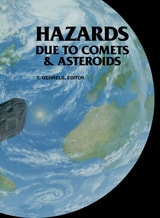
Hazards Due to Comets and Asteroids
Edited by T. Gehrels
University of Arizona Press, 1995
In 1993, the U.S. Department of Defense declassified information dealing with frequent explosions in the upper atmosphere caused by meteoric impact. It is estimated that impacts have occurred of a magnitude equivalent to the atomic bomb detonated at Hiroshima. Not all such space voyagers meet their end in the atmosphere, however; huge craters attest to the bombardment of earth over millions of years, and a major impact may have resulted in the extinction of dinosaurs. An impact in Siberia near the beginning of this century proves that such events are not confined to geologic time. Hazards Due to Comets and Asteroids marks a significant step in the attempt to come to grips with the threats posed by such phenomena. It brings together more than one hundred scientists from around the world, who draw on observational and theoretical research to focus on the technical problems related to all aspects of dealing with these hazards: searching for and identifying hazardous comets and asteroids; describing their statistics and characteristics; intercepting and altering the orbits of dangerous objects; and applying existent technologies—rocket boosters, rendezvous and soft-landing techniques, instrumentation—to such missions. The book considers defensive options for diverting or disrupting an approaching body, including solar sails, kinetic-energy impacts, nuclear explosives, robotic mass drivers, and various propulsion systems. A cataclysmic impact posing a threat to life on Earth is a possibility that tomorrow's technology is capable of averting. This book examines in depth the reality of the threat and proposes practical measures that can be initiated now should we ever need to deal with it.
[more]