Results by title
8 books match the query 'Astronomers'
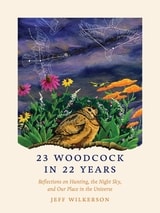
23 Woodcock in 22 Years
Reflections on Hunting, the Night Sky, and Our Place in the UniverseJeff Wilkerson
University of Iowa Press, 2024
As Wilkerson’s thoughts soar to the stars that produced the chemical elements that form us and all the land and its creatures, simple reflections on going afield to harvest a woodcock for a special holiday meal ground him. What emerges is a love story about a bird, the land, and all of creation from atomic nuclei to the farthest reaches of the universe, and a reminder to acknowledge the gentle flow of time while cherishing the everyday existence around us.

Edwin Hubble
Mariner of the NebulaeGale E. Christianson
University of Chicago Press, 1996
end of the decade, he proved that the universe is expanding, thus laying
the very cornerstone of the big bang theory. A revealing portrait of a
scientific genius at work, this book also offers an incisive narrative
of the history of astronomy, and an evocation of what we see when gazing
at the stars.
"Highly entertaining. . . . Hubble may have been the most important
astronomer since Galileo. Perhaps since Copernicus."—Dick Teresi,
New York Times Book Review
"Hubble's own story has not been adequately told until now. . . . A
riveting portrait of a great scientist and a haunted man, and the best
look we are likely to have of the real Hubble."—Dennis Overby, Los
Angeles Times Book Review
"Displays remarkable strength in its steadfast balance and scrupulous
honesty. The greatness of the discoveries is set off against the
contrasting pettiness of the man."—Hans Christian von Baeyer,
Boston Sunday Globe
"Fascinating. . . . This is one of the most impressive scientific
biographies of recent years."—Kirkus Review, starred review
— "Notable Books for the Year 1995" selection, New York Times Book
Review
—"Best Books of 1995" selection, Library Journal
—Selected as one of the five best science books in 1995 by Carl Sagen,
Washington Post
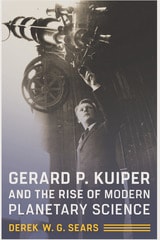
Gerard P. Kuiper and the Rise of Modern Planetary Science
Derek W. G. Sears
University of Arizona Press, 2019
Kuiper was an acclaimed astronomer of binary stars and white dwarfs when he accidentally discovered that Titan, the massive moon of Saturn, had an atmosphere. This turned our understanding of planetary atmospheres on its head, and it set Kuiper on a path of staggering discoveries: Pluto was not a planet, planets around other stars were common, some asteroids were primary while some were just fragments of bigger asteroids, some moons were primary and some were captured asteroids or comets, the atmosphere of Mars was carbon dioxide, and there were two new moons in the sky, one orbiting Uranus and one orbiting Neptune.
He produced a monumental photographic atlas of the Moon at a time when men were landing on our nearest neighbor, and he played an important part in that effort. He also created some of the world’s major observatories in Hawai‘i and Chile. However, most remarkable was that the keys to his success sprang from his wartime activities, which led him to new techniques. This would change everything.
Sears shows a brilliant but at times unpopular man who attracted as much dislike as acclaim. This in-depth history includes some of the twentieth century’s most intriguing scientists, from Harold Urey to Carl Sagan, who worked with—and sometimes against—the father of modern planetary science. Now, as NASA and other space agencies explore the solar system, they take with them many of the ideas and concepts first described by Gerard P. Kuiper.
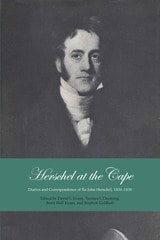
Herschel at the Cape
Diaries and Correspondence of Sir John Herschel, 1834-1838Edited by David S. Evans, Terence J. Deeming, Betty Hall Evans, and Stephen Goldfarb
University of Texas Press, 1969
Sir John Herschel, one of the founders of Southern Hemisphere astronomy, was a man of extraordinarily wide interests. He made contributions to botany, geology, and ornithology, as well as to astronomy, chemistry, and mathematics. Throughout his scientific career he kept a diary, recording his public and private life. The diaries from 1834 to 1838, years he spent making astronomical observations at the Cape of Good Hope, are reproduced in this book and prove to be much more than an ordinary scientist’s logbook. They present personal and social history, literary commentaries, the results of close observations of nature and numerous scientific experiments, the excitement of travel, political intrigues, gossip, and philosophical reflections—all interpreted through an alert and versatile mind. In the present transcription, the material has been enriched with selected correspondence of Sir John and his wife Lady Herschel (née Margaret Brodie Stewart).
Sir John devoted his working time at the Cape primarily to a systematic observation of the southern sky, complementing his earlier “sweeping” of the northern sky at Slough, England. He later became one of the founders of photography, but at the Cape he used a simple optical device, the camera lucida, in the production of numerous landscape drawings. Many of these, along with reproductions of sketches contained in the diaries and botanical drawings made by Sir John and Lady Herschel, are used to illustrate this book. Sir John was also a leading figure in the foundation of the educational system of the Cape and a supporter of exploratory expeditions into the interior.
As the son of Sir William Herschel, in his day the most famous British astronomer and the discoverer of the planet Uranus, Sir John was already celebrated when he arrived from England. Every individual of note, resident at the Cape or visiting, went to see him. He was supported in his work by his wife, who ran an enormous establishment and bore a huge family, but who nevertheless found time to travel in the country around the western Cape with him and to assist in his observations.
The diaries and letters are supplemented by especially valuable editorial notes that provide much needed and highly interesting information concerning persons and events mentioned and described by Sir John. All the original manuscript material used in this volume is archived at the Harry Ransom Center at the University of Texas at Austin. Sir John’s camera lucida drawings are from the South African Public Library in Cape Town.
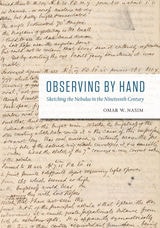
Observing by Hand
Sketching the Nebulae in the Nineteenth CenturyOmar W. Nasim
University of Chicago Press, 2013
Reading Galileo's Letters
Experiments in Friendship, Knowledge, and CommunityEdited by Paula Findlen and Hannah Marcus
University of Chicago Press, 2027
Essays by many of the foremost experts on Galileo offer an interdisciplinary approach to the legendary scientist’s correspondence.
The Tuscan mathematician, physicist, and astronomer Galileo Galilei (1564–1642) is one of history’s most iconic and controversial figures. Letters form the backbone of what one early Galileo scholar called the “private Galileo,” and his correspondence is indeed a record of his family and friendships; his intellectual evolution; his professional interactions with other scientific figures; and his relations with patrons, brokers, and publishers. Last, but hardly least, his letters are a unique cultural artifact of Galileo the writer and master of vernacular prose.
Galileo’s correspondence crossed Europe in public mail pouches, through diplomatic messengers, and was written in code. Today, there are 3,272 surviving letters to or from Galileo and his many friends, family members, disciples, and rivals across Europe. This volume examines these letters as an essential aspect of Galileo’s personal and scientific career. They are what the editors call his “experiments in friendship,” which enabled, abetted, and often served as early drafts of the theories in his published works. This collaborative volume brings together different approaches, case studies, and forms of expertise—historical and literary, intellectual and material, archival and digital. It is a must-read for all Galileo enthusiasts and anyone interested in how to make the most of a rich record of correspondence.
Selected Papers, Volume 7
The Non-Radial Oscillations of Stars in General Relativity and Other WritingsS. Chandrasekhar
University of Chicago Press, 1997
world through the eyes of one of the twentieth century's most brilliant
and sensitive scientists. Conceived by Chandrasekhar as a supplement to
his Selected Papers, this volume begins with eight papers he
wrote with Valeria Ferrari on the non-radial oscillations of stars. It
then explores some of the themes addressed in Truth and Beauty,
with meditations on the aesthetics of science and the world it examines.
Highlights include: "The Series Paintings of Claude Monet and the
Landscape of General Relativity," "The Perception of Beauty and the
Pursuit of Science," "On Reading Newton's Principia at Age Past
Eighty," and personal recollections of Indira Gandhi, Jawaharlal Nehru,
and others.
Selected Papers, Volume 7 paints a picture of Chandra's universe,
filled with stars and galaxies, but with space for poetics, paintings,
and politics.
The late S. Chandrasekhar was best known for his discovery of the upper
limit to the mass of a white dwarf star, for which he received the Nobel
Prize in Physics in 1983. He was the author of many books, including
The Mathematical Theory of Black Holes and, most recently,
Newton's Principia for the Common Reader.
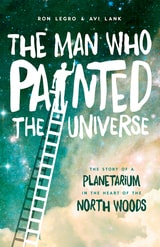
The Man Who Painted the Universe
The Story of a Planetarium in the Heart of the North WoodsRon Legro
Wisconsin Historical Society Press, 2015
The Man Who Painted the Universe: The Story of a Planetarium in the Heart of the North Woods introduces readers to the mild-mannered astronomy enthusiast whose creativity, ingenuity, fervor, and endurance realized a dream of galactic proportions. The story of this stargazer from Wisconsin’s North Woods so inspired two newspapermen, authors Ron Legro and Avi Lank, that they sought to document the story of the Kovac Planetarium for a new generation of stargazers and dreamers.