Results by title
9 books match the query 'Asylum'
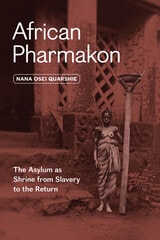
African Pharmakon
The Asylum as Shrine from Slavery to the ReturnNana Osei Quarshie
University of Chicago Press, 2025
For centuries, mental distress in West Africa has been subject to a mix of healing, harming, ritual, and regulation. In African Pharmakon, Nana Osei Quarshie questions conventional narratives about colonial psychiatry. Instead of displacing African therapeutic traditions, he argues, European psychiatric institutions in fact built upon them, adapting long-standing techniques of social control and healing.
With a focus on Ghana, Quarshie explores the shifting landscape of West African mental health practices, tracking their transformation from shrine-based rituals to colonial asylums and modern psychiatric institutions. Combining extensive archival research and ethnographic fieldwork, including the first scholarly examination of patient records from the Accra Psychiatric Hospital, Quarshie identifies five enduring techniques that have shaped the treatment of mental distress: spiritual pawning, logging, manhunting, mass expulsion, and pharmacotherapy.
Rejecting the simplistic opposition of Indigenous healing versus colonial oppression, African Pharmakon provides a nuanced account of how psychiatric care in Ghana became a tool of empowerment as well as exclusion. This pioneering study reframes our understanding of psychiatry and mental health governance in West Africa, past and present.

Asylum in the Grasslands
Diane Glancy
University of Arizona Press, 2007
In her new collection of poems, Glancy explores the history of loss that has marked the Cherokee community. In a voice that is as economical as it is eloquent and as sophisticated as it is exhilarating, she describes the loss of family, the loss of cultural heritage, and the loss of old worlds as new ones encroach. In one poem, a farm auction becomes an auction of culture, of heritage, of the past. In others, ancestors meet in a twenty-four-hour café, lunch is shared with a great-grandmother who has been traveling the universe, Christ appears as a cowboy in an apocalyptic vision, and Clytemnestra is discovered in a snakeskin. Some of the poems are as campy as a duck-decoy Custer in a shooting gallery. Some glitter with dime-store glue. Others speak with the reflection of sunlight off a stream. Sometimes the verse produces a shortstop language on the baseline of experience. In whatever form they take, Glancy’s poems stimulate and challenge the reader with their unfettered, unadorned, and unpretty purity. This collection is not only a spirited ride across the Great Plains, it is also an important addition to the literature of white–Native American cultural relationships.
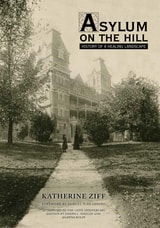
Asylum on the Hill
History of a Healing LandscapeKatherine Ziff
Ohio University Press, 2012
Asylum on the Hill is the story of a great American experiment in psychiatry, a revolution in care for those with mental illness, as seen through the example of the Athens Lunatic Asylum. Built in southeast Ohio after the Civil War, the asylum embodied the nineteenth-century “gold standard” specifications of moral treatment. Stories of patients and their families, politicians, caregivers, and community illustrate how a village in the coalfields of the Hocking River valley responded to a national movement to provide compassionate care based on a curative landscape, exposure to the arts, outdoor exercise, useful occupation, and personal attention from a physician.
Katherine Ziff’s compelling presentation of America’s nineteenth-century asylum movement shows how the Athens Lunatic Asylum accommodated political, economic, community, family, and individual needs and left an architectural legacy that has been uniquely renovated and repurposed. Incorporating rare photos, letters, maps, and records, Asylum on the Hill is a fascinating glimpse into psychiatric history.

Asylum, Prison, and Poorhouse
The Writings and Reform Work of Dorothea Dix in IllinoisDavid L. Lightner
Southern Illinois University Press, 1999
This illustrated collection of annotated newspaper articles and memorials by Dorothea Dix provides a forum for the great mid-nineteenth-century humanitarian and reformer to speak for herself.
Dorothea Lynde Dix (1802–87) was perhaps the most famous and admired woman in America for much of the nineteenth century. Beginning in the early 1840s, she launched a personal crusade to persuade the various states to provide humane care and effective treatment for the mentally ill by funding specialized hospitals for that purpose. The appalling conditions endured by most mentally ill inmates in prisons, jails, and poorhouses led her to take an active interest also in prison reform and in efforts to ameliorate poverty.
In 1846–47 Dix brought her crusade to Illinois. She presented two lengthy memorials to the legislature, the first describing conditions at the state penitentiary at Alton and the second discussing the sufferings of the insane and urging the establishment of a state hospital for their care. She also wrote a series of newspaper articles detailing conditions in the jails and poorhouses of many Illinois communities.
These long-forgotten documents, which appear in unabridged form in this book, contain a wealth of information on the living conditions of some of the most unfortunate inhabitants of Illinois. In his preface, David L. Lightner describes some of the vivid images that emerge from Dorothea Dix's descriptions of social conditions in Illinois a century and a half ago: "A helpless maniac confined throughout the bitter cold of winter to a dark and filthy pit. Prison inmates chained in hallways and cellars because no more men can be squeezed into the dank and airless cells. Aged paupers auctioned off by county officers to whoever will maintain them at the lowest cost."
Lightner provides an introduction to every document, placing each memorial and newspaper article in its proper social and historical context. He also furnishes detailed notes, making these documents readily accessible to readers a century and a half later. In his final chapter, Lightner assesses both the immediate and the continuing impact of Dix's work.

Asylum
The Concept and the PracticeRanjana Khanna
Duke University Press, 2026

Between Exile and Asylum
An Eastern EpistolaryPredrag Matvejevic
Central European University Press, 2004
Queer Migration and Asylum in Europe
Edited by Richard C. M. Mole
University College London, 2021
Europe is a popular destination for LGBTQ people seeking to escape discrimination and persecution. Yet, while European institutions have done much to promote the legal equality of sexual minorities and a number of states pride themselves on their acceptance of sexual diversity, the image of European tolerance is often quite different from the reality faced by LGBTQ migrants and asylum seekers. Queer Migration and Asylum in Europe brings together scholars from politics, sociology, urban studies, anthropology, and law to analyze how and why queer individuals migrate to Europe, as well as the legal, social, and political frameworks they are forced to navigate in the destination societies. The subjects covered include LGBTQ Latino migrants in queer and diasporic spaces in London; the diasporic consciousness of queer Polish, Russian, and Brazilian migrants in Berlin; the role of the Council of Europe in shaping legal and policy frameworks relating to queer migration and asylum; the challenges facing bisexual asylum seekers; queer asylum and homonationalism in the Netherlands; and the role of space, faith, and LGBTQ organizations in Germany, Italy, the UK, and France in supporting queer asylum seekers.
The Color of Asylum
The Racial Politics of Safe Haven in BrazilKatherine Jensen
University of Chicago Press, 2023
In 2013, as Syrians desperate to escape a brutal war fled the country, Brazil took the remarkable step of instituting an open-door policy for all Syrian refugees. Why did Brazil—in contrast to much of the international community—offer asylum to any Syrian who would come? And how do Syrians differ from other refugee populations seeking status in Brazil?
In The Color of Asylum, Katherine Jensen offers an ethnographic look at the process of asylum seeking in Brazil, uncovering the different ways asylum seekers are treated and the racial logic behind their treatment. She focuses on two of the largest and most successful groups of asylum seekers: Syrian and Congolese refugees. While the groups obtain asylum status in Brazil at roughly equivalent rates, their journey to that status could not be more different, with Congolese refugees enduring significantly greater difficulties at each stage, from arrival through to their treatment by Brazilian officials. As Jensen shows, Syrians, meanwhile, receive better treatment because the Brazilian state recognizes them as white, in a nation that has historically privileged white immigration. Ultimately, however, Jensen reaches an unexpected conclusion: Regardless of their country of origin, even migrants who do secure asylum status find their lives remain extremely difficult, marked by struggle and discrimination.
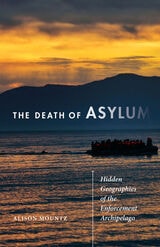
The Death of Asylum
Hidden Geographies of the Enforcement ArchipelagoAlison Mountz
University of Minnesota Press, 2020
Investigating the global system of detention centers that imprison asylum seekers and conceal persistent human rights violations
Remote detention centers confine tens of thousands of refugees, asylum seekers, and undocumented immigrants around the world, operating in a legal gray area that hides terrible human rights abuses from the international community. Built to temporarily house eight hundred migrants in transit, the immigrant “reception center” on the Italian island of Lampedusa has held thousands of North African refugees under inhumane conditions for weeks on end. Australia’s use of Christmas Island as a detention center for asylum seekers has enabled successive governments to imprison migrants from Asia and Africa, including the Sudanese human rights activist Abdul Aziz Muhamat, held there for five years.
In The Death of Asylum, Alison Mountz traces the global chain of remote sites used by states of the Global North to confine migrants fleeing violence and poverty, using cruel measures that, if unchecked, will lead to the death of asylum as an ethical ideal. Through unprecedented access to offshore detention centers and immigrant-processing facilities, Mountz illustrates how authorities in the United States, the European Union, and Australia have created a new and shadowy geopolitical formation allowing them to externalize their borders to distant islands where harsh treatment and deadly force deprive migrants of basic human rights.
Mountz details how states use the geographic inaccessibility of places like Christmas Island, almost a thousand miles off the Australian mainland, to isolate asylum seekers far from the scrutiny of humanitarian NGOs, human rights groups, journalists, and their own citizens. By focusing on borderlands and spaces of transit between regions, The Death of Asylum shows how remote detention centers effectively curtail the basic human right to seek asylum, forcing refugees to take more dangerous risks to escape war, famine, and oppression.